
#9 OF 28 IN PHYSICS

Dual Nature of Radiation and Matter JEE Main PYQs (2015–2026) with answers
190 questions across 11 JEE Main years, about 1 a paper (≈5 marks). The topics asked most are Wave nature of matter and the de Broglie relation and Einstein’s photoelectric equation and photon model.
- 93% of papers
- ≈5 marks a paper
- Class 12 · Ch 11
From official NTA papers · Updated 9 Nov 2026
What's asked most
- Wave nature of matter and the de Broglie relation41%Matter waves and the wave nature of particles · de Broglie wavelength of a moving particle
- Einstein’s photoelectric equation and photon model24%Threshold frequency, threshold wavelength and work function · Einstein’s photoelectric equation and maximum photoelectron kinetic energy
- Optional enrichment: photoelectric applications and radiation pressure24%Quantum efficiency of a photoelectric surface · Photocells and their applications
- Photoelectric effect: observations and experimental laws6%Laws of photoelectric emission · Effect of light intensity on photocurrent
- Optional enrichment: additional photon and electron experiments5%Compton effect and photon scattering
How often it comes
See as a table
| Year | Questions |
|---|---|
| 2026 | 18 |
| 2025 | 14 |
| 2024 | 24 |
| 2023 | 30 |
| 2022 | 24 |
| 2021 | 35 |
| 2020 | 16 |
| 2019 | 19 |
| 2018 | 3 |
| 2017 | 2 |
| 2016 | 4 |
| 2015 | 1 |
Where it fits
SYLLABUSJEE Main Physics syllabusWEIGHTAGE#9 of 28 Physics chaptersNCERTClass 12 Physics NCERT, Chapter 11
Questions here often join up with

All 190 questions
- Q1JEE Main 2026 · 28 Jan · Shift 2Number of photons of equal energy emitted per second by a laser source operating at is ____ (Given: and )Tap an option to check.
Show answer
Correct answer: option 1, - Q2JEE Main 2026 · 23 Jan · Shift 1The de Broglie wavelength of an oxygen molecule at is . The value of is (take Planck's constant , Boltzmann constant , mass of oxygen molecule )Tap an option to check.
Show answer
Correct answer: option 2,26 - Q3JEE Main 2026 · 22 Jan · Shift 2Light is incident on a metallic plate having work function . If the produced photoelectrons have zero kinetic energy then the angular frequency of the incident light is _ . ().Tap an option to check.
Show answer
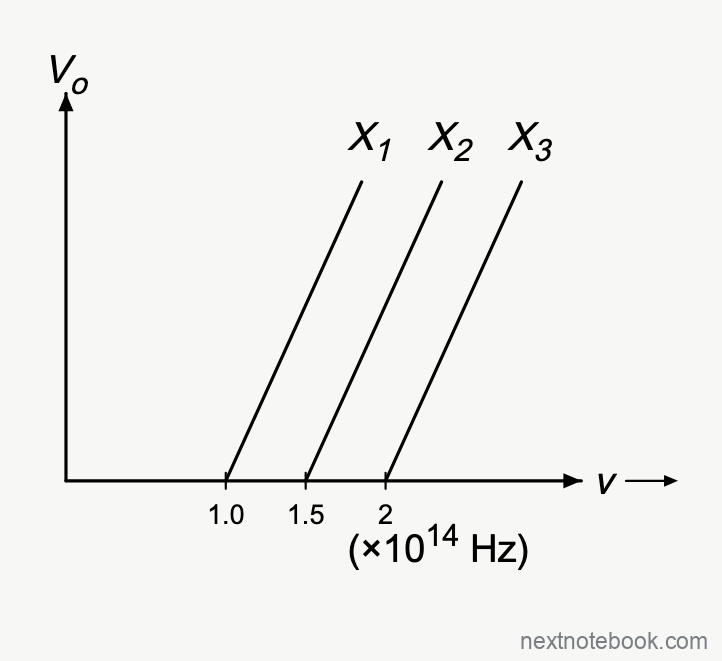
Correct answer: option 3, - Q4JEE Main 2026 · 4 Apr · Shift 1The graph shows variation of stopping potential with the frequency of the incident radiation for three photosensitive metals , and . Which metal will give out electrons with greater kinetic energy. for the same wavelength of incident radiation?
 Tap an option to check.
Show answer
Correct answer: option 1, - Q5JEE Main 2026 · 21 Jan · Shift 1A light wave described by (in SI units) falls on a metal surface of work function . The maximum kinetic energy of ejected photoelectron is (approximately) ____ . ( and )Tap an option to check.
Show answer
Correct answer: option 3,5.1 - Q6JEE Main 2026 · 5 Apr · Shift 1An electron of mass is moving in an electric field ( = constant ), with an initial velocity ( = constant ). If , its de Broglie wavelength at time is ________. ( = charge of electron)Tap an option to check.
Show answer
Correct answer: option 3, - Q7JEE Main 2026 · 5 Apr · Shift 1Light source having wavelength is used to generate photo-electrons whose stopping potential is . The work function of the used metal in the experiment is . The value of is _____. (h = , e = and c = )Tap an option to check.
Show answer
Correct answer: option 3, - Q8JEE Main 2026 · 2 Apr · Shift 1For a certain metal, when monochromatic light of wavelength is incident, the stopping potential for photoelectrons is . When the same metal is illuminated by light of wavelength , then the stopping potential becomes . The threshold wavelength for photoelectric emission for the given metal is . The value of is ________.Tap an option to check.
Show answer
Correct answer: option 2,4 - Q9JEE Main 2026 · 24 Jan · Shift 2When a light of a given wavelength falls on a metal surface the stopping potential for photoelectrons is . If a second light having wavelength twice of first light is used, the stopping potential drops to . The wave length of first light is ____ . (, , )Tap an option to check.
Show answer
Correct answer: option 1, - Q10JEE Main 2026 · 8 Apr · Shift 2and be the maximum kinetic energies of photoelectrons emitted from a surface of a given material for the light of wavelength and , respectively. If then the work function of material is given by:Tap an option to check.
Show answer
Correct answer: option 4,
Show the other 50 questions
- Q11JEE Main 2026 · 5 Apr · Shift 2An electron is travelling with a velocity in free space and when it enters a medium, its velocity is reduced by . The de Broglie wavelength of electron in the medium is , where is its de Broglie wavelength in free space. The value of is ________.Tap an option to check.
Show answer
Correct answer: option 3, - Q12JEE Main 2026 · 4 Apr · Shift 2The de Broglie wavelength associated with an electron accelerated through a potential difference is and the de Broglie wavelength associated with a proton accelerated through the same potential difference is . If their corresponding masses are and respectively, then the ratio of their de Broglie wavelengths is ________.Tap an option to check.
Show answer
Correct answer: option 1, - Q13JEE Main 2026 · 28 Jan · Shift 1The ratio of de Broglie wavelength of a deuteron with kinetic energy to that of an alpha particle with kinetic energy , is . The value of is _____. (Assume mass of proton = mass of neutron)Tap Show answer to check.
Show answer
Answer: 2 - Q14JEE Main 2026 · 6 Apr · Shift 2The de Broglie wavelength for an electron accelerated through the potential difference of volt is . When the potential difference is changed to volt, the associated de Broglie wavelength is increased by . If , then the value of is __________.Tap Show answer to check.
Show answer
Answer: 4 - Q15JEE Main 2026 · 21 Jan · Shift 2A particle having electric charge and mass is accelerated by applying an electric potential of . Wavelength of the matter wave associated with the particle is . The value of is ____ (Take Planck's constant = ).Tap Show answer to check.
Show answer
Answer: 10 - Q16JEE Main 2026 · 23 Jan · Shift 2The work functions of two metals ( and ) are in the ratio. When these metals are exposed to photons of energy , the kinetic energy of liberated electrons of is in the ratio of . The work functions (in eV) of and are respectively.Tap an option to check.
Show answer
Correct answer: option 1, - Q17JEE Main 2026 · 2 Apr · Shift 2The surface of sodium metal is irradiated with radiation of wavelength . The kinetic energy of ejected electrons is . The work function of sodium is . The value of is ________ . (Nearest integer) (Given: ; ; )Tap Show answer to check.
Show answer
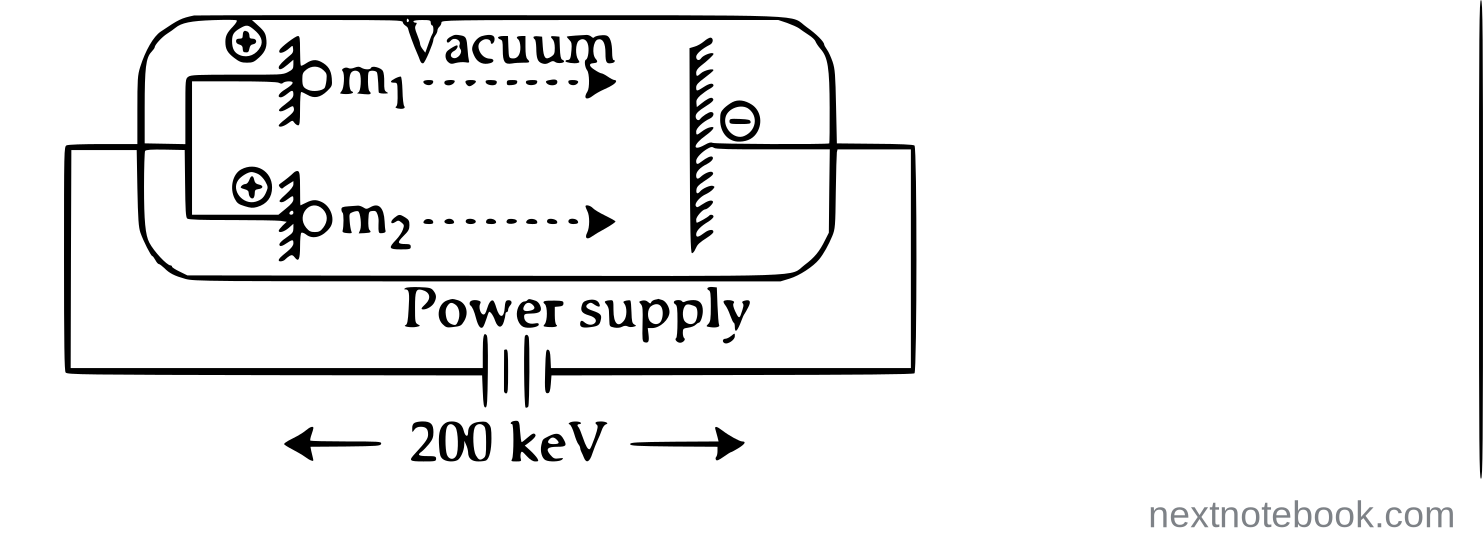
Answer: 5 - Q18JEE Main 2026 · 28 Jan · Shift 2Two positively charged particles and have been accelerated across the same potential difference of as shown below. [Given mass of and ] The de-Broglie wavelength of will be times of . The value of is ____ (nearest integer)
 Tap Show answer to check.
Show answer
Answer: 2 - Q19JEE Main 2025 · 4 Apr · Shift 1A small mirror of mass m is suspended by a massless thread of length l. Then the small angle through which the thread will be deflected when a short pulse of laser of energy E falls normal on the mirror (c = speed of light in vacuum and g = acceleration due to gravity)Tap an option to check.
Show answer
Correct answer: option 1,θ = (2E)/(mc sqrt(gl)) - Q20JEE Main 2025 · 4 Apr · Shift 1Given below are two statements: one is labelled as Assertion A and the other is labelled as Reason R
Assertion A: In photoelectric effect, on increasing the intensity of incident light the stopping potential increases.
Reason R: Increase in intensity of light increases the rate of photoelectrons emitted, provided the frequency of incident light is greater than threshold frequency.
In the light of the above statements, choose the correct answer from the options given belowTap an option to check.Show answer
Correct answer: option 1,A is false but R is true - Stuck on one?Log in free
See the step-by-step solution and video for every question, free with login.
- Q21JEE Main 2025 · 3 Apr · Shift 1The work function of a metal is 3 eV. The color of the visible light that is required to cause emission of photoelectrons isTap an option to check.
Show answer
Correct answer: option 4,Blue - Q22JEE Main 2025 · 24 Jan · Shift 1An electron of mass ‘’ with an initial velocity enters an electric field . If the initial de Broglie wavelength is , the value after time would beTap an option to check.
Show answer
Correct answer: option 4, - Q23JEE Main 2025 · 28 Jan · Shift 1A proton of mass ‘’ has same energy as that of a photon of wavelength ‘’. If the proton is moving at non-relativistic speed, then ratio of its de Broglie wavelength to the wavelength of photon is.Tap an option to check.
Show answer
Correct answer: option 2, - Q24JEE Main 2025 · 7 Apr · Shift 2A photoemissive substance is illuminated with a radiation of wavelength so that it releases electrons with de-Broglie wavelength . The longest wavelength of radiation that can emit photoelectron is . Expression for de-Broglie wavelength is given by: (: mass of the electron, : Planck’s constant and : speed of light)Tap an option to check.
Show answer
Correct answer: option 4, - Q25JEE Main 2025 · 23 Jan · Shift 1A sub-atomic particle of mass 10^-30 kg is moving with a velocity 2.21 × 10⁶ m/s. Under the matter wave consideration, the particle will behave closely like _____. (h = 6.63 × 10^-34 J.s)Tap an option to check.
Show answer
Correct answer: option 3,X-rays - Q26JEE Main 2025 · 23 Jan · Shift 2In photoelectric effect an em-wave is incident on a metal surface and electrons are ejected from the surface. If the work function of the metal is 2.14 eV and stopping potential is 2V, what is the wavelength of the em-wave? (Given hc = 1242 eVnm where h is the Planck’s constant and c is the speed of light in vacuum.)Tap an option to check.
Show answer
Correct answer: option 2,300 nm - Q27JEE Main 2025 · 2 Apr · Shift 1A monochromatic light is incident on a metallic plate having work function . An electron, emitted normally to the plate from a point with maximum kinetic energy, enters a constant magnetic field, perpendicular to the initial velocity of electron. The electron passes through a curve and hits back the plate at a point . The distance between and is: (Given: The magnitude of charge of an electron is and mass is , is Planck’s constant and is velocity of light. Take the magnetic field exists throughout the path of electron)Tap an option to check.
Show answer
Correct answer: option 1, - Q28JEE Main 2025 · 28 Jan · Shift 2Which of the following phenomena can not be explained by wave theory of light?Tap an option to check.
Show answer
Correct answer: option 4,Compton effect - Q29JEE Main 2025 · 24 Jan · Shift 2In photoelectric effect, the stopping potential v/s frequency curve is plotted. (h is the Planck’s constant and is work function of metal)
(A) v/s is linear.
(B) The slope of v/s curve =
(C) h constant is related to the slope of v/s line.
(D) The value of electric charge of electron is not required to determine h using the v/s curve.
(E) The work function can be estimated without knowing the value of h.
Choose the correct answer from the options given below:Tap an option to check.Show answer
Correct answer: option 1,(A), (C) and (E) only - Q30JEE Main 2025 · 24 Jan · Shift 2The ratio of the power of a light source to that the light source is 2. is emitting photons per second at . If the wavelength of the source is , then the number of photons per second emitted by is ______ .Tap Show answer to check.
Show answer
Answer: 5 - Stuck on one?Log in free
See the step-by-step solution and video for every question, free with login.
- Q31JEE Main 2025 · 8 Apr · Shift 2An electron is released from rest near an infinite non-conducting sheet of uniform charge density ‘’. The rate of change of de-Broglie wave length associated with the electron varies inversely as power of time. The numerical value of is __________.Tap Show answer to check.
Show answer
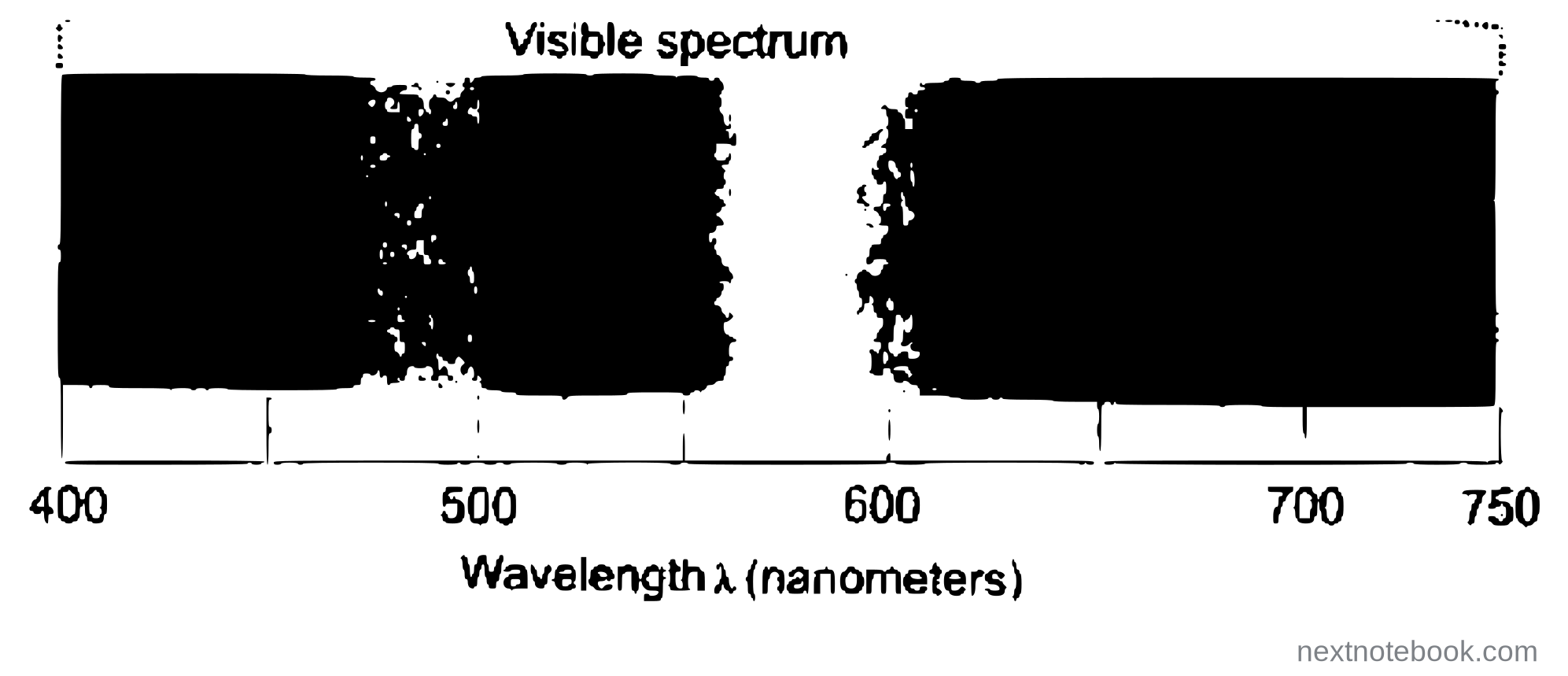
Answer: 2 - Q32JEE Main 2025 · 7 Apr · Shift 1Which of the following statements are correct, if the threshold frequency of caesium is ? A. When is placed inside a vacuum chamber with an ammeter connected to it and yellow light is focused on , the ammeter shows the presence of current. B. When the brightness of the yellow light is dimmed, the value of the current in the ammeter is reduced. C. When a red light is used instead of the yellow light, the current produced is higher with respect to the yellow light. D. When a blue light is used, the ammeter shows the formation of current. E. When a white light is used. the ammeter shows formation of current. Choose the correct answer from the options given below:
 Tap an option to check.
Show answer
Correct answer: option 4,A, B, D and E Only - Q33JEE Main 2024 · 8 Apr · Shift 1Average force exerted on a non-reflecting surface at normal incidence is . If is the light energy flux during span of hour minutes. Then the area of the surface is:Tap an option to check.
Show answer
Correct answer: option 4, - Q34JEE Main 2024 · 29 Jan · Shift 1The de-Broglie wavelength of an electron is the same as that of a photon. If velocity of electron is of the velocity of light, then the ratio of K.E. of electron and K.E. of photon will be:Tap an option to check.
Show answer
Correct answer: option 4, - Q35JEE Main 2024 · 6 Apr · Shift 2The acceptor level of a p-type semiconductor is . The maximum wavelength of light which can create a hole would be: Given .Tap an option to check.
Show answer
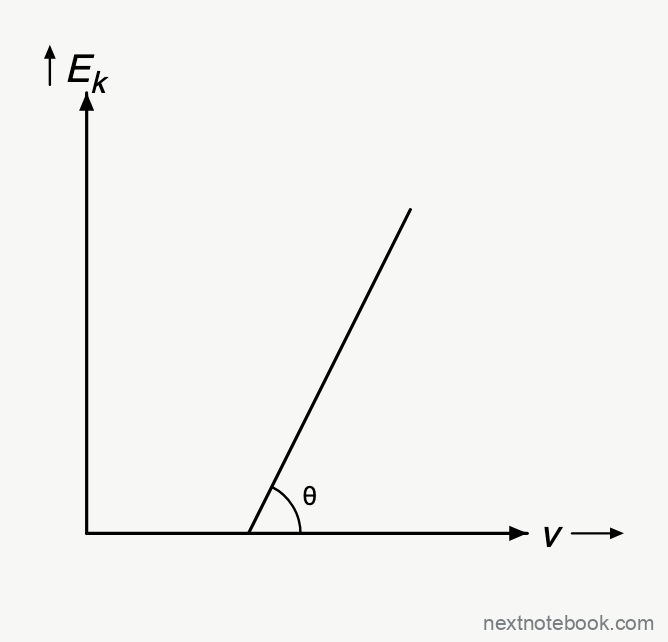
Correct answer: option 1, - Q36JEE Main 2024 · 30 Jan · Shift 2For the photoelectric effect, the maximum kinetic energy of the photoelectrons is plotted against the frequency of the incident photons as shown in figure. The slope of the graph gives
 Tap an option to check.
Show answer
Correct answer: option 4,Planck's constant - Q37JEE Main 2024 · 1 Feb · Shift 2Monochromatic light of frequency is produced by a laser. The power emitted is . How many photons per second on an average are emitted by the source?Tap an option to check.
Show answer
Correct answer: option 1, - Q38JEE Main 2024 · 31 Jan · Shift 1When a metal surface is illuminated by light of wavelength , the stopping potential is . When the same surface is illuminated by light of wavelength , stopping potential is . The threshold wavelength for this surface is:Tap an option to check.
Show answer
Correct answer: option 1, - Q39JEE Main 2024 · 30 Jan · Shift 1The work function of a substance is . The longest wavelength of light that can cause the emission of photoelectrons from this substance is approximately;Tap an option to check.
Show answer
Correct answer: option 2, - Q40JEE Main 2024 · 4 Apr · Shift 1Which figure shows the correct variation of applied potential difference with photoelectric current at two different intensities of light of same wavelengths:Tap an option to check.
Show answer
Correct answer: option 4,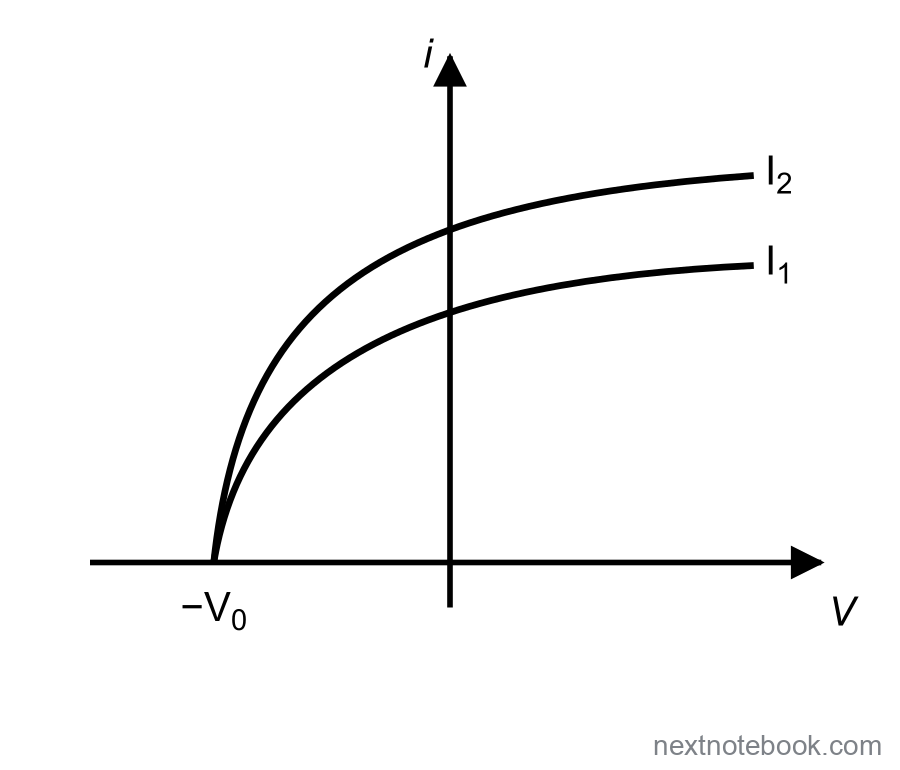
- Stuck on one?Log in free
See the step-by-step solution and video for every question, free with login.
- Q41JEE Main 2024 · 31 Jan · Shift 2In a photoelectric effect experiment a light of frequency times the threshold frequency is made to fall on the surface of photosensitive material. Now if the frequency is halved and intensity is doubled, the number of photo electrons emitted will be:Tap an option to check.
Show answer
Correct answer: option 4,Zero - Q42JEE Main 2024 · 27 Jan · Shift 1A convex lens of focal length forms an image of an extended source of light on a photoelectric cell. A current is produced. The lens is replaced by another convex lens having the same diameter but focal length . The photoelectric current now is:Tap an option to check.
Show answer
Correct answer: option 1, - Q43JEE Main 2024 · 27 Jan · Shift 2The threshold frequency of a metal with work function is:Tap an option to check.
Show answer
Correct answer: option 2,. - Q44JEE Main 2024 · 29 Jan · Shift 2Two sources of light emit with a power of . The ratio of number of photons of visible light emitted by each source having wavelengths and respectively, will be:Tap an option to check.
Show answer
Correct answer: option 1, - Q45JEE Main 2024 · 9 Apr · Shift 2UV light of is incident on a photosensitive metal surface having work function . The maximum kinetic energy of ejected photoelectrons will be:Tap an option to check.
Show answer
Correct answer: option 1, - Q46JEE Main 2024 · 8 Apr · Shift 2A proton and an electron have the same de Broglie wavelength. If and be the kinetic energies of proton and electron respectively, then choose the correct relation:Tap an option to check.
Show answer
Correct answer: option 4, - Q47JEE Main 2024 · 9 Apr · Shift 1A proton, an electron and an alpha particle have the same energies. Their de-Broglie wavelengths will be compared as:Tap an option to check.
Show answer
Correct answer: option 3, - Q48JEE Main 2024 · 1 Feb · Shift 1The de Broglie wavelength of a proton and an particle are and respectively. The ratio of the velocities of proton and particle will be:Tap an option to check.
Show answer
Correct answer: option 4, - Q49JEE Main 2024 · 6 Apr · Shift 1In photoelectric experiment energy of irradiates a photo sensitive material. The stopping potential was measured to be . Work function of the photo sensitive material is:Tap an option to check.
Show answer
Correct answer: option 3, - Q50JEE Main 2024 · 6 Apr · Shift 2When UV light of wavelength is incident on the metal surface having work function , electron emission takes place. The stopping potential is: (Given )Tap an option to check.
Show answer
Correct answer: option 3, - Stuck on one?Log in free
See the step-by-step solution and video for every question, free with login.
- Q51JEE Main 2024 · 5 Apr · Shift 2Which of the following statement is not true about stopping potential ?Tap an option to check.
Show answer
Correct answer: option 2,It increases with increase in intensity of the incident light - Q52JEE Main 2024 · 5 Apr · Shift 1Given below are two statements:
Statement I: Figure shows the variation of stopping potential with frequency () for the two photosensitive materials and . The slope gives value of , where h is Planck’s constant, e is the charge of electron.
Statement II: will emit photoelectrons of greater kinetic energy for the incident radiation having same frequency.
In the light of the above statements, choose the most appropriate answer from the options given below.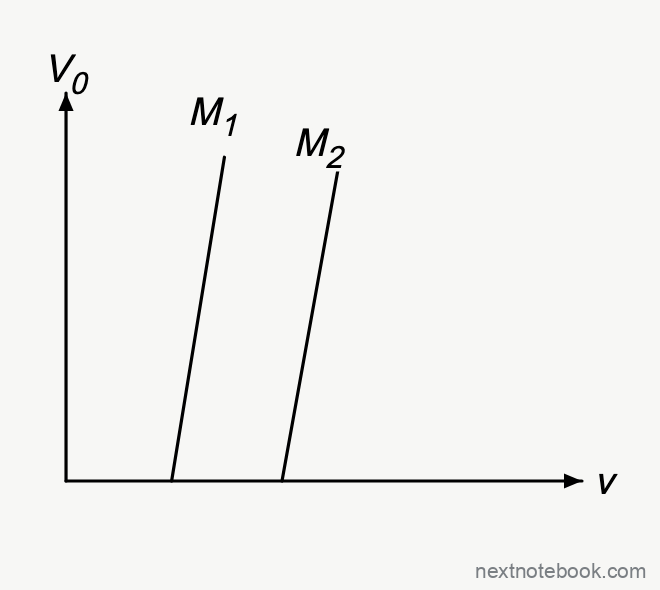 Tap an option to check.
Show answer
Correct answer: option 4,Statement I is correct and Statement II is incorrect - Q53JEE Main 2024 · 6 Apr · Shift 1Which of the following phenomena does not explain by wave nature of light. a. reflection b. diffraction c. photoelectric effect d. interference e. polarization Choose the most appropriate answer from the options given below:Tap an option to check.
Show answer
Correct answer: option 2,c only - Q54JEE Main 2024 · 4 Apr · Shift 2Given below are two statements: one is labeled as Assertion A and the other is labeled as Reason R.
Assertion A: Number of photons increases with increase in frequency of light.
Reason R: Maximum kinetic energy of emitted electrons increases with the frequency of incident radiation.Tap an option to check.Show answer
Correct answer: option 4,A is not correct but R is correct. - Q55JEE Main 2024 · 1 Feb · Shift 1According to the wave-particle duality of matter by de-Broglie, which of the following graph plot represents most appropriate relationship between wavelength of electron() and momentum of electron()?Tap an option to check.
Show answer
Correct answer: option 1,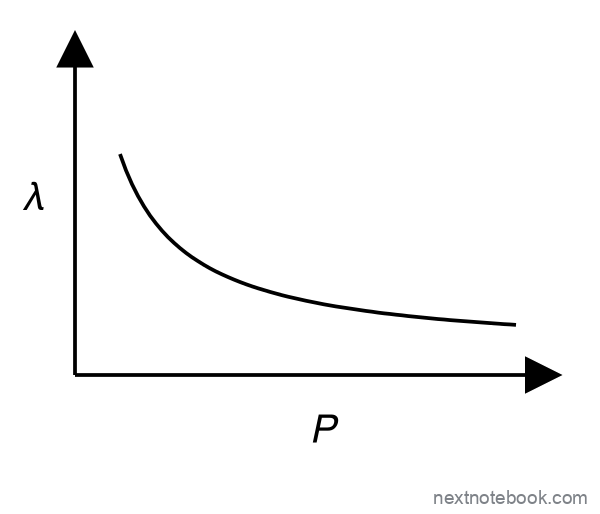
- Q56JEE Main 2024 · 6 Apr · Shift 1Frequency of the de-Broglie wave of electron in Bohr’s first orbit of hydrogen atom is __________ (nearest integer) [Give: (Rydberg constant) = , (Planck’s constant) = ]Tap Show answer to check.
Show answer
Answer: 661 - Q57JEE Main 2023 · 11 Apr · Shift 2The ratio of the de-Broglie wavelengths of proton and electron having same Kinetic energy: (Assume )Tap an option to check.
Show answer
Correct answer: option 3, - Q58JEE Main 2023 · 29 Jan · Shift 1The threshold wavelength for photoelectric emission from a material is .Photoelectrons will be emitted, when this material is illuminated with monochromatic radiation from a A. infra-red lamp B. infra – red lamp C. ultra-violet lamp D. ultra – violet lamp Choose the correct answer from the options given below:Tap an option to check.
Show answer
Correct answer: option 1,C and D only - Q59JEE Main 2023 · 6 Apr · Shift 2The work functions of Aluminium and Gold are and respectively. The ratio of the slope of the stopping potential versus frequency plot for Gold to that of Aluminium isTap an option to check.
Show answer
Correct answer: option 4, - Q60JEE Main 2023 · 25 Jan · Shift 2Given below are statements:
Statement I: Stopping potential in photoelectric effect does not depend on the power of the light source.
Statement II: For a given metal, the maximum kinetic energy of the photoelectron depends on the wavelength of the incident light.
In the light of above statements, choose the most appropriate answer from the options given belowTap an option to check.Show answer
Correct answer: option 2,Both Statement I and statement II are correct
Showing 60 of 190 questions. The rest are free after login.
Practise Wave nature of matter and the de Broglie relation first. Solutions and video answers are free.