#11 OF 28 IN PHYSICS
Thermodynamics (Physics) JEE Main PYQs (2015–2026) with answers
170 questions across 11 JEE Main years, about 1 a paper (≈4 marks). The topics asked most are Thermodynamic processes and work calculations and First law and its applications.
- 82% of papers
- ≈4 marks a paper
- Class 11 · Ch 11
From official NTA papers · Updated 9 Nov 2026
What's asked most
- Thermodynamic processes and work calculations47%Adiabatic process · Isochoric process
- First law and its applications21%First law of thermodynamics and sign convention · Heat supplied to or released by a gas
- Second law, heat engines and refrigerators20%Carnot engine and its efficiency · Carnot's theorem (optional enrichment)
- Heat, internal energy and work8%Work from a P–V diagram · Heat as energy transfer
- Equation of state and specific heat capacities3%Specific heat capacity of a substance · Equation of state of a perfect gas
See all 6 topics
- Thermodynamic system, state and equilibrium1%Thermodynamic state variables and properties
How often it comes
See as a table
| Year | Questions |
|---|---|
| 2026 | 19 |
| 2025 | 18 |
| 2024 | 21 |
| 2023 | 22 |
| 2022 | 20 |
| 2021 | 32 |
| 2020 | 16 |
| 2019 | 14 |
| 2018 | 2 |
| 2017 | 2 |
| 2016 | 3 |
| 2015 | 1 |
Where it fits
SYLLABUSJEE Main Physics syllabusWEIGHTAGE#11 of 28 Physics chaptersNCERTClass 11 Physics NCERT, Chapter 11
Questions here often join up with

All 170 questions
- Q1JEE Main 2026 · 28 Jan · Shift 1In the following - diagram the equation of state along the curved path is given by where is a constant. The total work done in the closed path is
 Tap an option to check.
Show answer
Correct answer: option 2, - Q2JEE Main 2026 · 23 Jan · Shift 2One mole of an ideal diatomic gas expands from volume to isothermally at a temperature and does joule of work. If the gas undergoes same magnitude of expansion adiabatically from doing the same amount of work , then its final temperature will be (close to) ___ .Tap an option to check.
Show answer
Correct answer: option 1, - Q3JEE Main 2026 · 6 Apr · Shift 2A cylinder with adiabatic walls is closed at both ends and is divided into two compartments by a frictionless adiabatic piston. Ideal gas is filled in both (left and right) the compartments at same , , . Heating is started from left side until pressure changes to . If initial volume of each compartment was 9 litres then the final volume in right-hand side compartment is ________ litres. (for this ideal gas )Tap an option to check.
Show answer
Correct answer: option 2,4 - Q4JEE Main 2026 · 5 Apr · Shift 1Given below are two statements: one is labelled as Assertion A and the other is labelled as Reason R
Statement I: Change in internal energy of a system containing mole of ideal gas can be written as , where , initial temperature, final temperature.
Statement II: Relation between degree of freedom and is
Choose the correct answer from the options given belowTap an option to check.Show answer
Correct answer: option 2,Both A and R are true but R is NOT the correct explanation of A - Q5JEE Main 2026 · 2 Apr · Shift 1Heat is supplied to a diatomic gas at constant pressure. Then the ratio of is ________.Tap an option to check.
Show answer
Correct answer: option 4, - Q6JEE Main 2026 · 5 Apr · Shift 1Consider the following statements: A. Zeroth law of thermodynamics gives concept of temperature B. First law of thermodynamics gives concept of internal energy C. In isothermal expansion of ideal gas, D. Product of intensive and extensive variables is extensive E. The ratio of any extensive variable to mass will be an extensive variable Choose the correct combination of statements from the options given below:Tap an option to check.
Show answer
Correct answer: option 3,A, B and D Only - Q7JEE Main 2026 · 8 Apr · Shift 2One mole of diatomic gas having rotational modes only is kept in a cylinder with a piston system. The cross-section area of the cylinder is . The gas is heated slowly to raise the temperature by during which the piston moves by . The amount of heat supplied to the gas is __________ . (Atmospheric pressure , ) (Neglect mass of the piston)Tap an option to check.
Show answer
Correct answer: option 2, - Q8JEE Main 2026 · 24 Jan · Shift 1Density of water at and are and respectively. The increase in internal energy of of water when it is heated from to is ____ . (specific heat capacity of water = . and 1 atmospheric pressure = )Tap an option to check.
Show answer
Correct answer: option 2, - Q9JEE Main 2026 · 8 Apr · Shift 2Initial pressure and volume of a monoatomic ideal gas are and . The change in internal energy of this gas in adiabatic expansion to volume is ______ J.Tap an option to check.
Show answer
Correct answer: option 3, - Q10JEE Main 2026 · 24 Jan · Shift 2mole of an ideal gas is undergoing the process shown in the figure. The heat involved in the process from to is Joule ( and ; , ). The value of is ____.
 Tap an option to check.
Show answer
Correct answer: option 3,
Show the other 50 questions
- Q11JEE Main 2026 · 22 Jan · Shift 1The volume of an ideal gas increases 8 times and temperature becomes of initial temperature during a reversible change. If there is no exchange of heat in this process ( ) then identify the gas from the following options (Assuming the gases given in the options are ideal gases):Tap an option to check.
Show answer
Correct answer: option 3,He - Q12JEE Main 2026 · 23 Jan · Shift 2The internal energy of a monoatomic gas is . One mole of helium is kept in a cylinder having internal cross section area of and fitted with a light movable frictionless piston. The gas is heated slowly by supplying heat. If the temperature rises by , then the piston will move ____ cm. (atmospheric pressure = )Tap an option to check.
Show answer
Correct answer: option 2,15.5 - Q13JEE Main 2026 · 28 Jan · Shift 2A thermodynamic system is taken through the cyclic process as shown in the figure. The total work done by the system during the cycle is ______ .
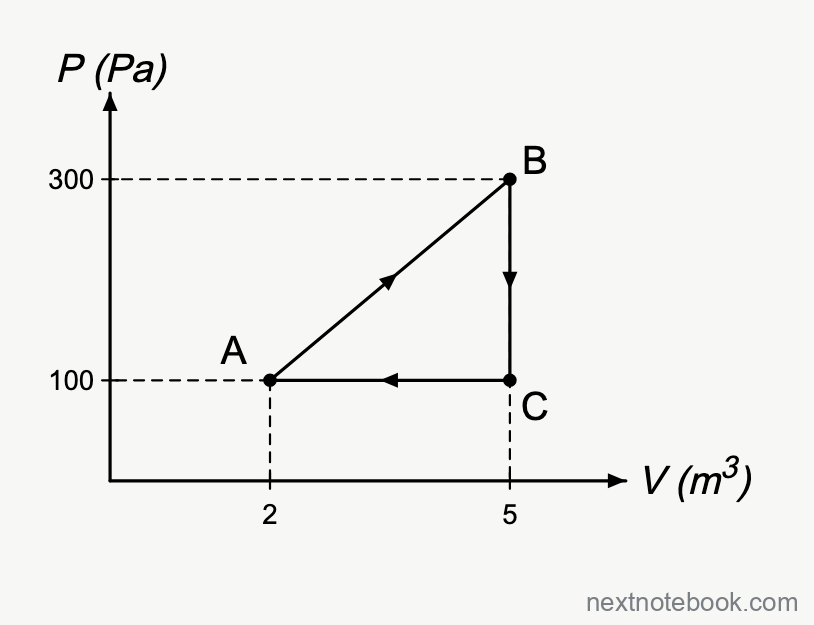 Tap Show answer to check.
Show answer
Answer: 300 - Q14JEE Main 2026 · 2 Apr · Shift 1A vessel contains of a gas at pressure and temperature with and . It is expanded adiabatically till pressure falls to . The work done during this process is __________ . ( is gas constant)Tap Show answer to check.
Show answer
Answer: 120 - Q15JEE Main 2026 · 2 Apr · Shift 2moles of unknown gas is heated at constant volume from to . The molar specific heat of this gas at constant pressure and . The change in the internal energy of the gas is __________ calorie.Tap Show answer to check.
Show answer
Answer: 300 - Q16JEE Main 2026 · 21 Jan · Shift 2A diatomic gas does 100 J of work when it is expanded isobarically. Then the heat given to the gas ____ J.Tap Show answer to check.
Show answer
Answer: 350 - Q17JEE Main 2026 · 21 Jan · Shift 1mole of oxygen is heated at constant volume from to . The change in the internal energy of the gas is ____ . (The molecular specific heat of oxygen at constant pressure, and .)Tap Show answer to check.
Show answer
Answer: 500 - Q18JEE Main 2026 · 24 Jan · Shift 1A gas of certain mass filled in a closed cylinder at a pressure of has temperature . The gas is now heated to double its temperature. The modified pressure ____ .Tap Show answer to check.
Show answer
Answer: 6460 - Q19JEE Main 2026 · 24 Jan · Shift 2When 300 J of heat given to an ideal gas with , its temperature raises from to keeping its volume constant. The mass of the gas is (approximately) ____ g. ()Tap Show answer to check.
Show answer
Answer: 0.48 - Q20JEE Main 2025 · 2 Apr · Shift 1In an adiabatic process, which of the following statements is true?Tap an option to check.
Show answer
Correct answer: option 3,The molar heat capacity is zero - Stuck on one?Log in free
See the step-by-step solution and video for every question, free with login.
- Q21JEE Main 2025 · 2 Apr · Shift 2Identify the characteristics of an adiabatic process in a monoatomic gas.
(A) Internal energy is constant.
(B) Work done in the process is equal to the change in internal energy.
(C) The product of temperature and volume is a constant.
(D) The product of pressure and volume is a constant.
(E) The work done to change the temperature from to is proportional to .
Choose the correct answer from the options given below:Tap an option to check.Show answer
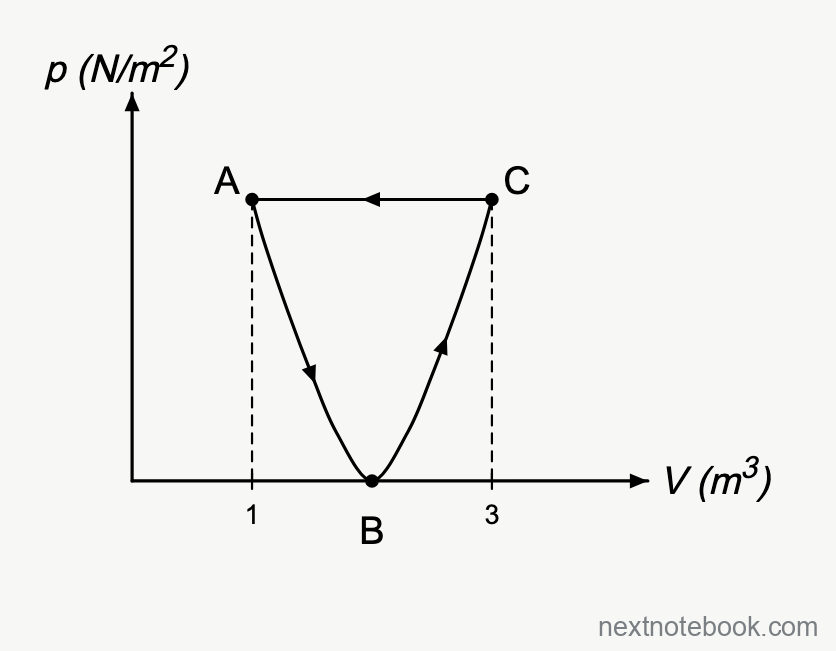
Correct answer: option 1,(B), (E) only - Q22JEE Main 2025 · 24 Jan · Shift 2The magnitude of heat exchanged by a system for the given cyclic process ABCA (as shown in figure) is (in SI unit):
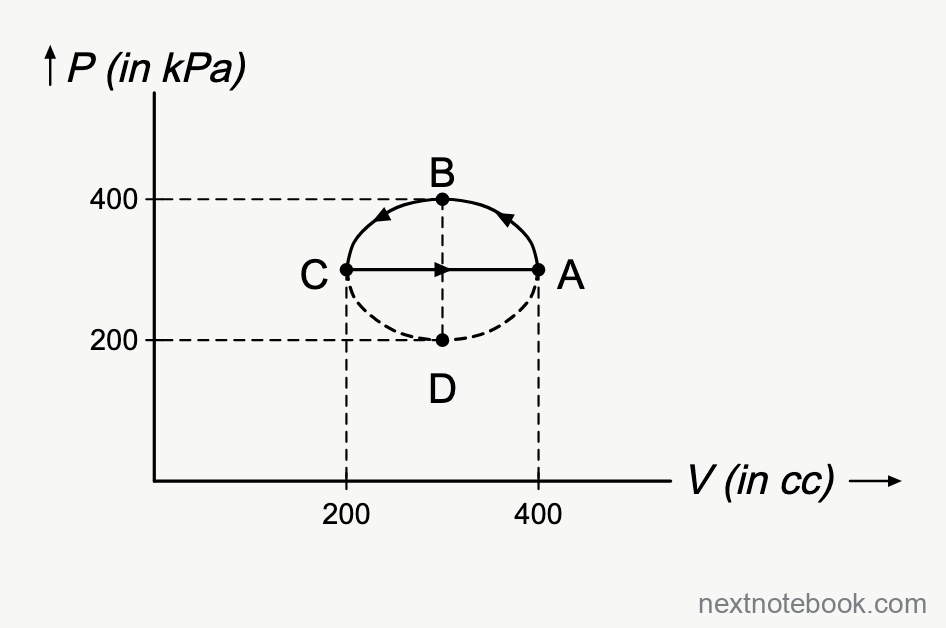 Tap an option to check.
Show answer
Correct answer: option 2, - Q23JEE Main 2025 · 28 Jan · Shift 1A Carnot engine is working between two temperatures and . In a new system two engines - engine works between to and engine works between to . If , and are the efficiencies of the engines , and , respectively, thenTap an option to check.
Show answer
Correct answer: option 4, - Q24JEE Main 2025 · 4 Apr · Shift 2Match List - I with List - II. Choose the correct answer from the options given below:
List - I List - II (A) Isobaric (I) ΔQ = ΔW (B) Isochoric (II) ΔQ = ΔU (C) Adiabatic (III) ΔQ = zero (D) Isothermal (IV) ΔQ = ΔU + PΔV Tap an option to check.Show answer
Correct answer: option 4,(A)-(IV), (B)-(II), (C)-(III), (D)-(I) - Q25JEE Main 2025 · 3 Apr · Shift 1During the melting of a slab of ice at at atmospheric pressure:Tap an option to check.
Show answer
Correct answer: option 1,Positive work is done on the ice-water system by the atmosphere. - Q26JEE Main 2025 · 24 Jan · Shift 2Given below are two statements. One is labelled as Assertion (A) and the other is labelled as Reason (R).
Assertion (A): In an insulated container, a gas is adiabatically shrunk to half of its initial volume. The temperature of the gas decreases.
Reason (R): [obscured]Tap an option to check.Show answer
Correct answer: option 4,(A) is false but (R) is true - Q27JEE Main 2025 · 8 Apr · Shift 2A monoatomic gas having is stored in a thermally insulated container and the gas is suddenly compressed to of its initial volume. The ratio of final pressure and initial pressure is: is the ratio of specific heats of the gas at constant pressure and at constant volume)Tap an option to check.
Show answer
Correct answer: option 1,32 - Q28JEE Main 2025 · 3 Apr · Shift 2An ideal gas exists in a state with pressure , volume . It is isothermally expanded to times of its initial volume (), then isobarically compressed to its original volume. Finally the system is heated isochorically to bring it to its initial state. The amount of heat exchanged in this process isTap an option to check.
Show answer
Correct answer: option 1, - Q29JEE Main 2025 · 23 Jan · Shift 2Using the given P-V diagram, the work done by an ideal gas along the path ABCD is:
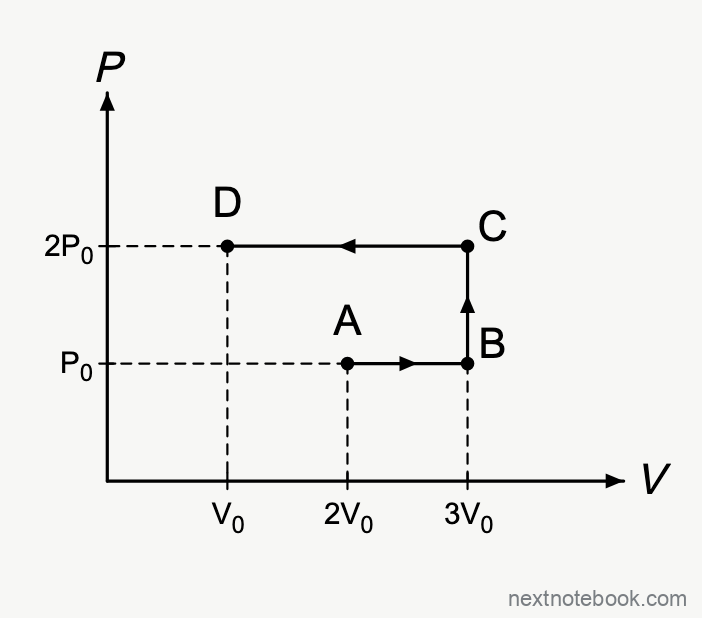 Tap an option to check.
Show answer
Correct answer: option 4,−3 P0V0 - Q30JEE Main 2025 · 3 Apr · Shift 1A gas is kept in a container having walls which are thermally non-conducting. Initially the gas has a volume of and temperature . The change in temperature when the gas is adiabatically compressed to is: (Take ; is the ratio of specific heats at constant pressure and at constant volume)Tap an option to check.
Show answer
Correct answer: option 2, - Stuck on one?Log in free
See the step-by-step solution and video for every question, free with login.
- Q31JEE Main 2025 · 24 Jan · Shift 1An ideal gas goes from an initial state to final state. During the process, the pressure of gas increases linearly with temperature. A. The work done by gas during the process is zero. B. The heat added to gas is different from change in its internal energy. C. The volume of the gas is increased. D. The internal energy of the gas is increased. E. The process is isochoric (constant volume process) Choose the correct answer from the options given below:Tap an option to check.
Show answer
Correct answer: option 3,A, D, E Only - Q32JEE Main 2025 · 3 Apr · Shift 2Pressure of an ideal gas, contained in a closed vessel, is increased by when heated by . Its initial temperature must be:Tap an option to check.
Show answer
Correct answer: option 4, - Q33JEE Main 2025 · 7 Apr · Shift 2Match List - I with List - II. Choose the correct answer from the options given below:
List - I List - II (A) Isothermal (I) ΔW (work done) = 0 (B) Adiabatic (II) ΔQ (supplied heat) = 0 (C) Isobaric (III) ΔU (change in internal energy) ≠ 0 (D) Isochoric (IV) ΔU = 0 Tap an option to check.Show answer
Correct answer: option 4,(A)-(IV), (B)-(II), (C)-(III), (D)-(I) - Q34JEE Main 2025 · 23 Jan · Shift 2Water of mass m gram is slowly heated to increase the temperature from to . The change in entropy of the water, given specific heat of water is , is:Tap an option to check.
Show answer
Correct answer: option 1, - Q35JEE Main 2025 · 3 Apr · Shift 1A piston of mass is hung from a massless spring whose restoring force law goes as , where is the spring constant of appropriate dimension. The piston separates the vertical chamber into two parts, where the bottom part is filled with ‘n’ moles of an ideal gas. An external work is done on the gas isothermally (at a constant temperature ) with the help of a heating filament (with negligible volume) mounted in lower part of the chamber, so that the piston goes up from a height to , the total energy delivered by the filament is:(Assume spring to be in its natural length before heating)
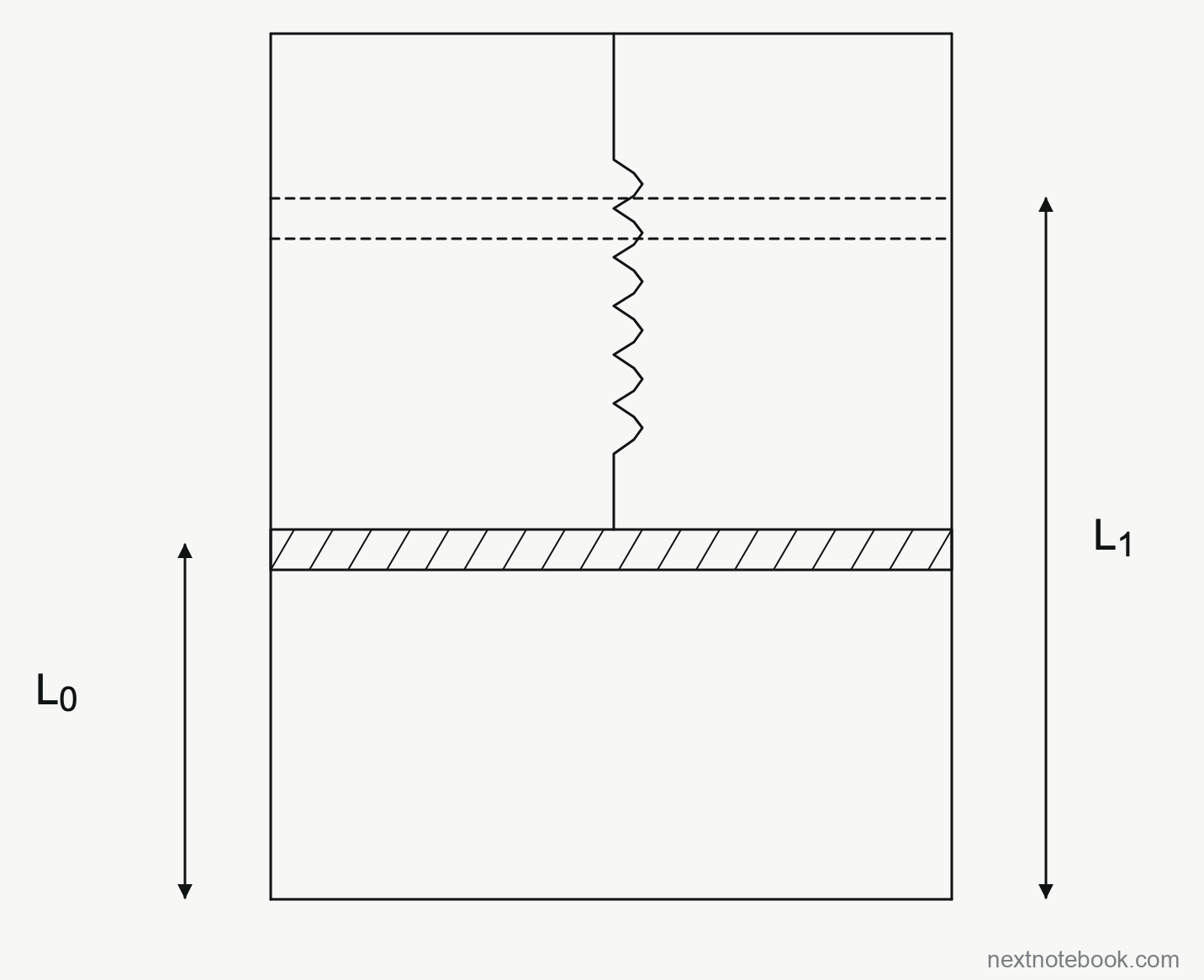 Tap an option to check.
Show answer
Correct answer: option 2, - Q36JEE Main 2025 · 22 Jan · Shift 2Given are statements for certain thermodynamic variables,
(A) Internal energy, volume (V) and mass (M) are extensive variables.
(B) Pressure (P), temperature (T) and density (ρ) are intensive variables.
(C) Volume (V), temperature (T) and density (ρ) are intensive variables.
(D) Mass (M), temperature (T) and internal energy are extensive variables.
Choose the correct answer from the options given below:Tap an option to check.Show answer
Correct answer: option 1,(A) and (B) Only - Q37JEE Main 2025 · 7 Apr · Shift 1An ideal gas has undergone through the cyclic process as shown in the figure. Work done by the gas in the entire cycle is ______ . (Take )
 Tap Show answer to check.
Show answer
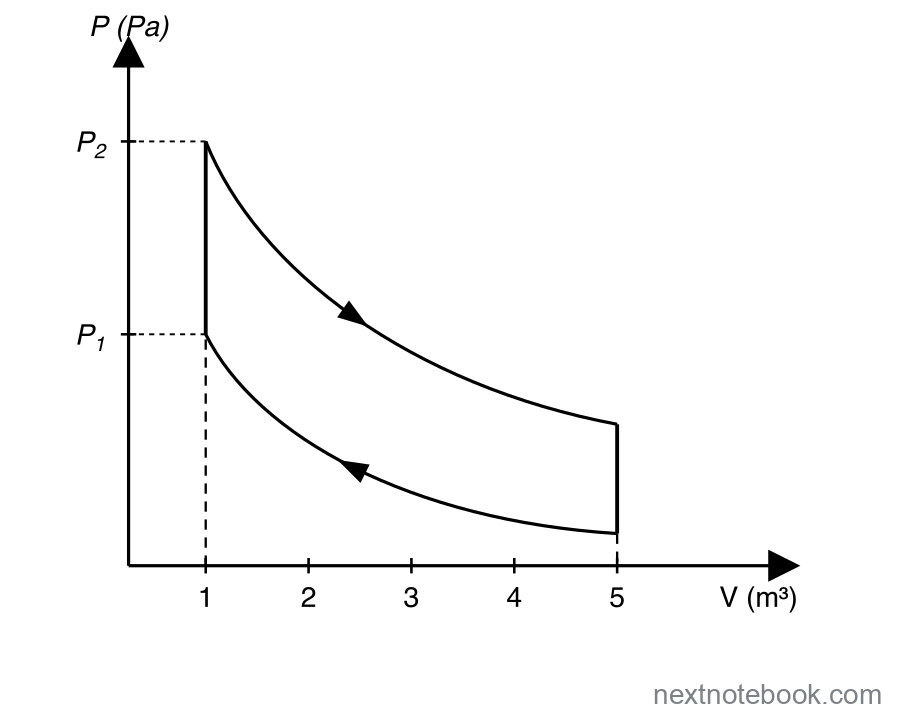
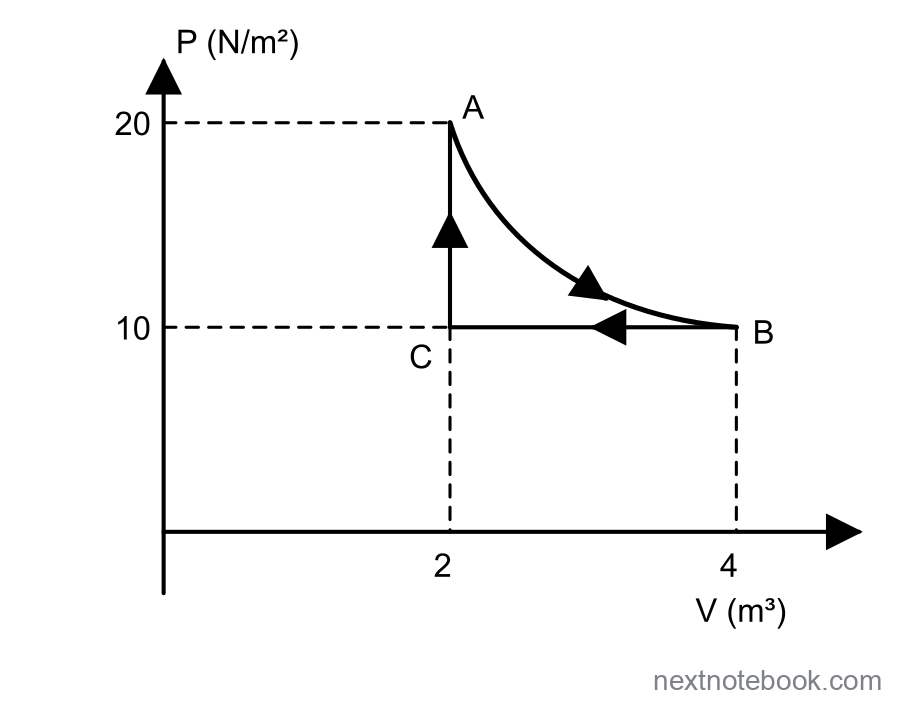
Answer: 314 - Q38JEE Main 2024 · 9 Apr · Shift 2A real gas within a closed chamber at undergoes the cyclic process as shown in figure. The gas obeys equation for the path A to B. The net work done in the complete cycle is (assuming ):
 Tap an option to check.
Show answer
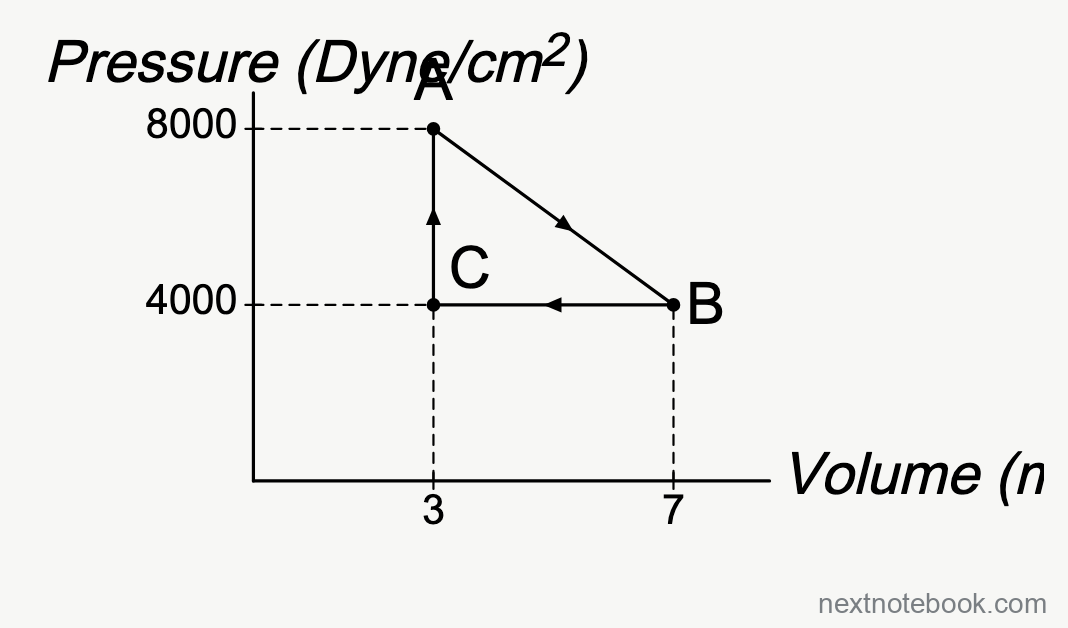
Correct answer: option 1, - Q39JEE Main 2024 · 29 Jan · Shift 1A thermodynamic system is taken from an original state A to an intermediate state B by a linear process as shown in the figure. It's volume is then reduced to the original value from B to C by an isobaric process. The total work done by the gas from A to B and B to C would be:
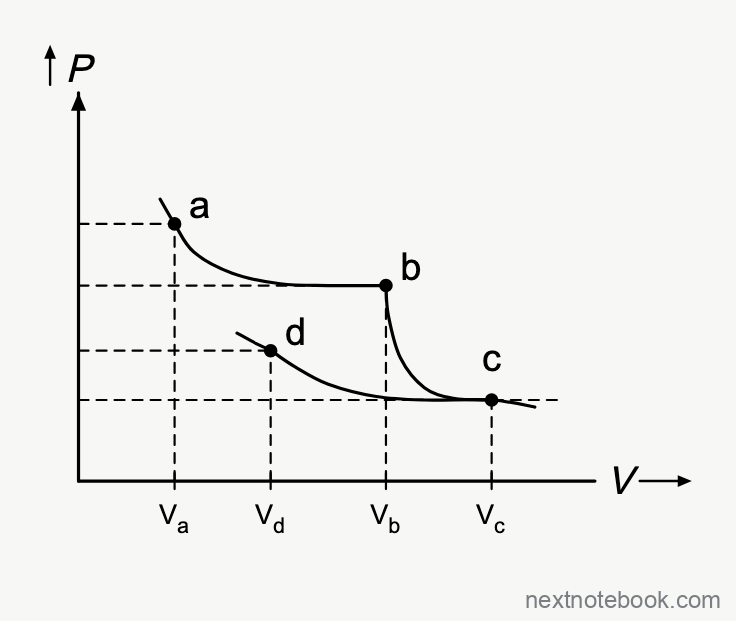
- Q40JEE Main 2024 · 8 Apr · Shift 1Two different adiabatic paths for the same gas intersect two isothermal curves as shown in P-V diagram. The relation between the ratio and the ratio is:
 Tap an option to check.
Show answer
Correct answer: option 4, - Stuck on one?Log in free
See the step-by-step solution and video for every question, free with login.
- Q41JEE Main 2024 · 5 Apr · Shift 2During an adiabatic process, if the pressure of a gas is found to be proportional to the cube of its absolute temperature, then the ratio of for the gas is:Tap an option to check.
Show answer
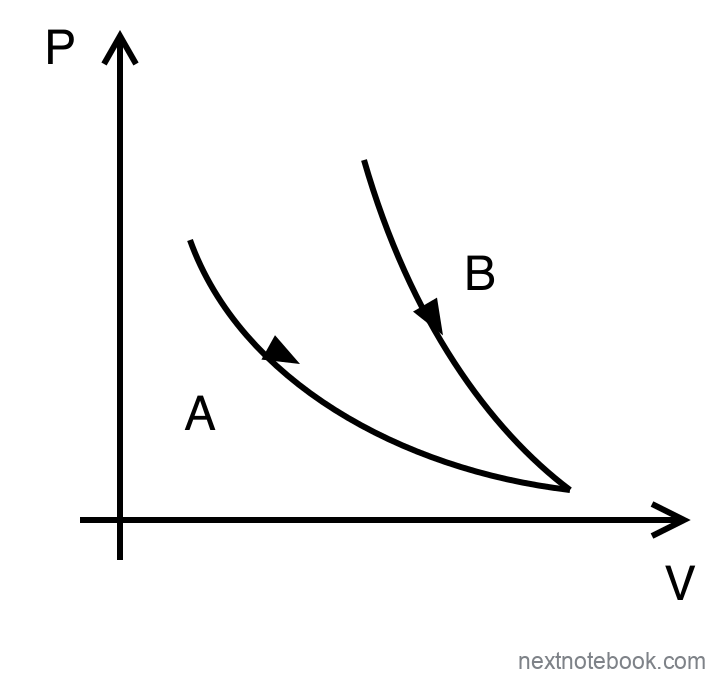
Correct answer: option 4, - Q42JEE Main 2024 · 30 Jan · Shift 2*36. Choose the correct statement for processes A&B shown in figure.
 Tap an option to check.
Show answer
Correct answer: option 1,for process B and for process A. - Q43JEE Main 2024 · 9 Apr · Shift 1A sample of mole gas at temperature is adiabatically expanded to double its volume. If adiabatic constant for the gas is , then the work done by the gas in the process is:Tap an option to check.
Show answer
Correct answer: option 3, - Q44JEE Main 2024 · 4 Apr · Shift 2A sample of gas at temperature is adiabatically expanded to double its volume. Adiabatic constant for the gas is . The work done by the gas in the process is:Tap an option to check.
Show answer
Correct answer: option 4, - Q45JEE Main 2024 · 27 Jan · Shift 1air is heated at constant volume through . The specific heat of air at constant volume is and . The change in its internal energy is approximately.Tap an option to check.
Show answer
Correct answer: option 1, - Q46JEE Main 2024 · 1 Feb · Shift 1The pressure and volume of an ideal gas are related as (Constant). The work done when the gas is taken from state A and is:Tap an option to check.
Show answer
Correct answer: option 1, - Q47JEE Main 2024 · 1 Feb · Shift 2A diatomic gas does of work when it is expanded isobarically. The heat given to the gas in the process is:Tap an option to check.
Show answer
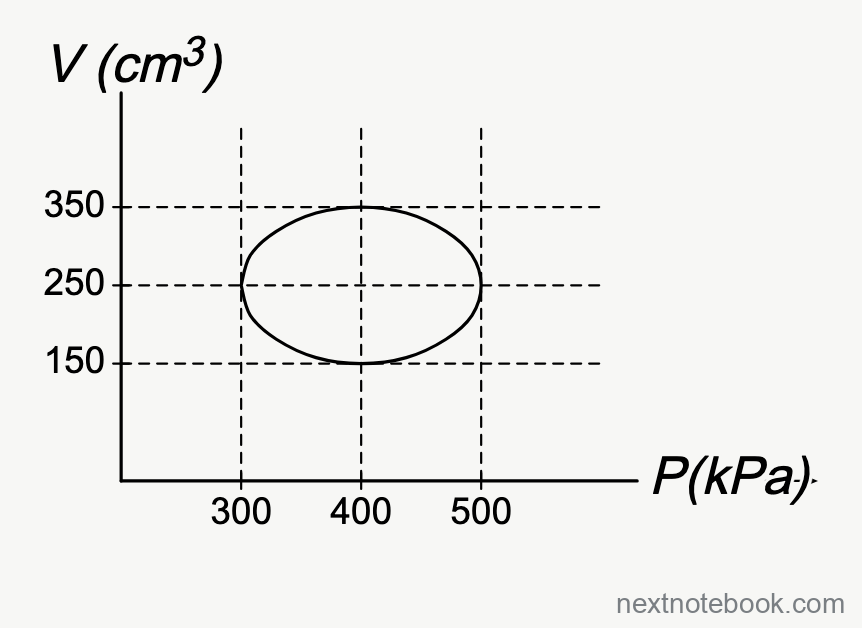
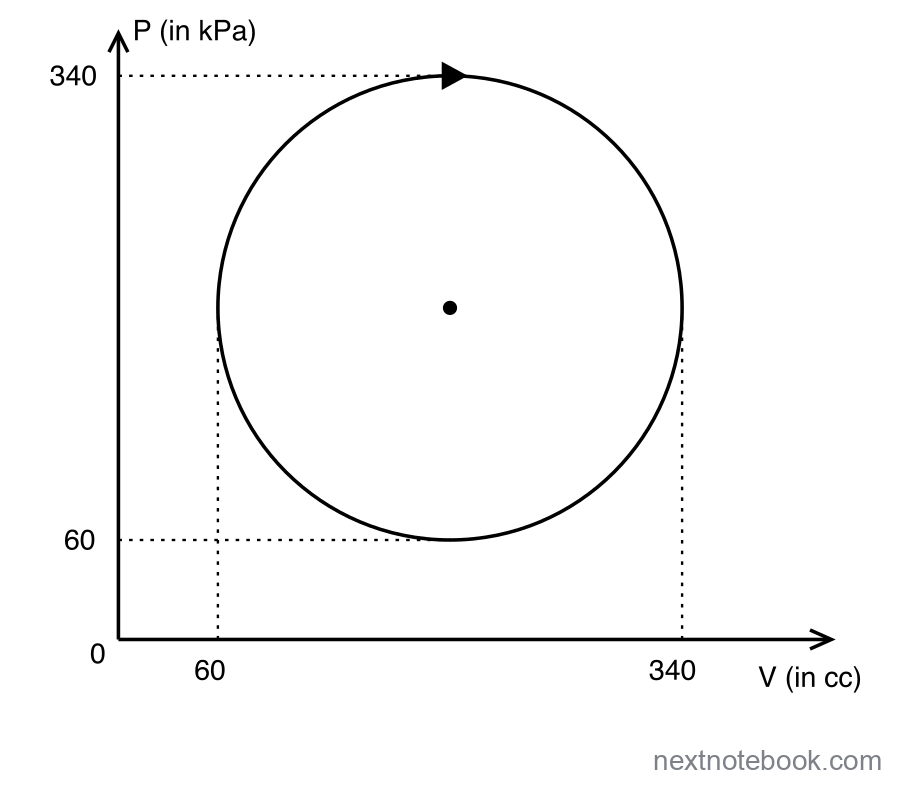
Correct answer: option 3, - Q48JEE Main 2024 · 5 Apr · Shift 1The heat absorbed by a system in going through the given cyclic process is: (the cycle is the circle in the figure; in kPa and in cc, both axes running from to )
 Tap an option to check.
Show answer
Correct answer: option 4, - Q49JEE Main 2024 · 9 Apr · Shift 1The volume of an ideal gas is changed adiabatically from litres to litres. The ratio of initial pressure to final pressure is:Tap an option to check.
Show answer
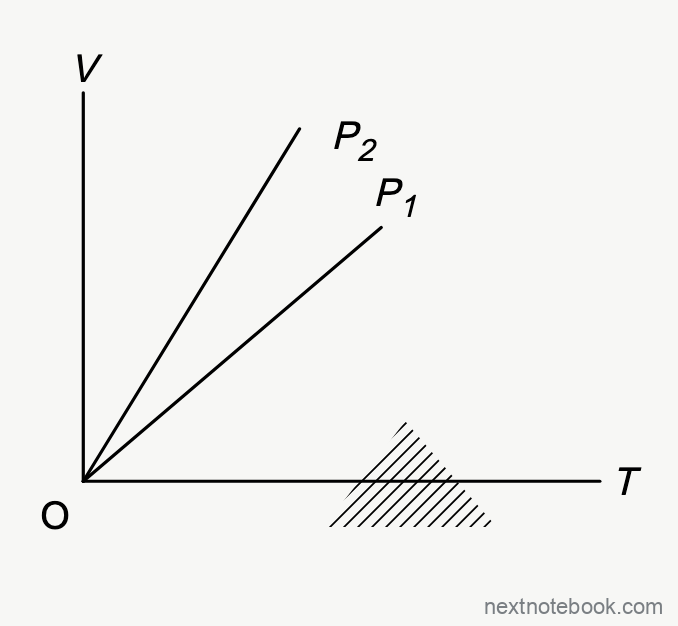
Correct answer: option 4, - Q50JEE Main 2024 · 31 Jan · Shift 1The given figure represents two isobaric processes for the same mass of an ideal gas, then
 Tap an option to check.
Show answer
Correct answer: option 1, - Stuck on one?Log in free
See the step-by-step solution and video for every question, free with login.
- Q51JEE Main 2024 · 27 Jan · Shift 2During an adiabatic process, the pressure of a gas is found to be proportional to the cube of its absolute temperature. The ratio of for the gas is:Tap an option to check.
Show answer
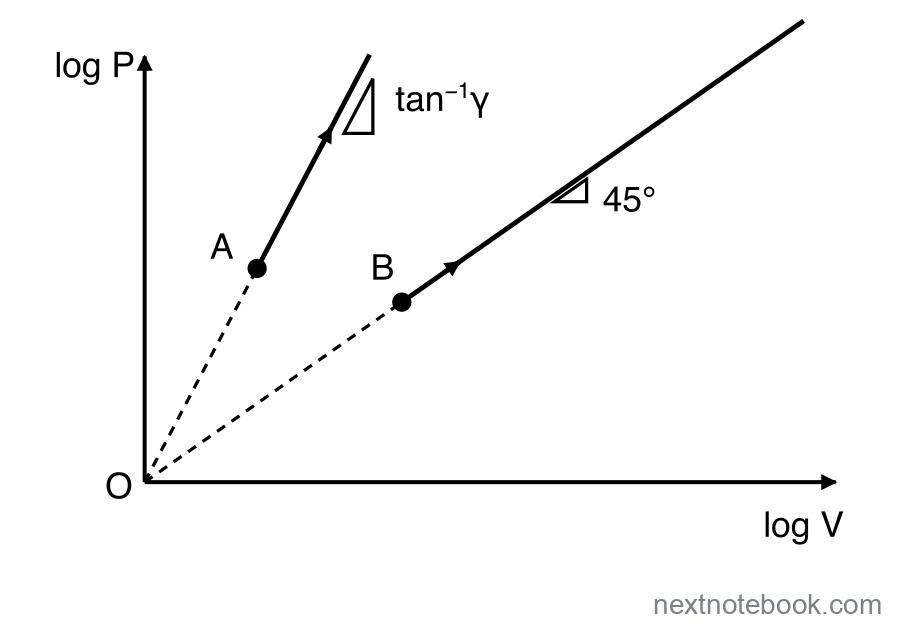
Correct answer: option 4, - Q52JEE Main 2024 · 30 Jan · Shift 1*45. Two thermodynamical processes are shown in the figure. The molar heat capacity for process A and B are and . The molar heat capacity at constant pressure and constant volume are represented by and , respectively. Choose the correct statement.
- Q53JEE Main 2024 · 8 Apr · Shift 2A diatomic gas does of work in an isobaric expansion. The heat given to the gas is:Tap an option to check.
Show answer
Correct answer: option 3, - Q54JEE Main 2024 · 30 Jan · Shift 2*46. If three moles of monoatomic gas is mixed with two moles of a diatomic gas , the value of adiabatic exponent for the mixture isTap an option to check.
Show answer
Correct answer: option 3,1.52 - Q55JEE Main 2024 · 6 Apr · Shift 2A total of heat is given to one mole of helium kept in a cylinder. The temperature of helium increases by . The work done by the gas is: Given, .Tap an option to check.
Show answer
Correct answer: option 4, - Q56JEE Main 2024 · 6 Apr · Shift 1The specific heat at constant pressure of a real gas obeying equation is:Tap an option to check.
Show answer
Correct answer: option 2, - Q57JEE Main 2024 · 27 Jan · Shift 1If three moles of an ideal gas at expand isothermally from to against a constant opposing pressure of , then the amount of heat transferred is__________ J.Tap Show answer to check.
Show answer
Answer: 1200 - Q58JEE Main 2024 · 4 Apr · Shift 2Three moles of an ideal gas are compressed isothermally from to using constant pressure of . Heat exchange for the compression is ____Tap Show answer to check.
Show answer
Answer: 200 - Q59JEE Main 2023 · 12 Apr · Shift 1An engine operating between the boiling and freezing points of water will have A. efficiency more than . B. efficiency less than the efficiency of a Carnot engine operating between the same two temperatures. C. efficiency equal to D. efficiency less than Choose the correct answer from the options given belowTap an option to check.
Show answer
Correct answer: option 4,B and D only - Q60JEE Main 2023 · 8 Apr · Shift 1An air bubble of volume rises from the bottom of a lake deep to the surface at a temperature of . The atmospheric pressure is , the density of water is and . There is no difference of the temperature of water at the depth of and on the surface. The volume of air bubble when it reaches the surface will be:Tap an option to check.
Show answer
Correct answer: option 2,
Showing 60 of 170 questions. The rest are free after login.
Practise Thermodynamic processes and work calculations first. Solutions and video answers are free.