#15 OF 32 IN BIOLOGY
Anatomy of Flowering Plants NEET PYQs (2012–2025) with answers
40 questions across 14 NEET years, about 3 a paper (≈10 marks). The topics asked most are The Tissue System and Anatomy of Stems.
- 100% of papers
- ≈10 marks a paper
- Class 11 · Ch 6
From official NTA papers · Updated 9 Nov 2026
What's asked most
- The Tissue System36%Vascular tissue system · Epidermal tissue system
- Anatomy of Stems29%Anatomy of dicotyledonous stem · Anatomy of monocotyledonous stem
- Secondary Growth19%Vascular cambium and its activity · Cork cambium and periderm formation
- Anatomy of Leaves8%Anatomy of isobilateral (monocotyledonous) leaf · Types of leaves
- Anatomy of Roots7%Anatomy of dicotyledonous root
See all 7 topics
- The Tissue1%The Tissue
- Meristematic and Permanent Tissues1%Meristematic tissues: characteristics and functions · Classification of meristems by position and origin
How often it comes
See as a table
| Year | Questions |
|---|---|
| 2025 | 1 |
| 2024 | 3 |
| 2023 | 3 |
| 2022 | 3 |
| 2021 | 3 |
| 2020 | 2 |
| 2019 | 3 |
| 2018 | 4 |
| 2017 | 6 |
| 2016 | 2 |
| 2015 | 1 |
| 2014 | 2 |
| 2013 | 3 |
| 2012 | 4 |
Where it fits
SYLLABUSNEET Biology syllabusWEIGHTAGE#15 of 32 Biology chaptersNCERTClass 11 Biology NCERT, Chapter 6
Questions here often join up with
All 40 questions
- Q1NEET 2025Find the statement that is NOT correct with regard to the structure of monocot stem.Tap an option to check.
Show answer
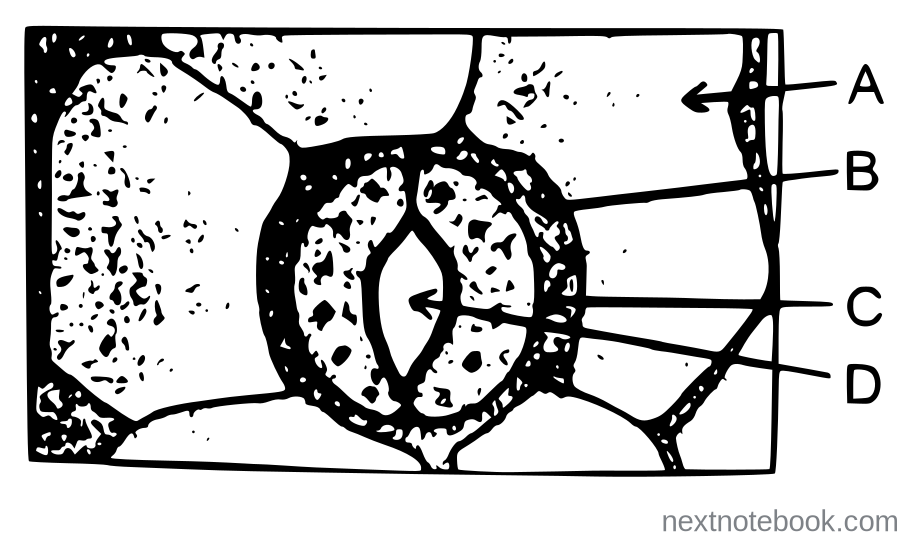
Correct answer: option 1,Hypodermis is parenchymatous. - Q2NEET 2024In the given figure, which component has thin outer walls and highly thickened inner walls?
 Tap an option to check.
Show answer
Correct answer: option 3,C - Q3NEET 2024Given below are two statements:
Statement I: Parenchyma is living but collenchyma is dead tissue.
Statement II: Gymnosperms lack xylem vessels but presence of xylem vessels is the characteristic of angiosperms.
In the light of the above statements, choose the correct answer from the options given below:Tap an option to check.Show answer
Correct answer: option 2,Statement I is false but Statement II is true - Q4NEET 2024Bulliform cells are responsible forTap an option to check.
Show answer
Correct answer: option 3,Inward curling of leaves in monocots. - Q5NEET 2023Given below are two statements: One is labelled as Assertion A and the other is labelled as
Reason R:
Assertion A: Late wood has fewer xylary elements with narrow vessels.
Reason R: Cambium is less active in winters.
In the light of the above statements, choose the correct answer from the options given below:Tap an option to check.Show answer
Correct answer: option 1,Both A and R are true and R is the correct explanation of A - Q6NEET 2023Given below are two statements:
Statement I: Endarch and exarch are the terms often used for describing the position of secondary xylem in the plant body.
Statement II: Exarch condition is the most common feature of the root system.
In the light of the above statements, choose the correct answer from the options given below:Tap an option to check.Show answer
Correct answer: option 4,Statement I is incorrect but Statement II is true - Q7NEET 2023Identify the correct statements: A. Lenticels are the lens-shaped openings permitting the exchange of gases. B. Bark formed early in the season is called hard bark. C. Bark is a technical term that refers to all tissues exterior to vascular cambium. D. Bark refers to periderm and secondary phloem. E. Phellogen is single-layered in thickness. Choose the correct answer from the options given below:Tap an option to check.
Show answer
Correct answer: option 2,A and D only - Q8NEET 2022In old trees the greater part of secondary xylem is dark brown and resistant to insect attack due to:
(a) secretion of secondary metabolities and their deposition in the lumen of vessels.
(b) deposition of organic compounds like tannins and resins in the central layers of stem.
(c) deposition of suberin and aromatic substances in the outer layer of stem.
(d) deposition of tannins, gum, resin and aromatic substances in the peripheral layers of stem.
(e) presence of parenchyma cells, functionally active xylem elements and essential oils.
Choose the correct answer from the options given below:Tap an option to check.Show answer
Correct answer: option 2,(a) and (b) Only - Q9NEET 2022Read the following statements about the vascular bundles:
(a) In roots, xylem and phloem in a vascular bundle are arranged in an alternate manner along the different radii.
(b) Conjoint closed vascular bundles do not possess cambium
(c) In open vascular bundles, cambium is present in between xylem and phloem
(d) The vascular bundles of dicotyledonous stem possess endarch protoxylem
(e) In monocotyledonous root, usually there are more than six xylem bundles present
Choose the correct answer from the options given below:Tap an option to check.Show answer
Correct answer: option 4,(a), (b), (c) and (d) Only - Q10NEET 2022The anatomy of springwood shows some peculiar features. Identify the correct set of statements about springwood.
(a) It is also called as the earlywood
(b) In spring season cambium produces xylem elements with narrow vessels
(c) It is lighter in colour
(d) The springwood along with autumnwood shows alternate concentric rings forming annual rings
(e) It has lower density
Choose the correct answer from the options given below:Tap an option to check.Show answer
Correct answer: option 3,(a), (c), (d) and (e) Only
Show the other 30 questions
- Q11NEET 2021Match List - I with List - II. Choose the correct answer from the options given below.
List - I List - II (a) Lenticels (i) Phellogen (b) Cork cambium (ii) Suberin deposition (c) Secondary cortex (iii) Exchange of gases (d) Cork (iv) Phelloderm 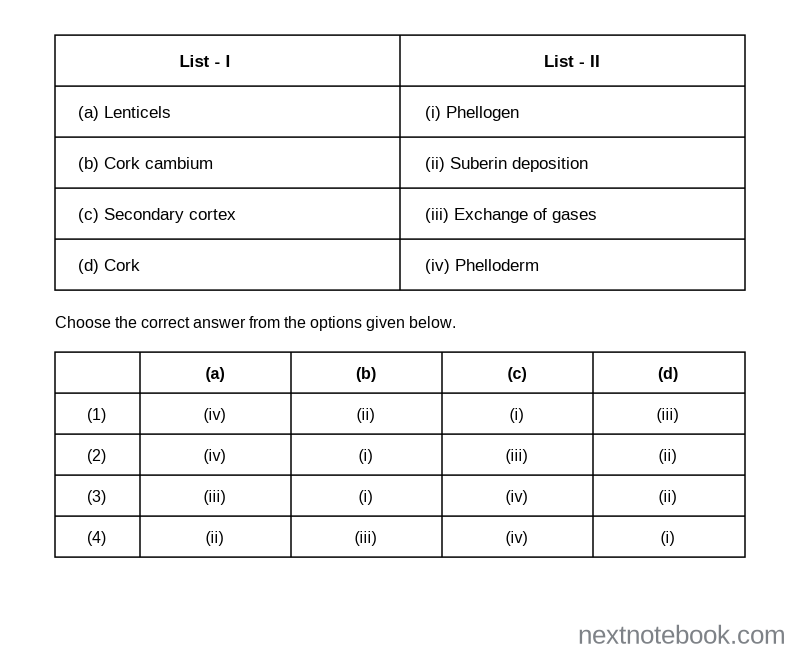 Tap an option to check.
Show answer
Correct answer: option 3,(a) (iii) (b) (i) (c) (iv) (d) (ii) - Q12NEET 2021Match List - I with List - II. List-I
(a) Cells with active cell division capacity
(b) Tissue having all cells similar in structure and function
(c) Tissue having different types of cells
(d) Dead cells with highly thickened walls and narrow lumen List-II (i) Vascular tissues (ii) Meristematic tissue (iii) Sclereids (iv) Simple tissue
Select the correct answer from the options given below.Tap an option to check.Show answer
Correct answer: option 2,(a) (ii) (b) (iv) (c) (i) (d) (iii) - Q13NEET 2021Select the correct pair.Tap an option to check.
Show answer
Correct answer: option 4,Cells of medullary rays that form part of cambial ring - Interfascicular cambium - Q14NEET 2020The transverse section of a plant shows following anatomical features:
(a) Large number of scattered vascular bundles surrounded by bundle sheath.
(b) Large conspicuous parenchymatous ground tissue.
(c) Vascular bundles conjoint and closed.
(d) Phloem parenchyma absent. Identify the category of plant and its part:Tap an option to check.Show answer
Correct answer: option 3,Monocotyledonous stem - Q15NEET 2020Identify the incorrect statement.Tap an option to check.
Show answer
Correct answer: option 1,Sapwood is the innermost secondary xylem and is lighter in colour - Q16NEET 2019Grass leaves curl inwards during very dry weather. Select the most appropriate reason from the followingTap an option to check.
Show answer
Correct answer: option 2,Flaccidity of bulliform cells - Q17NEET 2019Which of the statements given below is not true about formation of Annual Rings in trees?Tap an option to check.
Show answer
Correct answer: option 4,Annual rings are not prominent in trees of temperate region. - Q18NEET 2019Phloem in gymnosperms lacks:Tap an option to check.
Show answer
Correct answer: option 4,Both sieve tubes and companion cells - Q19NEET 2018Secondary xylem and phloem in dicot stem are produced byTap an option to check.
Show answer
Correct answer: option 1,Vascular cambium - Q20NEET 2018Plants having little or no secondary growth areTap an option to check.
Show answer
Correct answer: option 3,Grasses - Stuck on one?Log in free
See the step-by-step solution and video for every question, free with login.
- Q21NEET 2018Casparian strips occur inTap an option to check.
Show answer
Correct answer: option 4,Endodermis - Q22NEET 2018Stomata in grass leaf areTap an option to check.
Show answer
Correct answer: option 3,Dumb-bell shaped - Q23NEET 2017 · Code ASIdentify the wrong statement in context of heartwood.Tap an option to check.
Show answer
Correct answer: option 3,It conducts water and minerals efficiently - Q24NEET 2017 · Code ASWhich of the following facilitates opening of stomatal aperture?Tap an option to check.
Show answer
Correct answer: option 3,Radial orientation of cellulose microfibrils in the cell wall of guard cells - Q25NEET 2017 · Code ASWhich of the following is made up of dead cells?Tap an option to check.
Show answer
Correct answer: option 3,Phellem - Q26NEET 2017 · Code ASThe vascular Cambium normally gives rise toTap an option to check.
Show answer
Correct answer: option 3,Secondary xylem - Q27NEET 2017 · Code YWhich of the following statements is true for phloem in plants?Tap an option to check.
Show answer
Correct answer: option 3,Companion cells help in maintaining the pressure gradient in sieve tubes. - Q28NEET 2017 · Code YThe chief function of vessels in the plant body is to:Tap an option to check.
Show answer
Correct answer: option 4,Conduct water and mineral salts - Q29NEET 2016 · Code ASCortex is the region found betweenTap an option to check.
Show answer
Correct answer: option 3,Epidermis and stele - Q30NEET 2016 · Code ASThe balloon-shaped structures called tylosesTap an option to check.
Show answer
Correct answer: option 1,Are extensions of xylem parenchyma cells into vessels - Stuck on one?Log in free
See the step-by-step solution and video for every question, free with login.
- Q31AIPMT 2015Read the different components from (a) to (d) in the list given below and tell the correct order of the compo- nents with reference to their arrangement from outer side to inner side in a woody dicot stem
(a) Secondary cortex
(b) Wood
(c) Secondary phloem
(d) Phellem The correct order isTap an option to check.Show answer
Correct answer: option 2,(d), (a), (c), (b) - Q32AIPMT 2014You are given a fairly old piece of dicot stem and a dicot root. Which of the following anatomical structures will you use to distinguish between the two?Tap an option to check.
Show answer
Correct answer: option 3,Protoxylem - Q33AIPMT 2014Tracheids differ from the tracheary elements inTap an option to check.
Show answer
Correct answer: option 2,Being imperforate - Q34NEET 2013 · Code ASInterfascicular cambium develops from the cells ofTap an option to check.
Show answer
Correct answer: option 1,Medullary rays - Q35NEET 2013 · Code ASLenticels are involved inTap an option to check.
Show answer
Correct answer: option 2,Gaseous exchange - Q36NEET 2013Age of a tree can be estimated byTap an option to check.
Show answer
Correct answer: option 3,Number of annual rings - Q37AIPMT 2012The common bottle cork is a product of:Tap an option to check.
Show answer
Correct answer: option 2,Phellogen - Q38AIPMT 2012Companion cells are closely associated with:Tap an option to check.
Show answer
Correct answer: option 1,Sieve elements - Q39AIPMT 2012Closed vascular bundles lackTap an option to check.
Show answer
Correct answer: option 3,Cambium - Q40AIPMT 2012Water containing cavities in vascular bundles are found in:Tap an option to check.
Show answer
Correct answer: option 2,Maize
Practise The Tissue System first. Solutions and video answers are free.