#11 OF 28 IN PHYSICS
Work, Energy and Power NEET PYQs (2012–2025) with answers
27 questions across 12 NEET years, about 2 a paper (≈7 marks). The topics asked most are Power and Kinetic energy, work by specific forces, and the work-energy theorem.
- 83% of papers
- ≈7 marks a paper
- Class 11 · Ch 5
From official NTA papers · Updated 9 Nov 2026
What's asked most
- Power25%Definition and instantaneous or average power · Power required by a water-drawing pump
- Kinetic energy, work by specific forces, and the work-energy theorem22%Work-energy theorem for constant and variable forces · Work done by gravity, spring force, friction and other forces
- Mechanical energy conservation and potential-energy curves16%Potential-energy curves, allowed motion and turning points · Conservation of mechanical energy
- Work: meaning, sign and calculation6%Definition and meaning of work · Work by constant and multiple forces; positive, negative and zero work
- Potential energy and conservative forces6%Spring potential energy · Definition and reference-level dependence of potential energy
See all 6 topics
- Work by variable forces2%Work by a variable force using integration or a force-displacement graph
How often it comes
See as a table
| Year | Questions |
|---|---|
| 2025 | 1 |
| 2024 | 2 |
| 2023 | 2 |
| 2022 | 2 |
| 2021 | 2 |
| 2019 | 3 |
| 2018 | 1 |
| 2017 | 4 |
| 2016 | 2 |
| 2015 | 3 |
| 2013 | 2 |
| 2012 | 3 |
Where it fits
SYLLABUSNEET Physics syllabusWEIGHTAGE#11 of 28 Physics chaptersNCERTClass 11 Physics NCERT, Chapter 5
Questions here often join up with
All 27 questions
- Q1NEET 2025The kinetic energies of two similar cars and are and respectively. On applying breaks, car stops after and car stops after . If and are the forces applied by the breaks on cars and respectively, then the ratio of isTap an option to check.
Show answer
Correct answer: option 2, - Q2NEET 2024Two bodies and of same mass undergo completely inelastic one dimensional collision. The body moves with velocity while body is at rest before collision. The velocity of the system after collision is . The ratio isTap an option to check.
Show answer
Correct answer: option 4, - Q3NEET 2024At any instant of time , the displacement of any particle is given by (SI unit) under the influence of force of 5 N. The value of instantaneous power is (in SI unit):Tap an option to check.
Show answer
Correct answer: option 3,10 - Q4NEET 2023The potential energy of a long spring when stretched by is . If the spring is stretched by , potential energy stored in it will beTap an option to check.
Show answer
Correct answer: option 4, - Q5NEET 2023A bullet from a gun is fired on a rectangular wooden block with velocity . When bullet travels through the block along its length horizontally, velocity of bullet becomes . Then it further penetrates into the block in the same direction before coming to rest exactly at the other end of the block. The total length of the block isTap an option to check.
Show answer
Correct answer: option 1, - Q6NEET 2022The energy that will be ideally radiated by a transmitter in hour isTap an option to check.
Show answer
Correct answer: option 2, - Q7NEET 2022An electric lift with a maximum load of (lift + passengers) is moving up with a constant speed of . The frictional force opposing the motion is . The minimum power delivered by the motor to the lift in watts is: ()Tap an option to check.
Show answer
Correct answer: option 4,34500 - Q8NEET 2021A particle is released from height from the surface of the Earth. At a certain height its kinetic energy is three times its potential energy. The height from the surface of the earth and the speed of the particle at that instant are respectively:Tap an option to check.
Show answer
Correct answer: option 1, - Q9NEET 2021Water falls from a height of at the rate of to operate a turbine. The losses due to frictional force are of the input energy. How much power is generated by the turbine? ()Tap an option to check.
Show answer
Correct answer: option 3, - Q10NEET 2019Body A of mass moving with speed collides with another body B of mass , at rest. The collision is head on and elastic in nature. After the collision the fraction of energy lost by the colliding body A is:Tap an option to check.
Show answer
Correct answer: option 2,
Show the other 17 questions
- Q11NEET 2019A disc of radius and mass rolls on a horizontal floor. Its centre of mass has speed of . How much work is needed to stop it?Tap an option to check.
Show answer
Correct answer: option 1, - Q12NEET 2019A force acts on a particle in -direction where is in newton and in meter. Work done by this force to move the particle from to isTap an option to check.
Show answer
Correct answer: option 3, - Q13NEET 2018A moving block having mass , collides with another stationary block having mass . The lighter block comes to rest after collision. When the initial velocity of the lighter block is , then the value of coefficient of restitution will beTap an option to check.
Show answer
Correct answer: option 1, - Q14NEET 2017 · Code YThe energy liberated per nuclear fission is . If fissions occur per second the amount of power produced will beTap an option to check.
Show answer
Correct answer: option 2, - Q15NEET 2017 · Code YA body starts moving unidirectionally under the influence of a source of constant power. Which one of the graph correctly shows the variation of displacement() with time ()?Tap an option to check.
Show answer
Correct answer: option 4,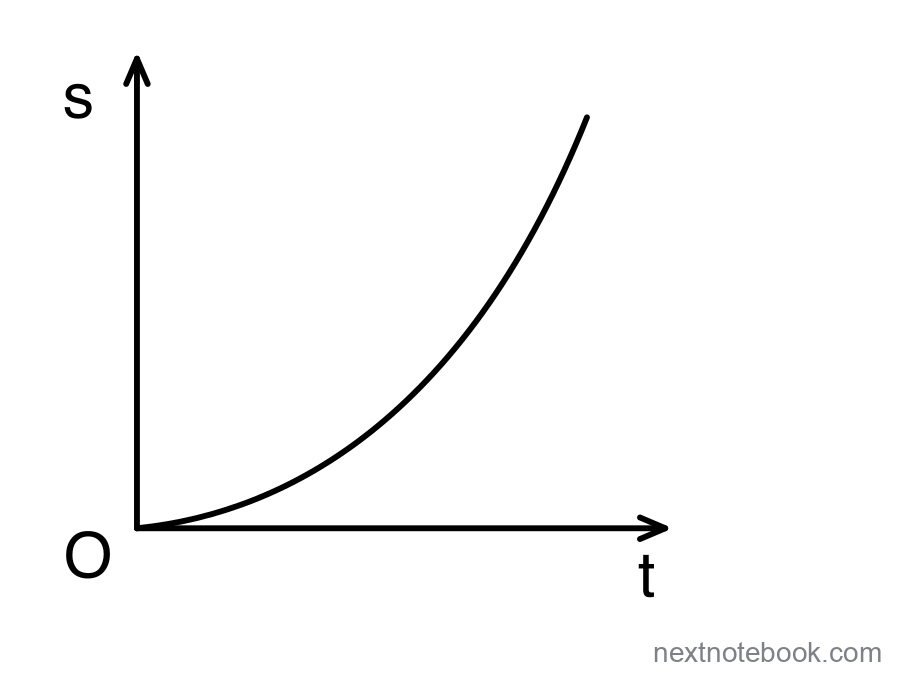
- Q16NEET 2017 · Code YThe rotational kinetic energy of a solid sphere of mass and radius rolling down an inclined plane of height is:Tap an option to check.
Show answer
Correct answer: option 2, - Q17NEET 2017 · Code ASConsider a drop of rain water having mass falling from a height of . It hits the ground with a speed of . Take constant with a value . The work done by the (i) gravitational force and the (ii) resistive force of air is respectivelyTap an option to check.
Show answer
Correct answer: option 4,(i) (ii) - Q18NEET 2016 · Code ASTwo identical balls and having velocities of and respectively collide elastically in one dimension. The velocities of and after the collision respectively will beTap an option to check.
Show answer
Correct answer: option 4,and - Q19NEET 2016 · Code ASA particle moves from a point to when a force of is applied. How much work has been done by the force?Tap an option to check.
Show answer
Correct answer: option 1, - Q20AIPMT 2015On a frictionless surface a block of mass moving at speed collides elastically with another block of same mass which is initially at rest. After collision the first block moves at an angle to its initial direction and has a speed . The second block's speed after the collision is:Tap an option to check.
Show answer
Correct answer: option 4, - Stuck on one?Log in free
See the step-by-step solution and video for every question, free with login.
- Q21AIPMT 2015A ball is thrown vertically downwards from a height of with an initial velocity . It collides with the ground loses 50 percent of its energy in collision and rebounds to the same height. The initial velocity is: (Take )Tap an option to check.
Show answer
Correct answer: option 1, - Q22AIPMT 2015If vectors and are functions of time, then the value of at which they are orthogonal to each other is:Tap an option to check.
Show answer
Correct answer: option 2, - Q23NEET 2013 · Code ASA uniform force of newton acts on a particle of mass kg. Hence the particle is displaced from position metre to position metre. The work done by the force on the particle isTap an option to check.
Show answer
Correct answer: option 1,J - Q24NEET 2013 · Code ASA small object of uniform density rolls up a curved surface with an initial velocity . It reaches up to a maximum height of with respect to the initial position. The object isTap an option to check.
Show answer
Correct answer: option 4,Disc - Q25AIPMT 2012The potential energy of particle in a force field is , where and are positive constants and si the distance of particle from the centre of the field. For stable equilibrium, the distance of the particle is:Tap an option to check.
Show answer
Correct answer: option 2, - Q26AIPMT 2012A solid cylinder of mass is rolling on a horizontal surface with velocity . It collides with a horizontal spring of force constant . The maximum compression produced in the spring will be:Tap an option to check.
Show answer
Correct answer: option 2, - Q27AIPMT 2012Two spheres A and B of masses and respectively collide. A is at rest initially and B is moving with velocity along -axis. After collision B has a velocity in a direction perpendicular to the original direction. The mass A moves after collision in the direction.Tap an option to check.
Show answer
Correct answer: option 4,to the -axis
Practise Power first. Solutions and video answers are free.