#3 OF 19 IN CHEMISTRY

Chemical Bonding and Molecular Structure JEE Main PYQs (2016–2026) with answers
358 questions across 11 JEE Main years, about 2 a paper (≈7 marks). The topics asked most are VSEPR Theory and Molecular Orbital Theory.
- 93% of papers
- ≈7 marks a paper
- Class 11 · Ch 4
From official NTA papers · Updated 9 Nov 2026
What's asked most
- VSEPR Theory22%VSEPR postulates and electron-pair repulsion order
- Molecular Orbital Theory13%Molecular orbital theory: configurations, bond order and magnetic character · Linear combination of atomic orbitals (LCAO)
- Hybridisation and Molecular Geometry12%Hybridisation using s and p orbitals · Hybridisation using s, p and d orbitals
- Foundations of Chemical Bonding10%Introduction to chemical bonding and stability · Limitations and exceptions to the octet rule
- Intermolecular Forces and Hydrogen Bonding8%Hydrogen bonding: intermolecular and intramolecular types
See all 10 topics
- Polarity, Dipole Moment and Ionic–Covalent Character8%Polarity of covalent bonds
- Bond Parameters7%Bond energy and factors affecting it · Bond enthalpy and bond dissociation enthalpy
- Ionic Bonding and Energetics6%Formation and energetic conditions of an ionic bond · Lattice energy and its factors
- Covalent Bonding: Valence Bond Theory and Orbital Overlap5%Types of orbital overlap and the resulting bonds · Orbital overlap and its role in bond formation
- Lewis Structures and Covalent Bonding4%Resonance structures and resonance energy · Formal charge and its use in selecting Lewis structures
How often it comes
See as a table
| Year | Questions |
|---|---|
| 2026 | 31 |
| 2025 | 21 |
| 2024 | 51 |
| 2023 | 56 |
| 2022 | 51 |
| 2021 | 62 |
| 2020 | 31 |
| 2019 | 34 |
| 2018 | 9 |
| 2017 | 7 |
| 2016 | 5 |
Where it fits
SYLLABUSJEE Main Chemistry syllabusWEIGHTAGE#3 of 19 Chemistry chaptersNCERTClass 11 Chemistry NCERT, Chapter 4
Questions here often join up with

All 358 questions
- Q1JEE Main 2026 · 23 Jan · Shift 2Which statements are NOT TRUE about ? A. It has a see-saw shape. B. Xe has 5 electron pairs in its valence shell in . C. The O-Xe-O bond angle is close to . D. The F-Xe-F bond angle is close to . E. Xe has 16 valence electrons in . Choose the correct answer from the options given below:Tap an option to check.
Show answer
Correct answer: option 1,B, C and E only - Q2JEE Main 2026 · 22 Jan · Shift 1Two -block elements X and Y form fluorides of the type . The fluoride compound is a Lewis acid and is a Lewis base. The hybridizations of the central atoms of and respectively areTap an option to check.
Show answer
Correct answer: option 4,and - Q3JEE Main 2026 · 21 Jan · Shift 1Given below are two statements:
Statement I: The number of species among , , , , , and , that have tetrahedral geometry is 3.
Statement II: In the set , all the molecules have incomplete octet around central atom.
In the light of the above statements, choose the correct answer from the options given below:Tap an option to check.Show answer
Correct answer: option 3,Statement I is false but Statement II is true - Q4JEE Main 2026 · 21 Jan · Shift 2Given below are two statements:
Statement I: Compound (), shown below, dissolves in solution and has two chiral carbon atoms
Statement II: Compound (), shown below, has two carbons with hybridization, one carbon with and one carbon with hybridization
In the light of the above statements, choose the correct answer from the options given below: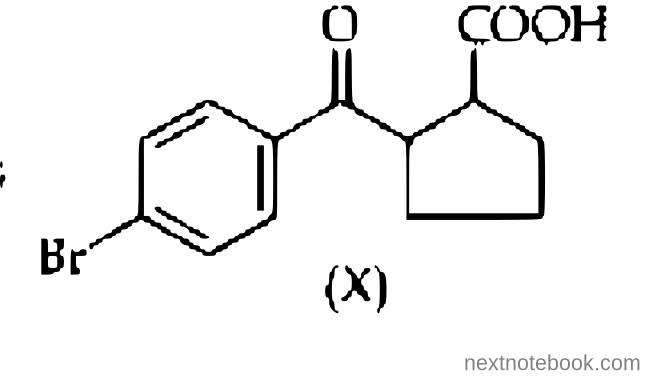 Tap an option to check.
Show answer
Correct answer: option 2,Both Statement I and Statement II are true - Q5JEE Main 2026 · 8 Apr · Shift 2Bromine trifluoride autoionizes to form and . The shapes of the cation and anion are respectively ________, and ________.Tap an option to check.
Show answer
Correct answer: option 1,bent, square planar - Q6JEE Main 2026 · 2 Apr · Shift 2is isostructural with: A. B. C. D. E. Choose the correct answer from the options given below:Tap an option to check.
Show answer
Correct answer: option 2,C and E Only - Q7JEE Main 2026 · 5 Apr · Shift 2The covalent radii of atoms A and B are and , respectively. The covalent bond length and total length of AB molecule are respectivelyTap an option to check.
Show answer
Correct answer: option 1, - Q8JEE Main 2026 · 2 Apr · Shift 1Given below are two statements: Statement (I): The correct sequence of bond lengths in the following species is: Statement (II): The correct sequence of number of unpaired electrons in the following species is: In the light of the above statements, choose the correct answer from the options given below:Tap an option to check.
Show answer
Correct answer: option 3,Statement I is true but Statement II is false - Q9JEE Main 2026 · 6 Apr · Shift 2Given below are two statements:
Statement I: The number of compounds among , , , and in which sulphur does not obey the Octet rule is 3.
Statement II: Among , , and , the number of sets in which all the molecules have one lone pair of electrons on the central atom is 1.
In the light of the above statements, choose the correct answer from the options given below:Tap an option to check.Show answer
Correct answer: option 2,Both Statement I and Statement II are false - Q10JEE Main 2026 · 4 Apr · Shift 2Which of the following pictorial diagram most correctly represents the ( - antibonding) molecular orbital between two atoms if the internuclear axis is taken to be in the -direction ( -axis )?
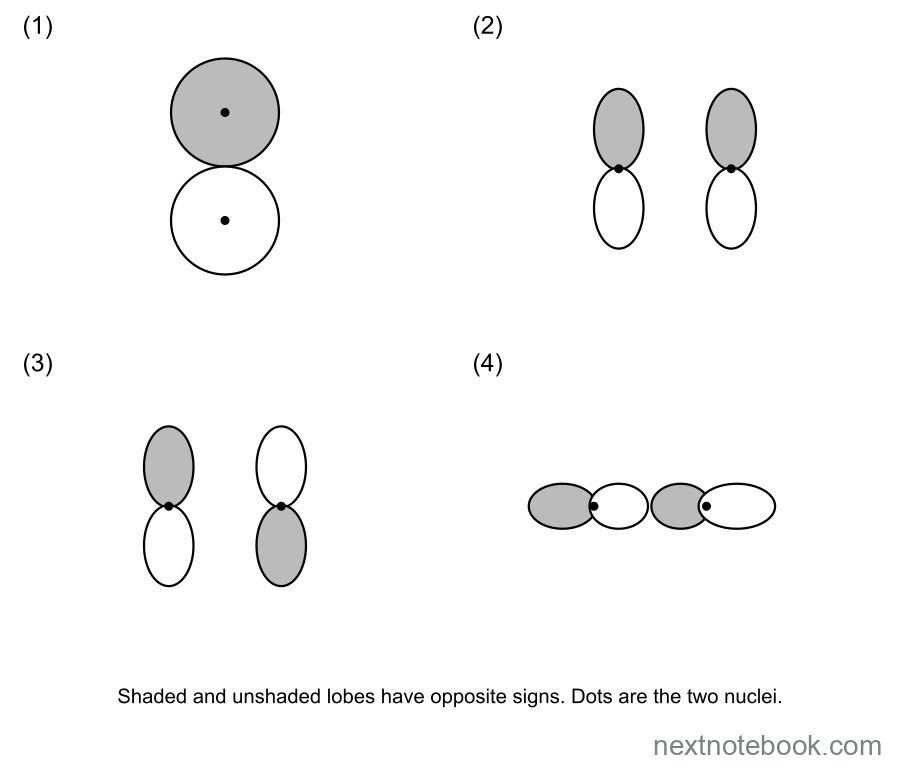 Tap an option to check.
Show answer
Correct answer: option 3,
Show the other 50 questions
- Q11JEE Main 2026 · 6 Apr · Shift 1The pairs among , , , and that do not have similar Lewis dot structure areTap an option to check.
Show answer
Correct answer: option 2,A and E - Q12JEE Main 2026 · 21 Jan · Shift 2Given below are two statements:
Statement I: The correct order in terms of bond dissociation enthalpy is .
Statement II: The correct trend in the covalent character of the metal halides is , and .
In the light of the above statements, choose the correct answer from the options given below:Tap an option to check.Show answer
Correct answer: option 4,Statement I is true but Statement II is false - Q13JEE Main 2026 · 21 Jan · Shift 1From the following, the least stable structure is:Tap an option to check.
Show answer
Correct answer: option 2,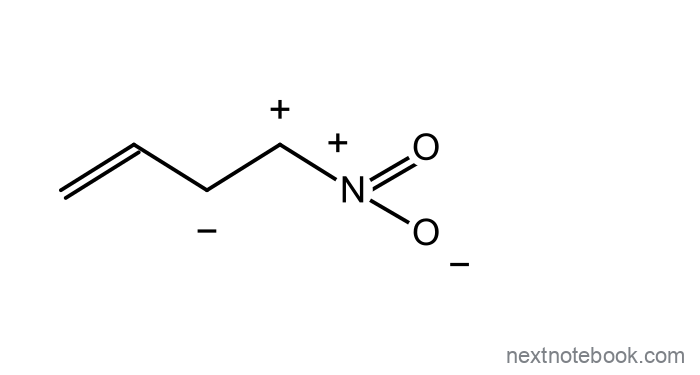
- Q14JEE Main 2026 · 24 Jan · Shift 1Given below are statements about some molecules/ions. Identify the CORRECT statements. A. The dipole moment value of is higher than that of . B. The dipole moment value of is zero. C. The bond order of and is same. D. The formal charge on the central oxygen atom of ozone is . E. In , all the three atoms satisfy the octet rule, hence it is very stable. Choose the correct answer from the options given below:Tap an option to check.
Show answer
Correct answer: option 2,B & C Only - Q15JEE Main 2026 · 23 Jan · Shift 1Identify the molecule with maximum number of lone pairs of electrons (obtained using Lewis dot structure) among , , and . Choose the correct bond angle made by the central atom of the molecule .Tap an option to check.
Show answer
Correct answer: option 1, - Q16JEE Main 2026 · 24 Jan · Shift 1Among the following, the CORRECT combinations are A. → T-shaped () B. → Square pyramidal () C. → Pentagonal bipyramidal () D. → Square planar () Choose the correct answer from the options given belowTap an option to check.
Show answer
Correct answer: option 3,A, B and C Only - Q17JEE Main 2026 · 5 Apr · Shift 2Given below are two statements:
Statement I: Aluminium upon reaction with forms ion.
Statement II: The geometry of , and is square planar, pyramidal and linear respectively.
In the light of the above statements, choose the correct answer from the options given below:Tap an option to check.Show answer
Correct answer: option 4,Statement I is false but Statement II is true - Q18JEE Main 2026 · 6 Apr · Shift 2Given below are two statements:
Statement I: is the correct trend in terms of bond angle.
Statement II: , and are ionic in nature.
In the light of the above statements, choose the correct answer from the options given below:Tap an option to check.Show answer
Correct answer: option 3,Statement I is true but Statement II is false - Q19JEE Main 2026 · 24 Jan · Shift 2The heat of atomisation of methane and ethane are ' and ' ' respectively. The longest wavelength () of light capable of breaking the bond can be expressed in SI unit as:Tap an option to check.
Show answer
Correct answer: option 4, - Q20JEE Main 2026 · 4 Apr · Shift 2Consider the following molecules/species: (x) , (y) and (z) . The correct order of carbon – oxygen double bond length is:
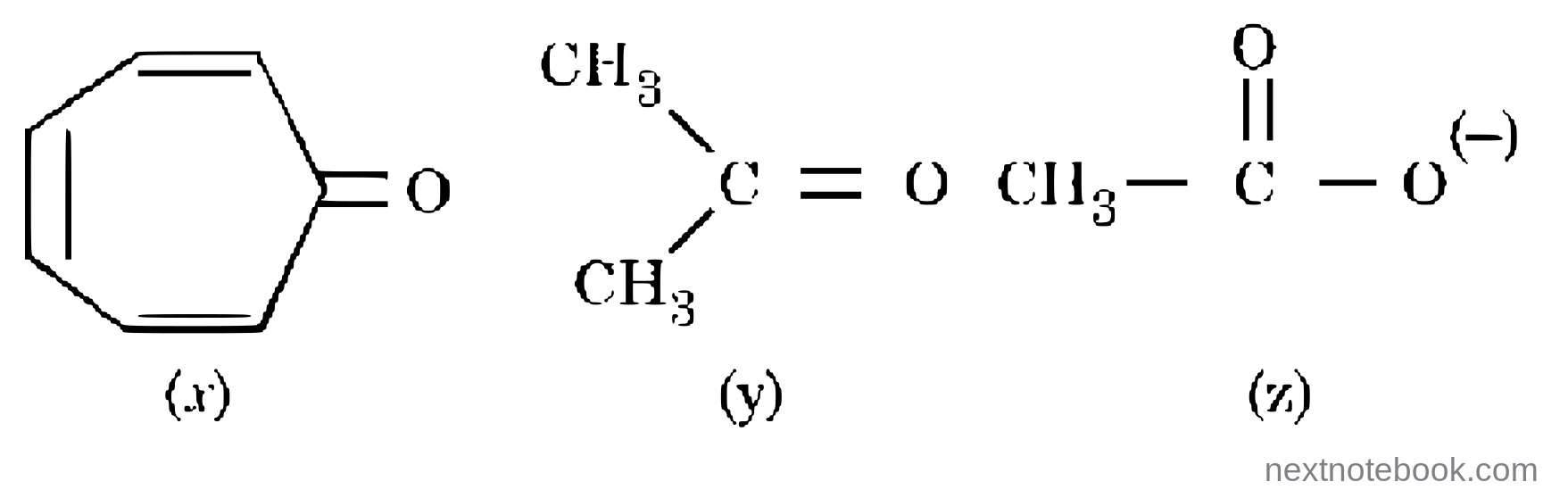 Tap an option to check.
Show answer
Correct answer: option 4, - Stuck on one?Log in free
See the step-by-step solution and video for every question, free with login.
- Q21JEE Main 2026 · 22 Jan · Shift 1The formal charges on the atoms marked as (1) to (4) in the Lewis representation of molecule respectively are
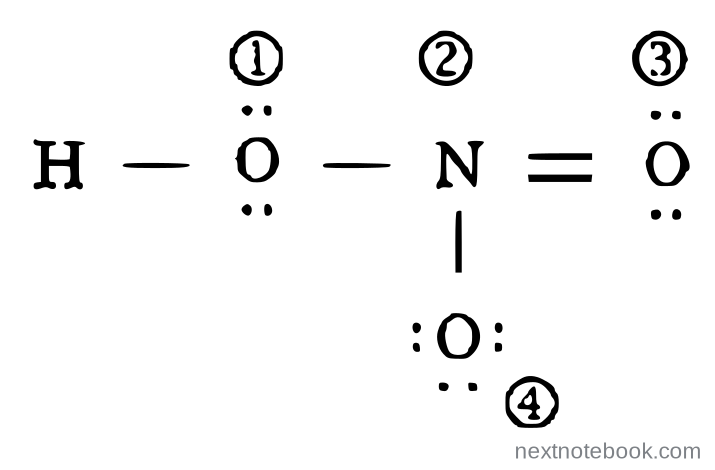 Tap an option to check.
Show answer
Correct answer: option 2, - Q22JEE Main 2026 · 28 Jan · Shift 1Given below are two statements:
Statement I: The number of species among , , and , that have unequal bond lengths is two. Here, is the central atom.
Statement II: Among , , and , has the highest bond order.
In the light of the above statements, choose the correct answer from the options given belowTap an option to check.Show answer
Correct answer: option 1,Both Statement I and Statement II are false - Q23JEE Main 2026 · 28 Jan · Shift 1Correct order of stability for the following is , ,Tap an option to check.
Show answer
Correct answer: option 2, - Q24JEE Main 2026 · 6 Apr · Shift 2Shown below is the structure of methyl acetate with three different , and carbon - oxygen bonds. ; is the bond, is the bond and is the bond. The correct order of bond lengths of these bonds is:Tap an option to check.
Show answer
Correct answer: option 2, - Q25JEE Main 2026 · 21 Jan · Shift 2The correct increasing order of , , and bonds in terms of covalent bond length is:Tap an option to check.
Show answer
Correct answer: option 3, - Q26JEE Main 2026 · 24 Jan · Shift 2Pair of species among the following having same bond order as well as paramagnetic character will be-Tap an option to check.
Show answer
Correct answer: option 3, - Q27JEE Main 2026 · 6 Apr · Shift 1Arrange the following compounds according to increasing order of boiling points. (A), (B), (C) and (D).Tap an option to check.
Show answer
Correct answer: option 3, - Q28JEE Main 2026 · 22 Jan · Shift 2Among , , , and , identify the molecule with lowest dipole moment value. The number of lone pairs of electrons present on the central atom of the molecule is:Tap an option to check.
Show answer
Correct answer: option 4,1 - Q29JEE Main 2026 · 4 Apr · Shift 1According to Lewis theory, the total number of bond-pairs and lone pair of electrons around the central atom of ion is ________.Tap Show answer to check.
Show answer
Answer: 6 - Q30JEE Main 2026 · 5 Apr · Shift 1Consider the following species: , , , , , , , , , Number of species having hybridized central atom is __________.Tap Show answer to check.
Show answer
Answer: 4 - Stuck on one?Log in free
See the step-by-step solution and video for every question, free with login.
- Q31JEE Main 2026 · 22 Jan · Shift 2If the enthalpy of sublimation of is , enthalpy of dissociation of is , ionization enthalpy of is , electron gain enthalpy of is , standard enthalpy of formation of is . The magnitude of lattice enthalpy of is ____ . (Nearest Integer)Tap Show answer to check.
Show answer
Answer: 1031 - Q32JEE Main 2025 · 24 Jan · Shift 1Which of the following statement is true with respect to , and ? A. The central atoms of all the molecules are hybridized. B. The , and angles in the above molecules are , and , respectively. C. The increasing order of dipole moment is . D. Both and are Lewis acids and is a Lewis base. E. A solution of in is basic. In this solution and act as Lowry-Bronsted acid and base respectively. Choose the correct answer from the options given below:Tap an option to check.
Show answer
Correct answer: option 1,A, B and C only - Q33JEE Main 2025 · 28 Jan · Shift 1The molecules having square pyramidal geometry areTap an option to check.
Show answer
Correct answer: option 3,BrF5 & XeOF4 - Q34JEE Main 2025 · 23 Jan · Shift 1Match the LIST-I with LIST-II Choose the correct answer from the options given below:
LIST-I (Classification of molecules based on octet rule) LIST-II (Example) (A) Molecules obeying octet rule (I) (B) Molecules with incomplete octet (II) (C) Molecules with incomplete octet with odd electron (III) (D) Molecules with expanded octet (IV) Tap an option to check.Show answer
Correct answer: option 4,A-IV, B-II, C-I, D-III - Q35JEE Main 2025 · 4 Apr · Shift 2Given below are two statements: Statement (I): For , all three possible structures may be drawn as follows. [Structures I, II and III are shown.] Statement (II): Structure III is most stable, as the orbitals having the lone pairs are axial, where the repulsion is minimum. In the light of the above statements, choose the most appropriate answer from the options given below:
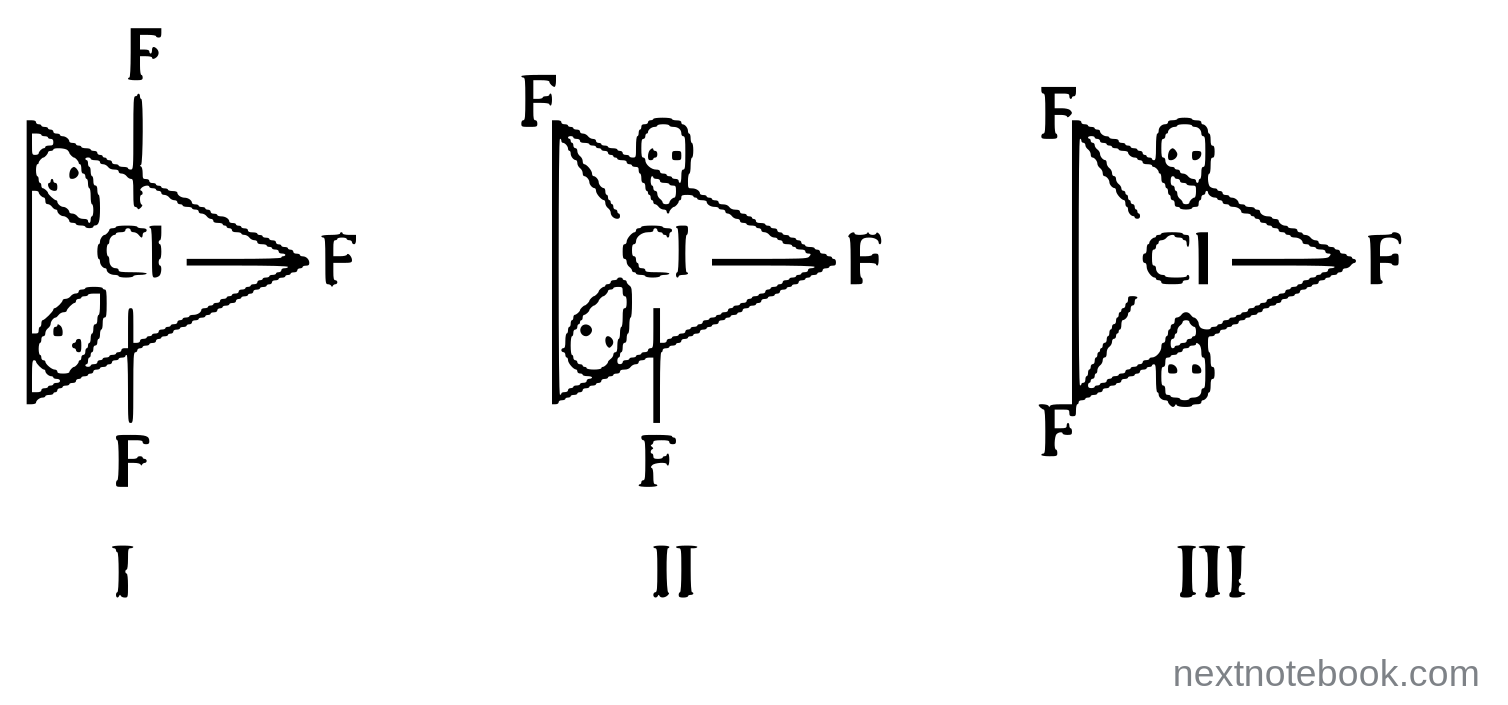 Tap an option to check.
Show answer
Correct answer: option 3,Statement I is correct but Statement II is incorrect - Q36JEE Main 2025 · 2 Apr · Shift 2Which among the following molecules is
(a) involved in hybridization,
(b) has different bond lengths and
(c) has lone pair of electrons on the central atom?Tap an option to check.Show answer
Correct answer: option 3,SF4 - Q37JEE Main 2025 · 2 Apr · Shift 1Among , , , , and , the hybridization of the molecule with zero dipole moment and highest number of lone-pairs of electrons on the central atom is:Tap an option to check.
Show answer
Correct answer: option 2, - Q38JEE Main 2025 · 24 Jan · Shift 2Given below are two statements: Statement (I): Experimentally determined oxygen-oxygen bond lengths in the are found to be same and the bond length is greater than that of a (double bond) but less than that of a single bond. Statement (II): The strong lone pair-lone pair repulsion between oxygen atoms is solely responsible for the fact that the bond length in ozone is smaller than that of a double bond but more than that of a single bond . In the light of the above statements, choose the correct answer from the options given below:Tap an option to check.
Show answer
Correct answer: option 3,Statement I is true but Statement II is false - Q39JEE Main 2025 · 7 Apr · Shift 1Match the LIST-I with LIST-I LIST-I Molecule / ion A. B. C. D. LIST-II Bond pair: lone pair (on the central atom) I. II. III. IV. Choose the correct answer from the options given below:Tap an option to check.
Show answer
Correct answer: option 3,A-III, B-IV, C-II, D-I - Q40JEE Main 2025 · 7 Apr · Shift 2In , and the hybridizations at the central atom are respectively:Tap an option to check.
Show answer
Correct answer: option 3,, and - Stuck on one?Log in free
See the step-by-step solution and video for every question, free with login.
- Q41JEE Main 2025 · 22 Jan · Shift 2Arrange the following compounds in increasing order of their dipole moment: HBr, H2S, NF3 and CHCl3Tap an option to check.
Show answer
Correct answer: option 1,NF3 < HBr < H2S < CHCl3 - Q42JEE Main 2025 · 3 Apr · Shift 1Match the LIST-I with LIST-II LIST-I (Molecules/ ion) A. B. C. D. LIST-II (Hybridisation of central atom) I. II. III. IV. Choose the correct answer from the options given below:Tap an option to check.
Show answer
Correct answer: option 2,A-II, B-III, C-IV, D-I - Q43JEE Main 2025 · 4 Apr · Shift 1Which of the following molecule(s) show/s paramagnetic behavior? A. O2 B. N2 C. F2 D. S2 E. Cl2 Choose the correct answer from the options given below:Tap an option to check.
Show answer
Correct answer: option 2,A & D Only - Q44JEE Main 2025 · 2 Apr · Shift 1A molecule with the formula has all it’s elements from -block. Element A is rarest, monoatomic, non-radioactive from its group and has the lowest ionization enthalpy value among A, X and Y. Elements X and Y have first and second highest electronegativity values respectively among all the known elements. The shape of the molecule is:Tap an option to check.
Show answer
Correct answer: option 3,Square pyramidal - Q45JEE Main 2025 · 2 Apr · Shift 2In 3,3-dimethylhex-1-en-4-yne, there are _____, _____ and _____ hybridised carbon atoms respectively.Tap an option to check.
Show answer
Correct answer: option 3,4, 2, 2 - Q46JEE Main 2025 · 24 Jan · Shift 2In the given structure, number of and hybridized carbon atoms present respectively are:
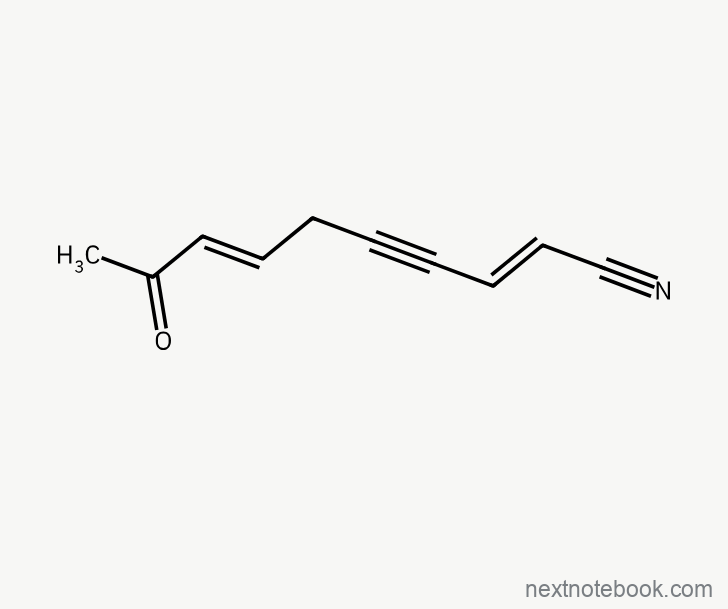 Tap an option to check.
Show answer
Correct answer: option 1,and - Q47JEE Main 2025 · 7 Apr · Shift 2Given below are two statements: Statement (I): [drawn cis-1,2-dichloroethene structure] is more polar than [drawn cis-1,2-dibromoethene structure]. Statement (II): Boiling point of [drawn trans-1,2-dibromoethene structure] is lower than [drawn cis-1,2-dibromoethene structure] but it is more polar than [drawn cis-1,2-dibromoethene structure]. In the light of the above statements, choose the most appropriate answer from the options given below:
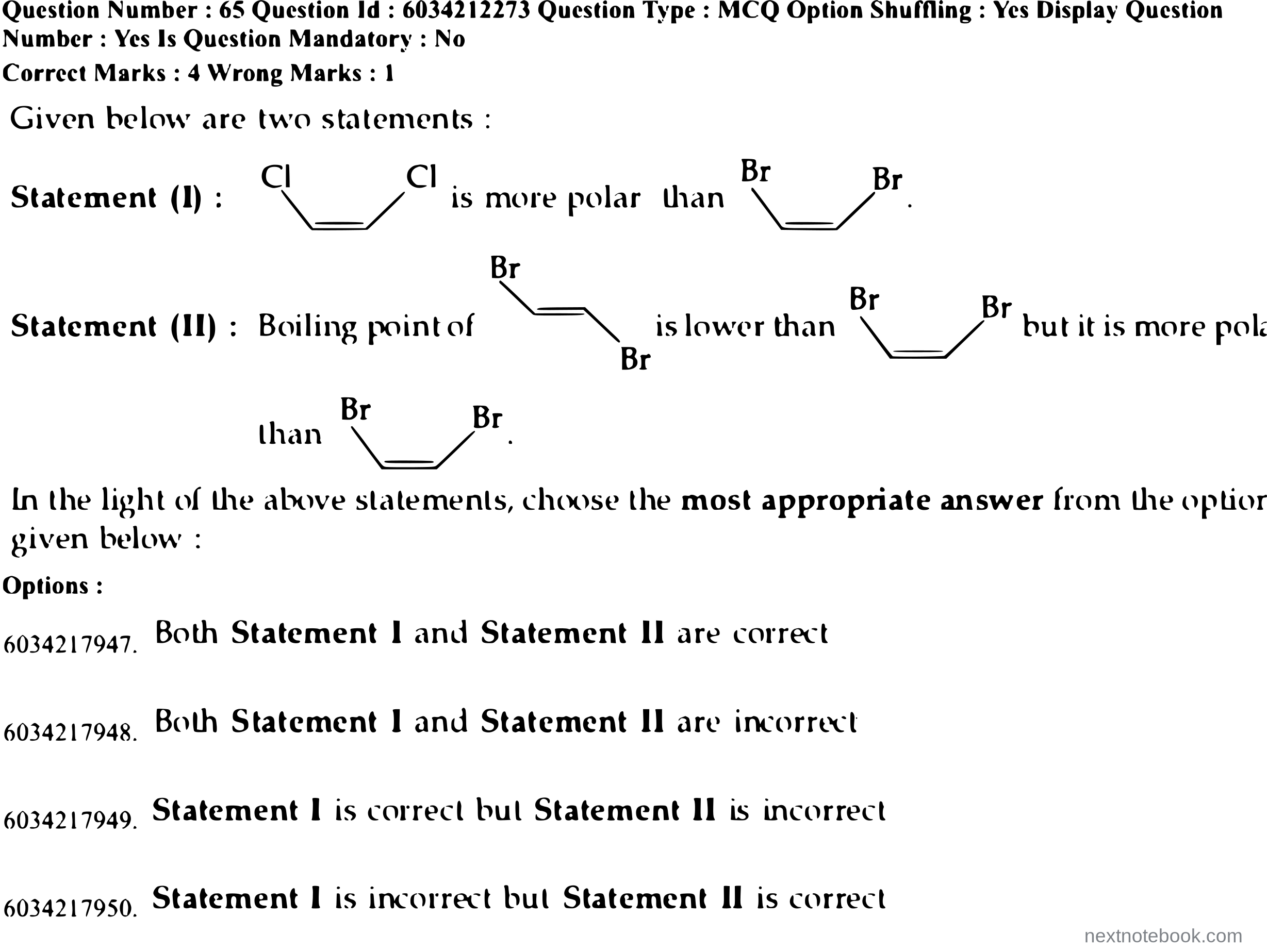 Tap an option to check.
Show answer
Correct answer: option 3,Statement I is correct but Statement II is incorrect - Q48JEE Main 2025 · 3 Apr · Shift 1Given: [C (graphite)] = The for is __________ (nearest integer value)Tap Show answer to check.
Show answer
Answer: 25 - Q49JEE Main 2025 · 28 Jan · Shift 1The formation enthalpies, for and are 220.0 and 250.0 , respectively, at 298.15 K, and for is −242.0 at the same temperature. The average bond enthalpy of the O−H bond in water at 298.15 K is ______ (nearest integer).Tap Show answer to check.
Show answer
Answer: 466 - Q50JEE Main 2025 · 23 Jan · Shift 2The bond dissociation enthalpy of calculated from the given data is __________ . (Nearest integer) [Given: is a pure ionic compound and X forms a diatomic molecule in gaseous state]Tap Show answer to check.
Show answer
Answer: 200 - Stuck on one?Log in free
See the step-by-step solution and video for every question, free with login.
- Q51JEE Main 2025 · 28 Jan · Shift 2Total number of molecules/species from following which will be paramagnetic is __________. , , , , , , , ,Tap Show answer to check.
Show answer
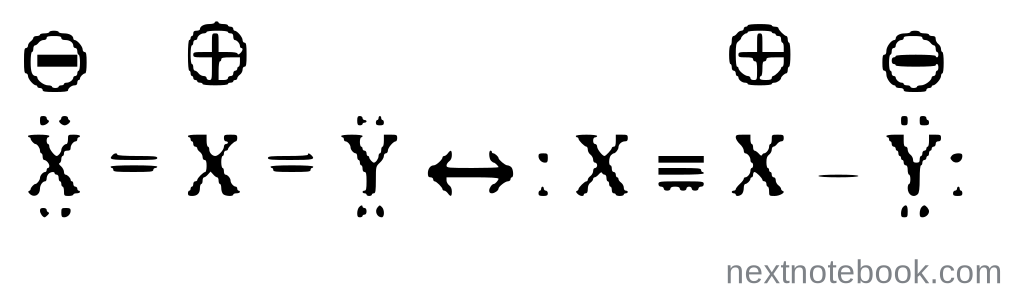
Answer: 6 - Q52JEE Main 2025 · 8 Apr · Shift 2Resonance in can be represented as . The enthalpy of formation of is 80 . The magnitude of resonance energy of is __________ (nearest integer value) Given: Bond energies of , , and are 940, 410, 500 and 602 respectively. valence X: 3, Y: 2
 Tap Show answer to check.
Show answer
Answer: 98 - Q53JEE Main 2024 · 4 Apr · Shift 1Number of elements from the following that CANNOT form compounds with valencies which match with their respective group valencies is__________________.Tap an option to check.
Show answer
Correct answer: option 1,3 - Q54JEE Main 2024 · 4 Apr · Shift 1Number of molecules / ions from the following in which the central atom is involved in hybridization is____________. , , ,Tap an option to check.
Show answer
Correct answer: option 4,2 - Q55JEE Main 2024 · 4 Apr · Shift 2The correct statement/s about Hydrogen bonding is/ are A. Hydrogen bonding exists when is covalently bonded to the highly electro negative atom. B. Intermolecular H bonding is present in - nitro phenol C. Intermolecular H bonding is present in . D. The magnitude of H bonding depends on the physical state of the compound. E. - bonding has powerful effect on the structure and properties of compounds Choose the correct answer from the options given below:Tap an option to check.
Show answer
Correct answer: option 4,A,D,E only - Q56JEE Main 2024 · 27 Jan · Shift 1Choose the polar molecule from the following:Tap an option to check.
Show answer
Correct answer: option 4,CHCl₃ - Q57JEE Main 2024 · 6 Apr · Shift 1Match the List I with List II Choose the correct answer from the options given below:
List-I (Hybridization) List-II (Orientation in Space) (a) sp3 (I) Trigonal bipyramidal (b) dsp2 (II) Octahedral (c) sp3d (III) Tetrahedral (d) sp3d2 (IV) Square planar Tap an option to check.Show answer
Correct answer: option 4,a - III, b - IV, c - I, d - II - Q58JEE Main 2024 · 1 Feb · Shift 1Given below are two statements: one is labelled as Assertion (A) and the other is labelled as Reason (R).
Assertion (A): has lower boiling point then .
Reason (R): In liquid state molecules are associated through van der Waal’s forces, but molecules are associated through hydrogen bonding.
In the light of the above statements, choose the most appropriate answer from the options given below:Tap an option to check.Show answer
Correct answer: option 4,(A) is correct but (R) is not correct - Q59JEE Main 2024 · 30 Jan · Shift 2The molecule/ion with square pyramidal shape isTap an option to check.
Show answer
Correct answer: option 3,BrF5 - Q60JEE Main 2024 · 5 Apr · Shift 1Number of and bonds present in ethylene molecule is respectively:Tap an option to check.
Show answer
Correct answer: option 2,5 and 1
Showing 60 of 358 questions. The rest are free after login.
Practise VSEPR Theory first. Solutions and video answers are free.