#14 OF 19 IN CHEMISTRY

Thermodynamics (Chemistry) JEE Main PYQs (2016–2026) with answers
198 questions across 11 JEE Main years, about 1 a paper (≈4 marks). The topics asked most are Thermochemistry: reaction enthalpy and Hess’s law and Heat, work and internal energy.
- 83% of papers
- ≈4 marks a paper
- Class 11 · Ch 5
From official NTA papers · Updated 9 Nov 2026
What's asked most
- Thermochemistry: reaction enthalpy and Hess’s law22%Standard state, standard enthalpy and thermochemical equations · Exothermic and endothermic reactions
- Heat, work and internal energy20%Work in thermodynamics and sign convention · Pressure-volume work: calculation and p–V diagram
- Gibbs energy and spontaneity18%Gibbs energy change and spontaneity · Gibbs energy, equilibrium and equilibrium constant
- Enthalpies of common reactions and transformations16%Calorimetry and measurement of reaction enthalpy · Standard enthalpy of combustion
- First law and heat capacities9%Enthalpy and the relation between enthalpy and internal energy
See all 6 topics
- Thermodynamic system, state and basic properties7%State variables, state functions and path functions · Macroscopic properties; intensive and extensive properties
How often it comes
See as a table
| Year | Questions |
|---|---|
| 2026 | 20 |
| 2025 | 22 |
| 2024 | 16 |
| 2023 | 34 |
| 2022 | 27 |
| 2021 | 32 |
| 2020 | 12 |
| 2019 | 26 |
| 2018 | 3 |
| 2017 | 4 |
| 2016 | 2 |
Where it fits
SYLLABUSJEE Main Chemistry syllabusWEIGHTAGE#14 of 19 Chemistry chaptersNCERTClass 11 Chemistry NCERT, Chapter 5
Questions here often join up with

All 198 questions
- Q1JEE Main 2026 · 23 Jan · Shift 2It is noticed that is more stable than but is less stable than . Observe the following reactions. ; ; Identify the correct set from the followingTap an option to check.
Show answer
Correct answer: option 3,; - Q2JEE Main 2026 · 28 Jan · Shift 1of an ideal gas 'X' at and undergoes isothermal reversible expansion until pressure of the gas is . Which of the following option is correct? (Given: and )Tap an option to check.
Show answer
Correct answer: option 2, - Q3JEE Main 2026 · 23 Jan · Shift 1A cup of water at (system) is placed in a microwave oven and the oven is turned on for one minute during which the water begins to boil. Which of the following option is true?Tap an option to check.
Show answer
Correct answer: option 2, - Q4JEE Main 2026 · 2 Apr · Shift 2Gas ‘’ undergoes change from state ‘’ to state ‘’. In this process, the heat absorbed and work done by the gas is and respectively. Now gas is brought back to state ‘’ by another process during which of heat is evolved. In the reverse process of ‘’ to ‘’,Tap an option to check.
Show answer
Correct answer: option 4,of the work is done on the gas ‘’ by the surrounding. - Q5JEE Main 2026 · 5 Apr · Shift 2Consider the following data for the reaction at . The (in ) for the reaction is: Compound | () | () | 42 | 200 | 8 | 140 | 80 | 250Tap an option to check.
Show answer
Correct answer: option 2, - Q6JEE Main 2026 · 2 Apr · Shift 1Consider the following data. (i) (ii) . (iii) . (iv) The enthalpy of formation of anhydrous solid is:Tap an option to check.
Show answer
Correct answer: option 4, - Q7JEE Main 2026 · 4 Apr · Shift 1Given below are two statements:
Statement I:For an ideal gas, heat capacity at constant volume is always greater than the heat capacity at constant pressure.
Statement II: In a constant volume process, no work is produced and all the heat withdrawn goes into the chaotic motion and is reflected by a temperature increase of the ideal gas.
In the light of the above statements, choose the correct answer from the options given belowTap an option to check.Show answer
Correct answer: option 4,Statement I is false but Statement II is true - Q8JEE Main 2026 · 6 Apr · Shift 2Match List - I with List - II. Given and are initial and final volumes respectively. Choose the correct answer from the options given below:
List - I (Isothermal process) List - II (Expression) A. Reversible expansion I. q = 0 B. Free expansion II. q = nRT ln (V2)/(V1) C. Irreversible Compression III. w = - pext (V1 - V2) D. Cyclic reversible IV. (qrev)/(T) = 0 Tap an option to check.Show answer
Correct answer: option 3,A-II, B-I, C-III, D-IV - Q9JEE Main 2026 · 6 Apr · Shift 1Arrange the following isothermal processes in order of the magnitude of the work () involved between states 1 and 2. A. Expansion in single stage B. Expansion in multi stages C. Compression in single stage D. Compression in multi stages Choose the correct option.Tap an option to check.
Show answer
Correct answer: option 3, - Q10JEE Main 2026 · 5 Apr · Shift 2The correct order of molar heat capacities measured at and is:Tap an option to check.
Show answer
Correct answer: option 2,Bromine(l) Copper(s) Helium(g)
Show the other 50 questions
- Q11JEE Main 2026 · 21 Jan · Shift 2Consider the following data: (methane, g) Enthalpy of sublimation of graphite Dissociation enthalpy of The bond enthalpy of bond is given by:Tap an option to check.
Show answer
Correct answer: option 2, - Q12JEE Main 2026 · 22 Jan · Shift 1Match the LIST-I with LIST-II Choose the correct answer from the options given below:
List-I List-II A. Work done in reversible, isothermal expansion of 2 mol of ideal gas from 2dm³ to 20dm³ at 300 K. I. 4 B. Work done in irreversible isothermal expansion of 1 mol ideal gas from 1 m³ to 3 m³ at 300 K against a constant pressure of 3 kPa. II. 11.5 C. Change in internal energy for adiabatic expansion of a 1 mol ideal gas with change of temperature = 320 K and C̄v = 3/2R. III. 6 D. Change in enthalpy at constant pressure of 1 mol ideal gas with change of temperature = 337 K and C̄p = 5/2R. IV. 7 Tap an option to check.Show answer
Correct answer: option 4,A-II, B-III, C-I, D-IV - Q13JEE Main 2026 · 21 Jan · Shift 1Which of the following graphs between pressure ' ' versus volume ' ' represents the maximum work done?Tap an option to check.
Show answer
Correct answer: option 3,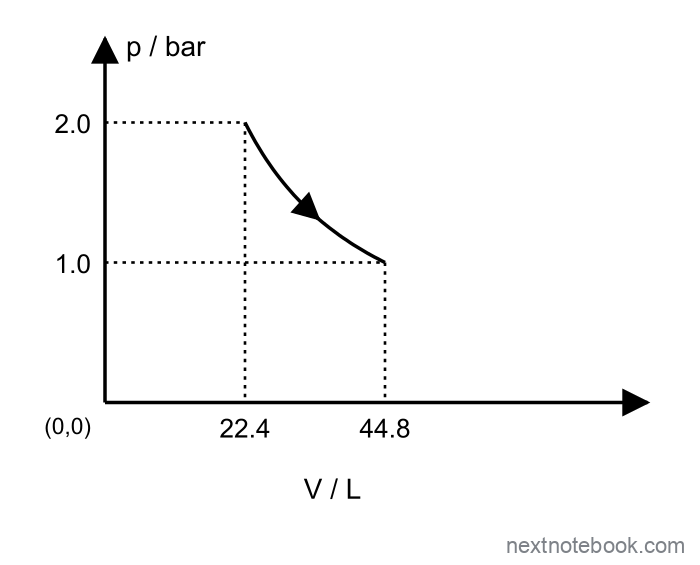
- Q14JEE Main 2026 · 21 Jan · Shift 1For the reaction, , graph is plotted as shown below. Identify correct statements. A. Standard free energy change for the reaction is . B. As in graph is positive, will not dissociate into at all. C. Reverse reaction will go to completion. D. When 1 mole of changes into equilibrium mixture, value of . E. When 2 mole of changes into equilibrium mixture, for equilibrium mixture is .
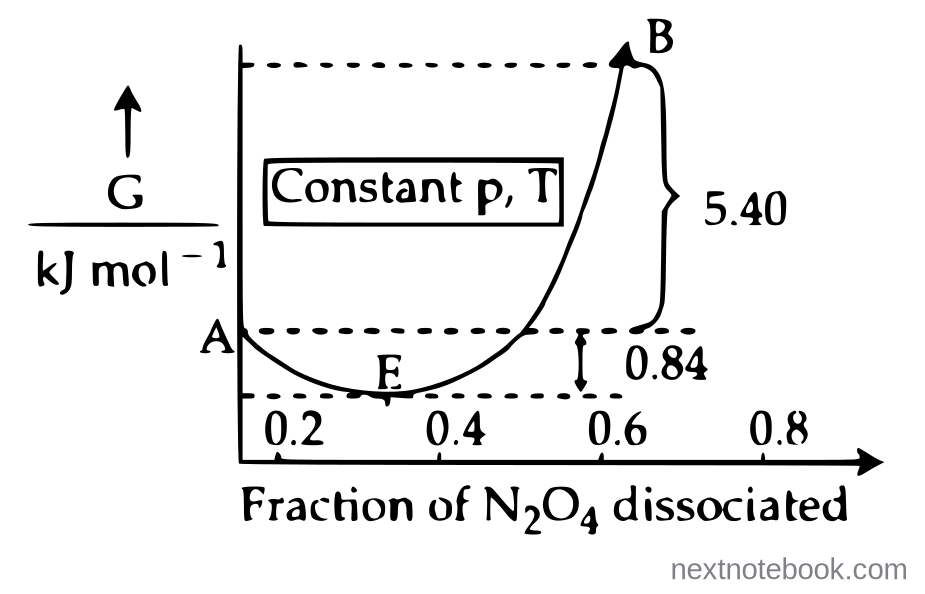 Tap an option to check.
Show answer
Correct answer: option 1,D and E only - Q15JEE Main 2026 · 24 Jan · Shift 1Match the LIST-I with LIST-II
Chloro derivative Example (A) Vinyl Chloride (I) CH2=CH-CH2Cl (B) Benzyl Chloride (II) CH3-CH(Cl)-CH3 (C) Alkyl Chloride (III) CH2=CHCl (D) Allyl Chloride (IV) 1-chloro-1-phenylethane, C6H5-CH(Cl)-CH3 Tap an option to check.Show answer
Correct answer: option 2,A-III, B-IV, C-II, D-I - Q16JEE Main 2026 · 4 Apr · Shift 2If of ethanol is burnt completely in a bomb calorimeter at , the heat produced is . The of ethanol at is ______ . (Nearest integer) Given: Standard enthalpy for combustion of graphite Standard enthalpy of formation of water Molar mass in of C, H, O are 12, 1 and 16 respectivelyTap Show answer to check.
Show answer
Answer: 3 - Q17JEE Main 2026 · 21 Jan · Shift 1Use the following data: Substance One mole each of and are taken in a closed flask and allowed to establish the equilibrium at . The value of (in ) is ____. (Nearest integer) (Given: , )Tap Show answer to check.
Show answer
Answer: 70 - Q18JEE Main 2026 · 8 Apr · Shift 2Consider the reaction The magnitude of enthalpy change for the reaction in is __________. (Nearest integer) Given:Tap Show answer to check.
Show answer
Answer: 1126 - Q19JEE Main 2026 · 6 Apr · Shift 1Consider the reaction at . If and are and at the same temperature, then the magnitude of for the reaction in is . (Nearest integer) (Given: , , , )Tap Show answer to check.
Show answer
Answer: 34 - Q20JEE Main 2026 · 2 Apr · Shift 1At the transition temperature , and where and are two states of substance . The transition temperature in when pressure is is ____________. (Nearest integer)Tap Show answer to check.
Show answer
Answer: 727 - Stuck on one?Log in free
See the step-by-step solution and video for every question, free with login.
- Q21JEE Main 2025 · 4 Apr · Shift 2Consider the given data: (a) (b) Choose the correct statement:Tap an option to check.
Show answer
Correct answer: option 1,The heat of solution depends on the amount of solvent. - Q22JEE Main 2025 · 28 Jan · Shift 2An ideal gas undergoes a cyclic transformation starting from the point A and coming back to the same point by tracing the path as shown in the three cases above. Choose the correct option regarding :
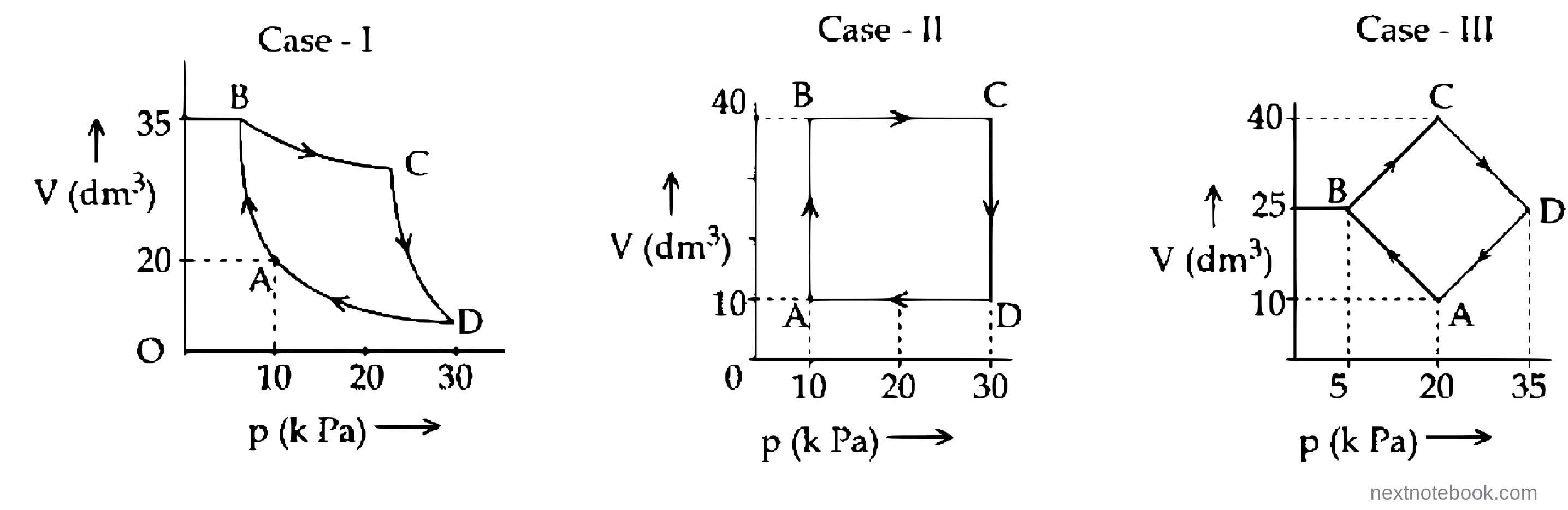 Tap an option to check.
Show answer
Correct answer: option 4, - Q23JEE Main 2025 · 7 Apr · Shift 2The correct statement amongst the following is:Tap an option to check.
Show answer
Correct answer: option 4,is zero for - Q24JEE Main 2025 · 23 Jan · Shift 2The effect of temperature on spontaneity of reactions are represented as: ΔH ΔS Temperature Spontaneity (A) + − any T Non spontaneous (B) + + low T spontaneous (C) − − low T Non spontaneous (D) − + any T spontaneous The incorrect combinations are:Tap an option to check.
Show answer
Correct answer: option 3,(B) and (C) only - Q25JEE Main 2025 · 2 Apr · Shift 2Arrange the following in order of magnitude of work done by the system/ on the system at constant temperature.
(a) for expansion in infinite stages.
(b) for expansion in single stage.
(c) for compression in infinite stages.
(d) for compression in single stage.
Choose the correct answer from the options given below:Tap an option to check.Show answer
Correct answer: option 1, - Q26JEE Main 2025 · 2 Apr · Shift 1Two vessels A and B are connected via stopcock. The vessel A is filled with a gas at a certain pressure. The entire assembly is immersed in water and is allowed to come to thermal equilibrium with water. After opening the stopcock the gas from vessel A expands into vessel B and no change in temperature is observed in the thermometer. Which of the following statement is true?
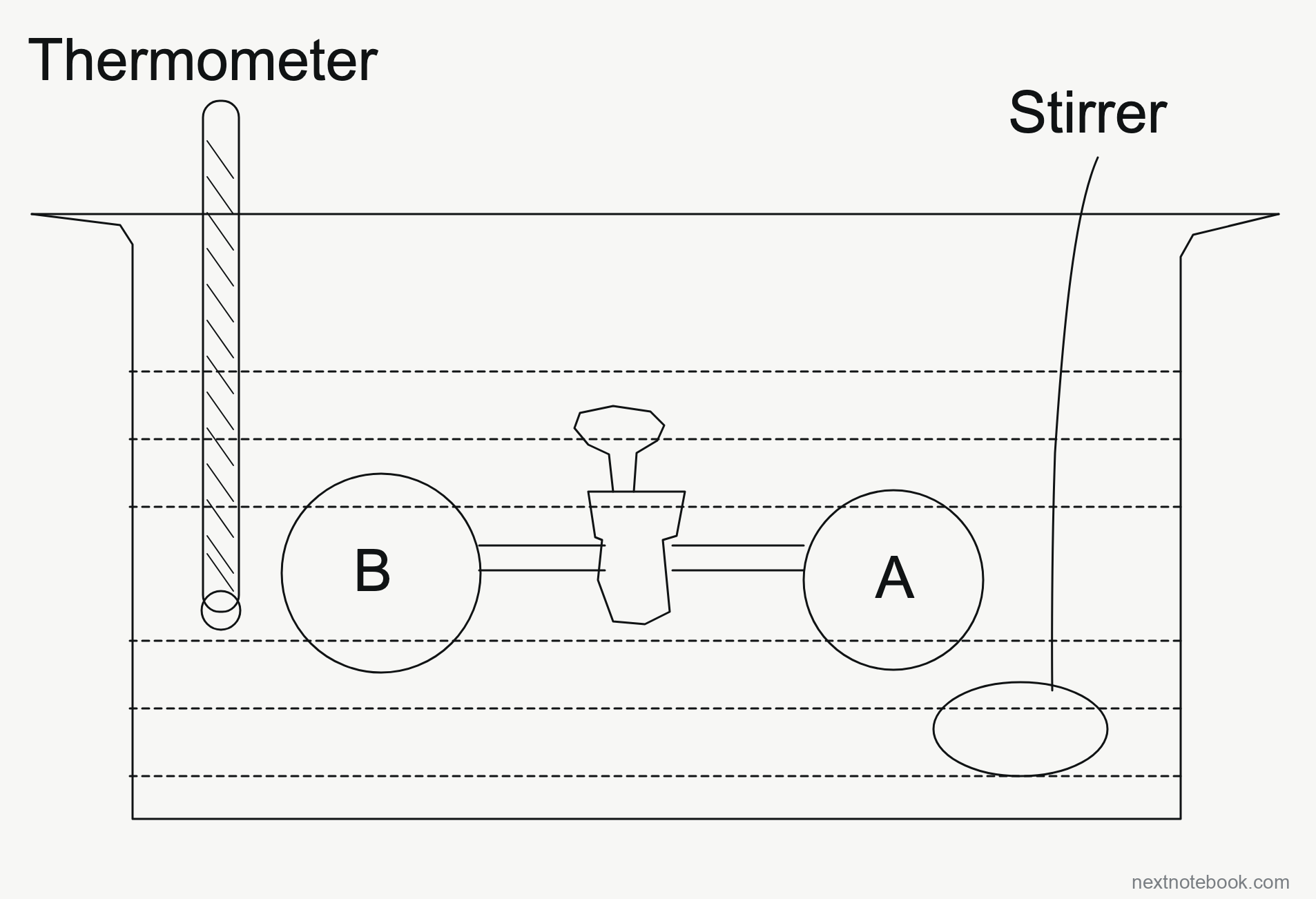 Tap an option to check.
Show answer
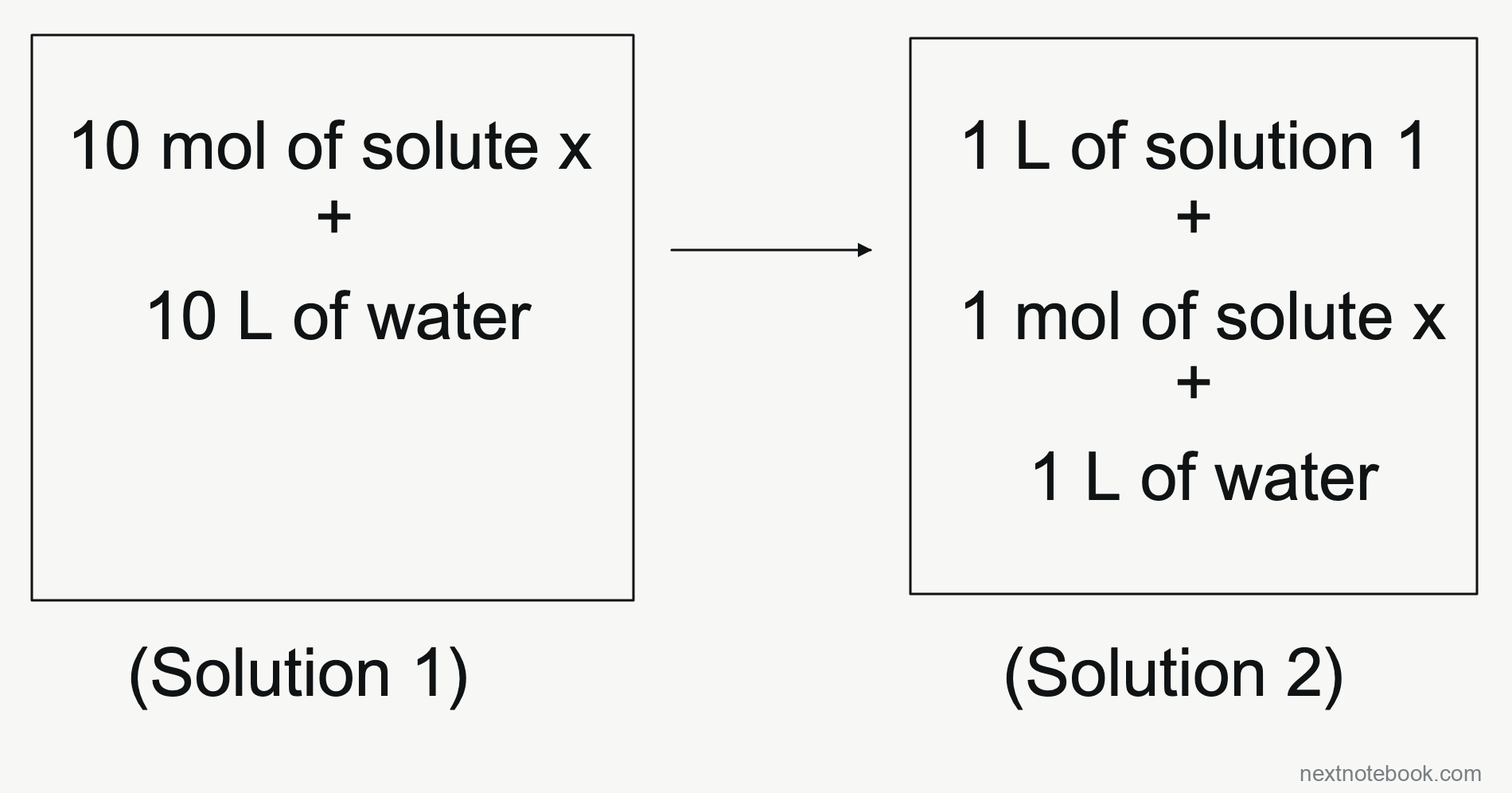
Correct answer: option 4,The pressure in the vessel B before opening the stopcock is zero - Q27JEE Main 2025 · 3 Apr · Shift 1Which of the following properties will change when system containing solution 1 will become solution 2?
 Tap an option to check.
Show answer
Correct answer: option 1,Gibbs free energy - Q28JEE Main 2025 · 24 Jan · Shift 1Let us consider an endothermic reaction which is non-spontaneous at the freezing point of water. However, the reaction is spontaneous at boiling point of water. Choose the correct option.Tap an option to check.
Show answer
Correct answer: option 2,Both and are - Q29JEE Main 2025 · 24 Jan · Shift 2Which of the following mixing of base and acid leads to the largest increase in temperature?Tap an option to check.
Show answer
Correct answer: option 4,and - Q30JEE Main 2025 · 7 Apr · Shift 1Total enthalpy change for freezing of of water at to ice at is ________ (Given: )Tap an option to check.
Show answer
Correct answer: option 2, - Stuck on one?Log in free
See the step-by-step solution and video for every question, free with login.
- Q31JEE Main 2025 · 7 Apr · Shift 2The hydration energies of and are and respectively. If lattice energy of is , then the heat of solution of is:Tap an option to check.
Show answer
Correct answer: option 4, - Q32JEE Main 2025 · 2 Apr · Shift 2Which of the following graphs correctly represents the variation of thermodynamic properties of Haber's process?Tap an option to check.
Show answer
Correct answer: option 2,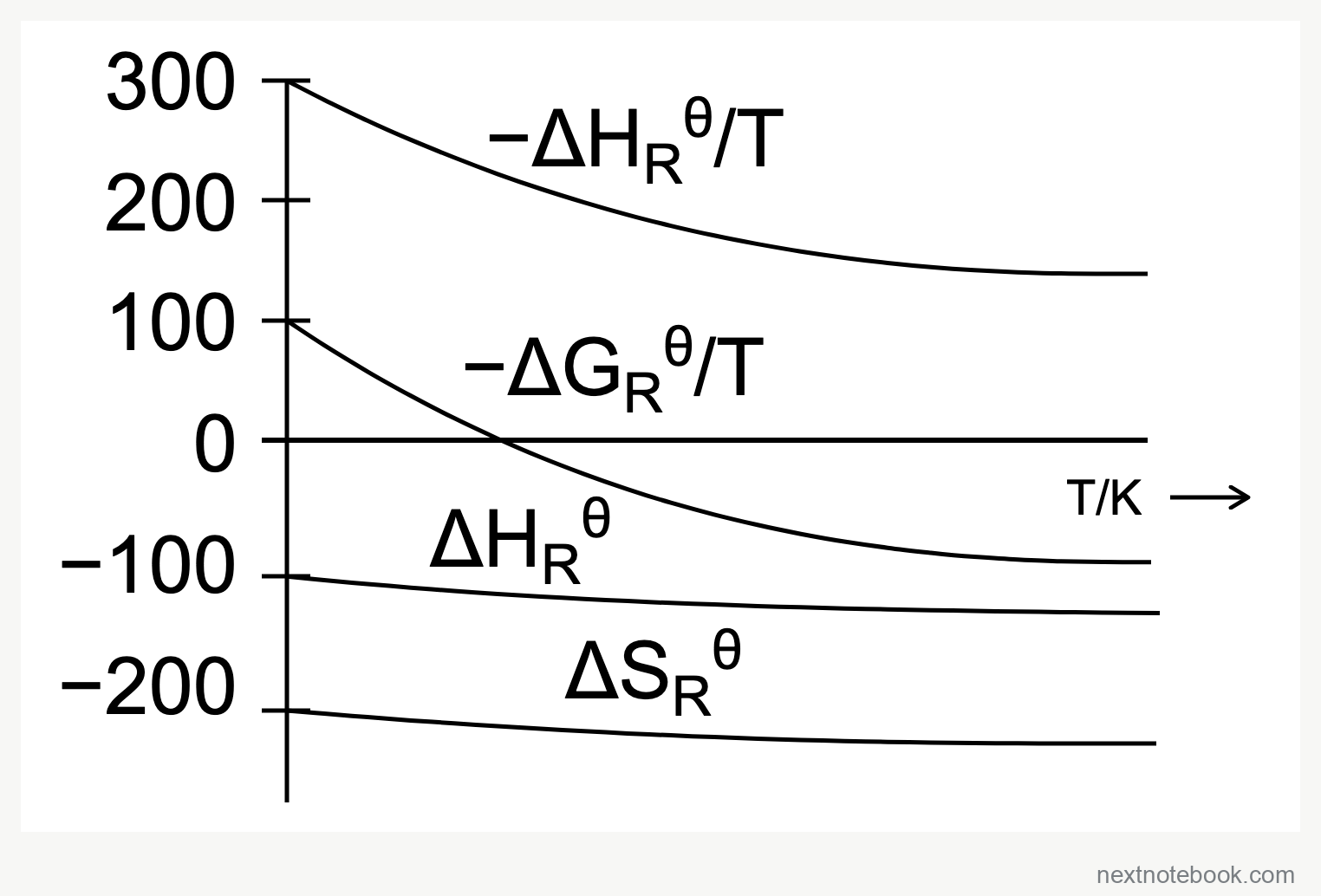
- Q33JEE Main 2025 · 24 Jan · Shift 2kcal kcal The heat of formation of is given by:Tap an option to check.
Show answer
Correct answer: option 1,kcal - Q34JEE Main 2025 · 23 Jan · Shift 1Ice at −5°C is heated to become vapor with temperature of 110°C at atmospheric pressure. The entropy change associated with this process can be obtained fromTap an option to check.
Show answer
Correct answer: option 4,∫268K273K (Cp,m/T)dT + ΔHm,fusion/Tf + ΔHm,vaporisation/Tb + ∫273K373K (Cp,m/T)dT + ∫373K383K (Cp,m/T)dT - Q35JEE Main 2025 · 4 Apr · Shift 1Let us consider a reversible reaction at temperature, T. In this reaction, both ΔH and ΔS were observed to have positive values. If the equilibrium temperature is Te, then the reaction becomes spontaneous at:Tap an option to check.
Show answer
Correct answer: option 4,T > Te - Q36JEE Main 2025 · 4 Apr · Shift 1One mole of an ideal gas expands isothermally and reversibly from 10 dm3 to 20 dm3 at 300 K. ΔU, q and work done in the process respectively are Given: R = 8.3 J K^-1 mol^-1 ln 10= 2.3 log 2 = 0.30 log 3 = 0.48Tap an option to check.
Show answer
Correct answer: option 4,0, 1.718 kJ, −1.718 kJ - Q37JEE Main 2025 · 28 Jan · Shift 2Consider the following data: Heat of formation of Heat of formation of Heat of combustion of benzene The heat of formation of benzene is __________ . (Nearest integer)Tap Show answer to check.
Show answer
Answer: 48 - Q38JEE Main 2025 · 3 Apr · Shift 2A perfect gas (0.1 mol) having (independent of temperature) undergoes the above transformation from point 1 to point 4. If each step is reversible, the total work done (w) while going from point 1 to point 4 is (−) ________ J (nearest integer) [Given: ]
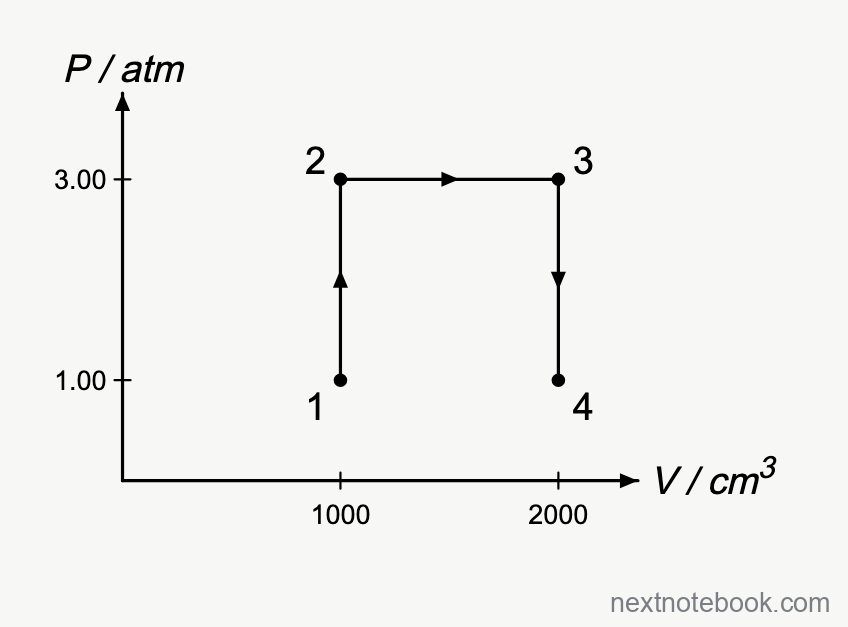 Tap Show answer to check.
Show answer
Answer: 304 - Q39JEE Main 2025 · 23 Jan · Shift 1The standard enthalpy and standard entropy of decomposition of N2O4 to NO2 are 55.0 kJ mol^-1 and 175.0 J/K/mol respectively. The standard free energy change for this reaction at 25°C in J mol^-1 is ____ (Nearest integer)Tap Show answer to check.
Show answer
Answer: 2850 - Q40JEE Main 2025 · 24 Jan · Shift 1Standard entropies of , and are , and respectively. The temperature in Kelvin at which the reactionTap Show answer to check.
Show answer
Answer: 700 - Stuck on one?Log in free
See the step-by-step solution and video for every question, free with login.
- Q41JEE Main 2025 · 3 Apr · Shift 2A sample of n–octane () was completely burnt in excess of oxygen in a bomb calorimeter, whose heat capacity is . As a result of combustion reaction, the temperature of the calorimeter is increased by . The magnitude of the heat of combustion of octane at constant volume is __________ (nearest integer).Tap Show answer to check.
Show answer
Answer: 2500 - Q42JEE Main 2025 · 22 Jan · Shift 2Consider the following cases of standard enthalpy of reaction (ΔH°r, in kJ mol^−1) C2H6(g) + (7)/(2) O2(g) → 2CO2(g) + 3H2O(l) ΔH°1 = −1550 C(graphite) + O2(g) → CO2(g) ΔH°2 = −393.5 H2(g) + (1)/(2) O2(g) → H2O(l) ΔH°3 = −286 The magnitude of ΔH°f C2H6(g) is ________ kJ mol^−1 (Nearest integer).Tap Show answer to check.
Show answer
Answer: 95 - Q43JEE Main 2024 · 29 Jan · Shift 1Which of the following is not correct?Tap an option to check.
Show answer
Correct answer: option 3,is positive for a spontaneous reaction - Q44JEE Main 2024 · 1 Feb · Shift 1*79. Choose the correct option for free expansion of an ideal gas under adiabatic condition from the following:Tap an option to check.
Show answer
Correct answer: option 4, - Q45JEE Main 2024 · 5 Apr · Shift 1Given below are two statements: One is labelled as Assertion (A) and the other is labelled as
Reason (R):
Assertion (A): Enthalpy of neutralization of strong monobasic acid with strong monoacidic base is always
Reason (R): Enthalpy of neutralization is the amount of heat liberated when one mole of ions furnished by acid combine with one mole of ions furnished by base to form one mole of water.Tap an option to check.Show answer
Correct answer: option 2,Both (A) and (R) are true but (R) is the correct explanation of (A) - Q46JEE Main 2024 · 8 Apr · Shift 2for water is at and . Change in internal energy for this vapourisation under same condition is ________ . (Integer answer) (Given )Tap Show answer to check.
Show answer
Answer: 38 - Q47JEE Main 2024 · 9 Apr · Shift 1When equal volume of and are separately neutralisd by excess volume of solution, and of heat is liberated respectively. The value of is________Tap Show answer to check.
Show answer
Answer: 2 - Q48JEE Main 2024 · 5 Apr · Shift 2Combustion of mole of benzene is expressed as The standard enthalpy of combustion of mol of benzene is kJ. . Given: 1. Standard Enthalpy of formation of mol of , for the reaction (graphite) is . 2. Standard Enthalpy of formation of mol of , for the reaction (graphite) is 3. Standard and Enthalpy of formation of mol of for the reaction is .Tap Show answer to check.
Show answer
Answer: 6535 - Q49JEE Main 2024 · 29 Jan · Shift 2Standard enthalpy of vapourisation for is . Heat required for vapourisation of of at constant temperature is............... . (Given molar mass in : , )Tap Show answer to check.
Show answer
Answer: 56 - Q50JEE Main 2024 · 9 Apr · Shift 1The heat of solution of anhydrous and are and respectively. The heat of hydration of to is . The value of is______ (nearest integer)Tap Show answer to check.
Show answer
Answer: 82 - Stuck on one?Log in free
See the step-by-step solution and video for every question, free with login.
- Q51JEE Main 2024 · 31 Jan · Shift 2If moles of an ideal gas expands from to a volume of at under isothermal and reversible condition then work is . The value iof is____________. (Given )Tap Show answer to check.
Show answer
Answer: 28721 - Q52JEE Main 2024 · 30 Jan · Shift 2Two reaction are given below The enthalpy change for following reaction is ____________ .Tap Show answer to check.
Show answer
Answer: 492 - Q53JEE Main 2024 · 30 Jan · Shift 1An ideal gas undergoes a cyclic transformation starting from the point and coming back to the same point by tracing the path as shown in the diagram above. The total work done in the process is ____________
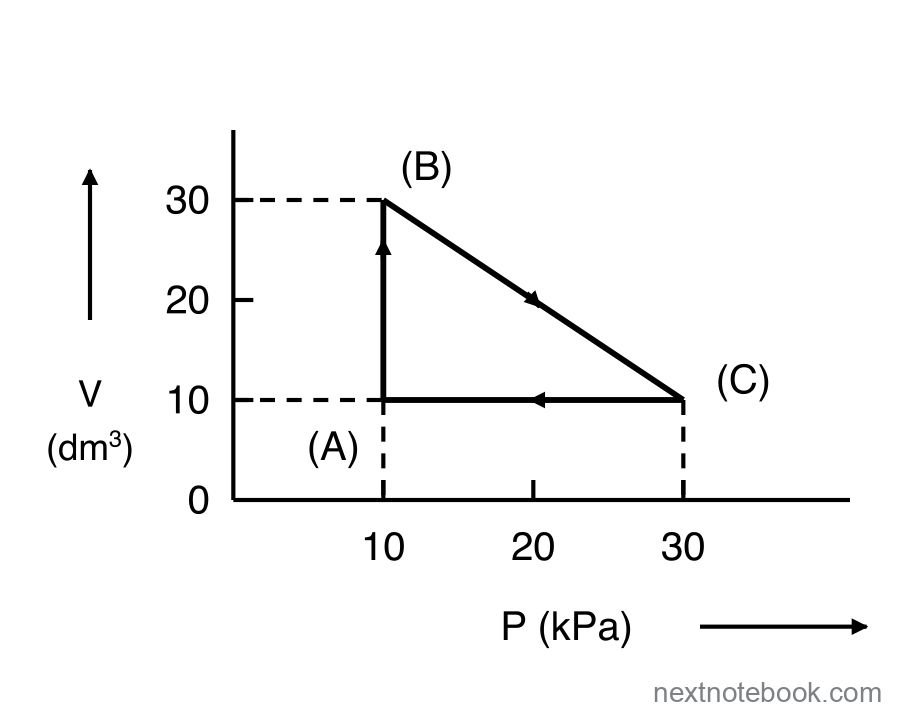 Tap Show answer to check.
Show answer
Answer: 200 - Q54JEE Main 2024 · 5 Apr · Shift 1The heat of combustion of solid benzoic acid at constant volume is at . The heat of combustion of constant pressure is , the value of is______.Tap Show answer to check.
Show answer
Answer: 150 - Q55JEE Main 2024 · 6 Apr · Shift 1An ideal gas , is expanded adiabatically against a constant pressure of until it doubles in volume. If the initial temperature and pressure is and respectively then the final temperature is ________ (nearest integer)Tap Show answer to check.
Show answer
Answer: 274 - Q56JEE Main 2024 · 9 Apr · Shift 2When and , then the temperature of vapour, at one atmosphere is __________.Tap Show answer to check.
Show answer
Answer: 400 - Q57JEE Main 2024 · 8 Apr · Shift 1A cylinder fitted with a piston is shown with two piston positions and . The volume of the cylinder below position is , and the volume between positions and is . of an ideal gas is kept in the cylinder at the position , at . If the piston is moved to position , keeping the temperature unchanged, then work is done in this reversible process. = __________ . (nearest integer) [Given: absolute temperature = , ]Tap Show answer to check.
Show answer
Answer: 55 - Q58JEE Main 2024 · 6 Apr · Shift 2For the reaction at , , and . The reaction will become spontaneous above ____ .Tap Show answer to check.
Show answer
Answer: 2000 - Q59JEE Main 2023 · 30 Jan · Shift 1When litre of ideal gas expands isothermally into vacuum to a total volume of litre, the change in internal energy is ____________J. (Nearest integer)Tap Show answer to check.
Show answer
Answer: 0 - Q60JEE Main 2023 · 24 Jan · Shift 2The number of statement/s, which are correct with respect to the compression of carbon dioxide from point in the Andrews isotherm from the following is __________. A. Carbon dioxide remains as a gas upto point B. Liquid carbon dioxide appears at point C. Liquid and gaseous carbon dioxide coexist between points and D. As the volume decreases from to , the amount of liquid decreases
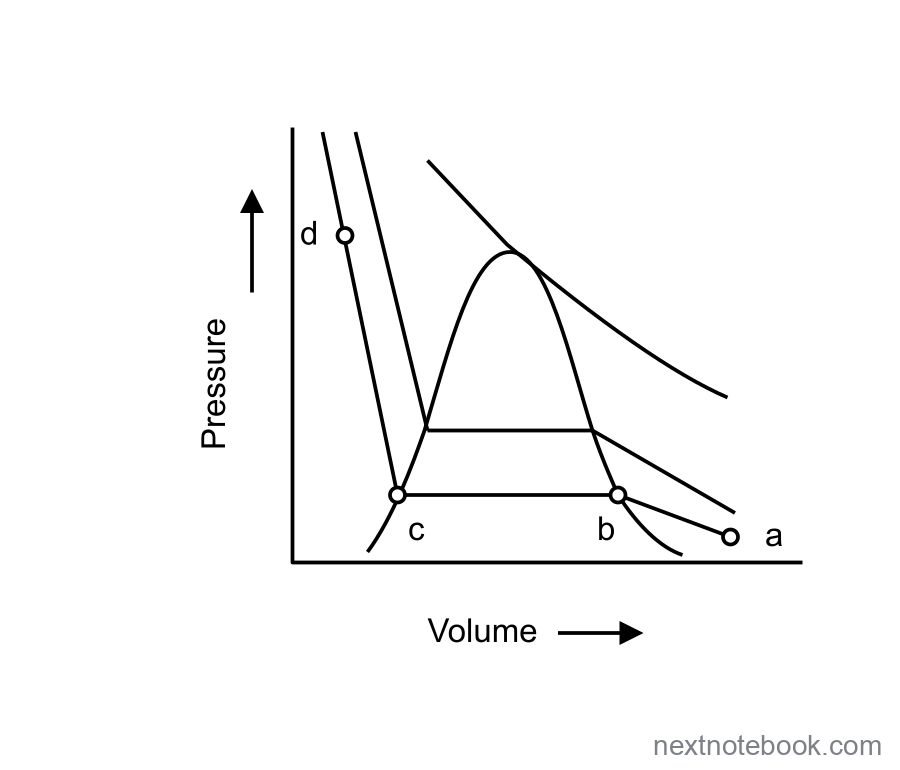 Tap Show answer to check.
Show answer
Answer: 2
Showing 60 of 198 questions. The rest are free after login.
Practise Thermochemistry: reaction enthalpy and Hess’s law first. Solutions and video answers are free.