#3 OF 28 IN PHYSICS
Ray Optics and Optical Instruments NEET PYQs (2012–2025) with answers
40 questions across 14 NEET years, about 3 a paper (≈10 marks). The topics asked most are Optical instruments and Prisms, deviation and dispersion.
- 100% of papers
- ≈10 marks a paper
- Class 12 · Ch 9
From official NTA papers · Updated 9 Nov 2026
What's asked most
- Optical instruments24%Astronomical telescopes, reflecting and refracting, and their magnifying powers · Camera and defects of the eye
- Prisms, deviation and dispersion23%Ray path through a prism and deviation · Minimum deviation and refractive index of a prism
- Refraction by lenses and optical combinations17%Combination of thin lenses in contact · Cutting of lenses
- Refraction at plane surfaces and total internal reflection14%Critical angle, total internal reflection and applications · Total internal reflection in nature and technology
- Experimental skills in ray optics13%Measure focal length of convex and concave mirrors and a convex lens by parallax · Measure focal length of a concave mirror and convex lens by the u-v method
See all 7 topics
- Reflection of light and spherical mirrors6%Mirror focal length and focal length of spherical mirrors · Mirror equation and graphs
- Refraction at spherical surfaces2%Refraction at single and double spherical surfaces · Linear magnification at a spherical refracting surface
How often it comes
See as a table
| Year | Questions |
|---|---|
| 2025 | 2 |
| 2024 | 2 |
| 2023 | 3 |
| 2022 | 3 |
| 2021 | 4 |
| 2020 | 1 |
| 2019 | 3 |
| 2018 | 3 |
| 2017 | 6 |
| 2016 | 3 |
| 2015 | 2 |
| 2014 | 2 |
| 2013 | 2 |
| 2012 | 4 |
Where it fits
SYLLABUSNEET Physics syllabusWEIGHTAGE#3 of 28 Physics chaptersNCERTClass 12 Physics NCERT, Chapter 9
Questions here often join up with
All 40 questions
- Q1NEET 2025A microscope has an objective of focal length , eyepiece of focal length and the tube length of . If the distance of distinct vision of eye is , the magnification in the microscope isTap an option to check.
Show answer
Correct answer: option 2, - Q2NEET 2025In a certain camera, a combination of four similar thin convex lenses are arranged axially in contact. Then the power of the combination and the total magnification in comparison to the power and magnification for each lens will be, respectivelyTap an option to check.
Show answer
Correct answer: option 3,and - Q3NEET 2024A light ray enters through a right angled prism at point with the angle of incidence as shown in figure. It travels through the prism parallel to its base and emerges along the face . The refractive index of the prism is:
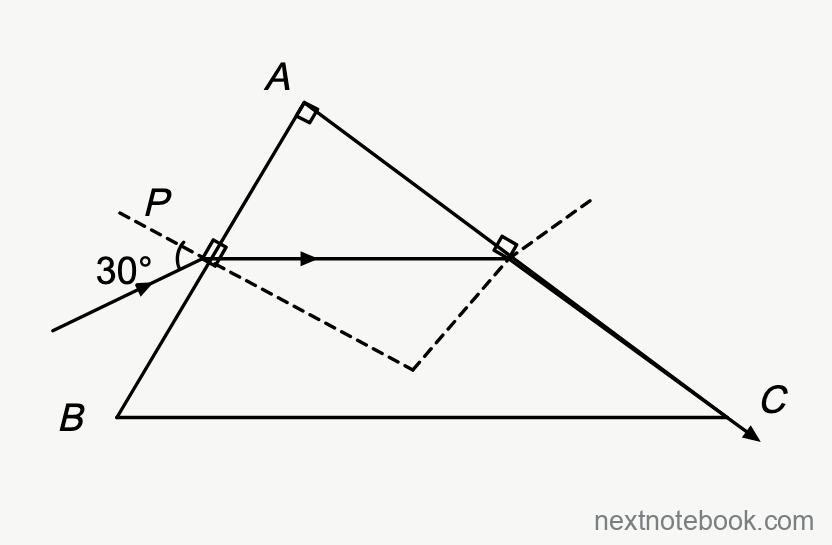 Tap an option to check.
Show answer
Correct answer: option 4, - Q4NEET 2024A small telescope has an objective of focal length and an eye piece of focal length . The magnifying power of telescope for viewing a distant object is:Tap an option to check.
Show answer
Correct answer: option 4, - Q5NEET 2023Light travels a distance in time in air and in time in another denser medium. What is the critical angle for this medium?Tap an option to check.
Show answer
Correct answer: option 4, - Q6NEET 2023Two thin lenses are of same focal lengths (), but one is convex and the other one is concave. When they are placed in contact with each other, the equivalent focal length of the combination will beTap an option to check.
Show answer
Correct answer: option 4,Infinite - Q7NEET 2023In the figure shown here, what is the equivalent focal length of the combination of lenses (Assume that all layers are thin)?
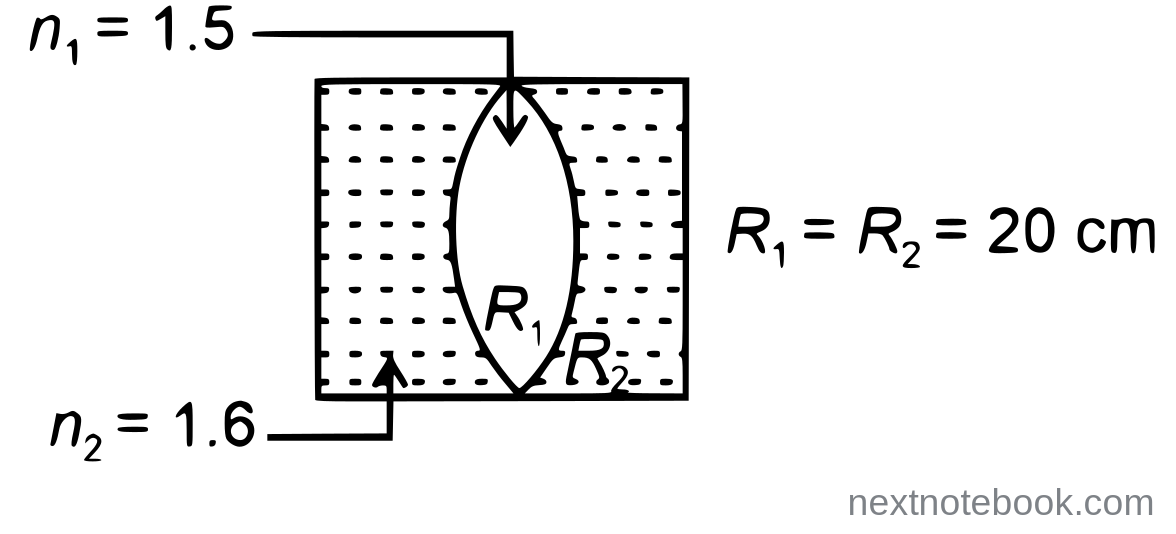 Tap an option to check.
Show answer
Correct answer: option 3, - Q8NEET 2022A biconvex lens has radii of curvature, each. If the refractive index of the material of the lens is , the power of the lens isTap an option to check.
Show answer
Correct answer: option 4, - Q9NEET 2022A light ray falls on a glass surface of refractive index , at an angle . The angle between the refracted and reflected rays would beTap an option to check.
Show answer
Correct answer: option 4, - Q10NEET 2022Two transparent media and are separated by a plane boundary. The speed of light in those media are and , respectively. The critical angle for a ray of light for these two media isTap an option to check.
Show answer
Correct answer: option 3,
Show the other 30 questions
- Q11NEET 2021Find the value of the angle of emergence from the prism. Refractive index of the glass is .
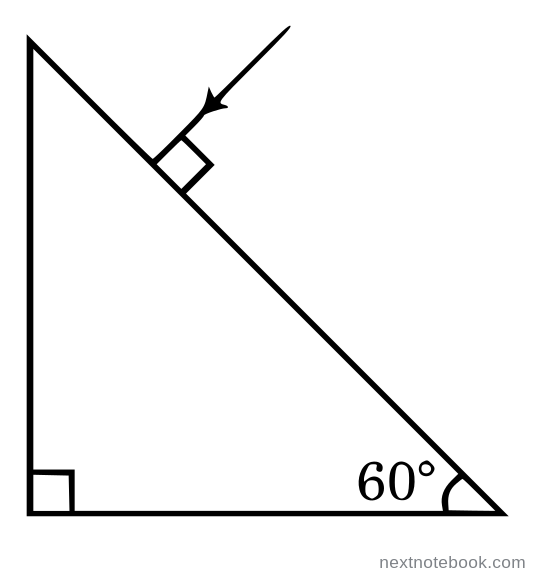 Tap an option to check.
Show answer
Correct answer: option 2, - Q12NEET 2021A lens of large focal length and large aperture is best suited as an objective of an astronomical telescope since:Tap an option to check.
Show answer
Correct answer: option 4,all of the above. - Q13NEET 2021A convex lens ‘A’ of focal length and a concave lens ‘B’ of focal length are kept along the same axis with a distance ‘’ between them. If a parallel beam of light falling on ‘A’ leaves ‘B’ as a parallel beam, then the distance ‘’ in will be:Tap an option to check.
Show answer
Correct answer: option 3,15 - Q14NEET 2021A point object is placed at a distance of from a convex lens of focal length . If a plane mirror were put perpendicular to the principal axis of the lens and at a distance of from it, the final image would be formed at a distance of: [figure]
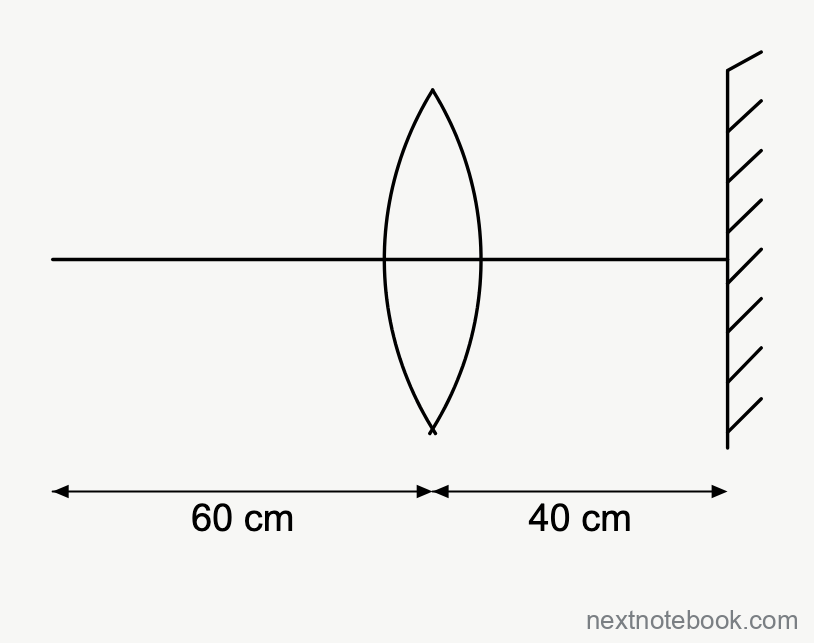 Tap an option to check.
Show answer
Correct answer: option 1,from the plane mirror, it would be a virtual image. - Q15NEET 2020A ray is incident at an angle of incidence on one surface of a small angle prism (with angle of prism ) and emerges normally from the opposite surface. If the refractive index of the material of the prism is , then the angle of incidence is nearly equal to:Tap an option to check.
Show answer
Correct answer: option 1, - Q16NEET 2019Two similar thin equi-convex lenses, of focal length each, are kept coaxially in contact with each other such that the focal length of the combination is . When the space between the two lenses is filled with glycerine (which has the same refractive index as that of glass) then the equivalent focal length is . The ratio will be:Tap an option to check.
Show answer
Correct answer: option 2, - Q17NEET 2019Pick the wrong answer in the context with rainbow.Tap an option to check.
Show answer
Correct answer: option 3,An observer can see a rainbow when his front is towards the sun - Q18NEET 2019In total internal reflection when the angle of incidence is equal to the critical angle for the pair of media in contact, what will be angle of refraction?Tap an option to check.
Show answer
Correct answer: option 4, - Q19NEET 2018The refractive index of the material of a prism is and the angle of the prism is . One of the two refracting surfaces of the prism is made a mirror inwards, by silver coating. A beam of monochromatic light entering the prism from the other face will retrace its path (after reflection from the silvered surface) if its angle of incidence on the prism isTap an option to check.
Show answer
Correct answer: option 1, - Q20NEET 2018An object is placed at a distance of from a concave mirror of focal length . If the object is displaced through a distance of towards the mirror, the displacement of the image will beTap an option to check.
Show answer
Correct answer: option 1,away from the mirror - Stuck on one?Log in free
See the step-by-step solution and video for every question, free with login.
- Q21NEET 2018An astronomical refracting telescope will have large angular magnification and high angular resolution, when it has an objective lens ofTap an option to check.
Show answer
Correct answer: option 2,Large focal length and large diameter - Q22NEET 2017 · Code YIf the angle of a prism is and angle of minimum deviation is , then the angle of refraction will beTap an option to check.
Show answer
Correct answer: option 2, - Q23NEET 2017 · Code YA person has near point at . The focal length of spectacles lenses to read at having glasses separated from the eyes, is:Tap an option to check.
Show answer
Correct answer: option 4, - Q24NEET 2017 · Code YA light beam is incident on a denser medium whose refractive index is at an angle of incidence . Find the ratio of width of refracted beam in a medium to the width of the incident beam in air.Tap an option to check.
Show answer
Correct answer: option 1, - Q25NEET 2017 · Code ASA thin prism having refracting angle is made of glass of refractive index . This prism is combined with another thin prism of glass of refractive index . This combination produces dispersion without deviation. The refracting angle of second prism should beTap an option to check.
Show answer
Correct answer: option 2, - Q26NEET 2017 · Code ASA beam of light from a source L is incident normally on a plane mirror fixed at a certain distance from the source. The beam is reflected back as a spot on a scale placed just above the source L. When the mirror is rotated through a small angle , the spot of the light is found to move through a distance on the scale. The angle is given byTap an option to check.
Show answer
Correct answer: option 1, - Q27NEET 2017 · Code ASThe ratio of resolving powers of an optical microscope for two wavelengths and isTap an option to check.
Show answer
Correct answer: option 3, - Q28NEET 2016 · Code ASTwo identical glass () equiconvex lenses of focal length each are kept in contact. The space between the two lenses is filled with water (). The focal length of the combination isTap an option to check.
Show answer
Correct answer: option 2, - Q29NEET 2016 · Code ASAn air bubble in a glass slab with refractive index (near normal incidence) is cm deep when viewed from one surface and cm deep when viewed from the opposite face. The thickness (in cm) of the slab isTap an option to check.
Show answer
Correct answer: option 1, - Q30NEET 2016 · Code ASA person can see clearly objects only when they lie between and from his eyes. In order to increase the maximum distance of distinct vision to , the type and power of the correcting lens, the person has to use, will beTap an option to check.
Show answer
Correct answer: option 4,Concave, - Stuck on one?Log in free
See the step-by-step solution and video for every question, free with login.
- Q31AIPMT 2015A beam of light consisting of red, green and blue colours is incident on a right angled prism. The refractive index of the material of the prism for the above red, green and blue wavelengths are 1.39, 1.44 and 1.47, respectively.
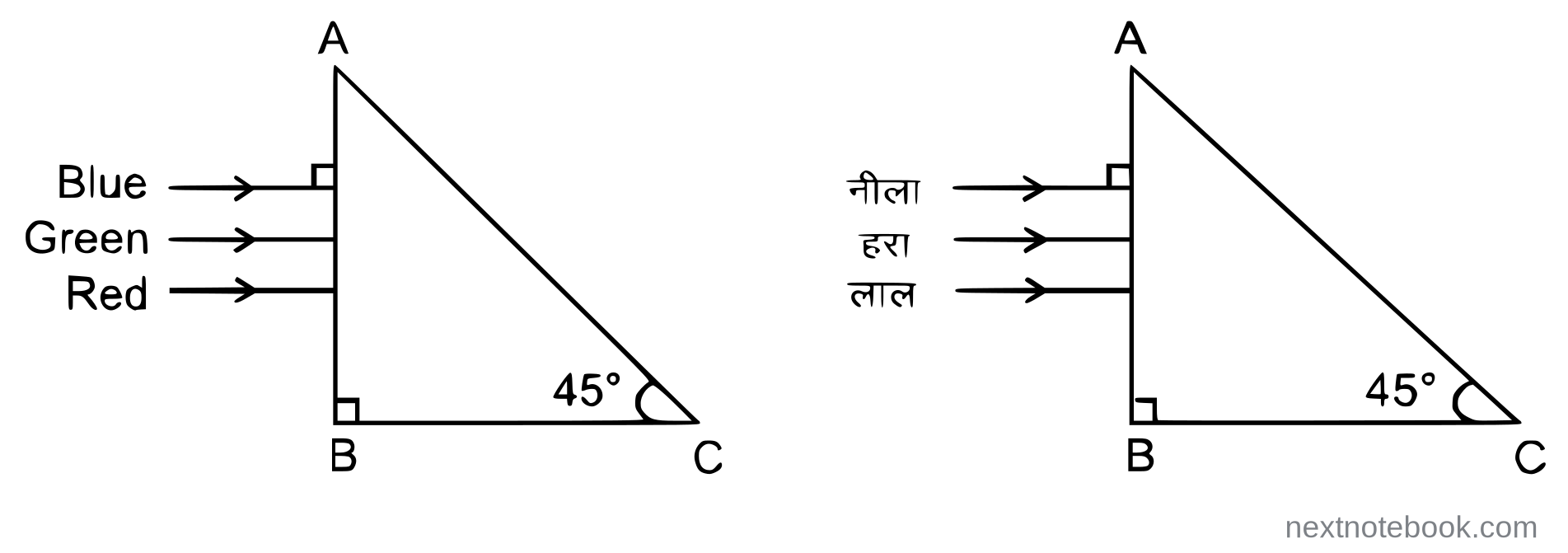 Tap an option to check.
Show answer
Correct answer: option 3,separate the red colour part from the green and blue colours - Q32AIPMT 2015In an astronomical telescope in normal adjustment a straight black line of length is drawn on inside part of objective lens. The eye-piece forms a real image of this line. The length of this image is . The magnification of the telescope is:Tap an option to check.
Show answer
Correct answer: option 3, - Q33AIPMT 2014If the focal length of objective lens is increased then magnifying power ofTap an option to check.
Show answer
Correct answer: option 4,microscope will decrease but that of telescope will increase. - Q34AIPMT 2014The angle of a prism is ''. One of its refracting surfaces is silvered. Light rays falling at an angle of incidence on the first surface returns back through the same path after suffering reflection at the silvered surface. The refractive index , of the prism isTap an option to check.
Show answer
Correct answer: option 2, - Q35NEET 2013 · Code ASA plano-convex lens fits exactly into a plano-concave lens. Their plane surfaces are parallel to each other. If lenses are made of different materials of refractive indices and and is the radius of curvature of the curved surface of the lenses, then the focal length of the combination isTap an option to check.
Show answer
Correct answer: option 3, - Q36NEET 2013For a normal eye, the cornea of eye provides a converging power of and the least converging power of the eye lens behind the cornea is . Using this information, the distance between the retina and the cornea - eye lens can be estimated to beTap an option to check.
Show answer
Correct answer: option 3, - Q37AIPMT 2012When a biconvex lens of glass having refractive index is dipped in a liquid, it acts as a plane sheet of glass. This implies that the liquid must have refractive index.Tap an option to check.
Show answer
Correct answer: option 1,equal to that of glass - Q38AIPMT 2012A ray of light is incident at an angle of incidence, , on one face of prism of angle (assumed to be small) and emerges normally from the opposite face. If the refractive index of the prism is , the angle of incidence , is nearly equal to:Tap an option to check.
Show answer
Correct answer: option 1, - Q39AIPMT 2012A concave mirror of focal length is placed at a distance of from a convex lens of focal length A beam of light coming from infinity and falling on this convex lens – concave mirror combination returns to infinity. The distance must equal:Tap an option to check.
Show answer
Correct answer: option 3, - Q40AIPMT 2012The magnifying power of a telescope is . When it is adjusted for parallel rays the distance between the objective and eyepiece is . The focal length of lenses are:Tap an option to check.
Show answer
Correct answer: option 3,
Practise Optical instruments first. Solutions and video answers are free.