#16 OF 28 IN PHYSICS
Waves NEET PYQs (2012–2025) with answers
24 questions across 11 NEET years, about 1 a paper (≈6 marks). The topics asked most are Additional sound-wave applications and mixed problems and Vibrations of air columns and resonance.
- 79% of papers
- ≈6 marks a paper
- Class 11 · Ch 14
From official NTA papers · Updated 9 Nov 2026
What's asked most
- Additional sound-wave applications and mixed problems26%General mixed problems on sound waves · Pressure-wave equation
- Vibrations of air columns and resonance18%Resonance tube and resonance-column determination of sound speed · Standing waves and harmonics in an open organ pipe
- Vibrating strings and sonometer15%Sonometer and laws of transverse vibrations of a string · Standing waves and normal modes in strings fixed at both ends
- Standing waves and normal modes13%Formation and equation of standing waves · Nodes, antinodes, and properties of standing waves
- Beats8%Beat formation, beat frequency, and beat period
See all 8 topics
- Wave speed in strings and sound-producing media8%Transverse-wave speed on a stretched string · Speed of a longitudinal wave and sound
- Energy, power, and sound characteristics7%Sound intensity, intensity level, and loudness · Characteristics of sound: pitch, loudness, and quality
- Progressive waves and their mathematical description7%Sinusoidal progressive-wave equation and direction of propagation · Relation between wave speed, wavelength, and frequency
How often it comes
See as a table
| Year | Questions |
|---|---|
| 2025 | 1 |
| 2023 | 1 |
| 2022 | 1 |
| 2020 | 1 |
| 2018 | 2 |
| 2017 | 5 |
| 2016 | 2 |
| 2015 | 3 |
| 2014 | 3 |
| 2013 | 3 |
| 2012 | 2 |
Where it fits
SYLLABUSNEET Physics syllabusWEIGHTAGE#16 of 28 Physics chaptersNCERTClass 11 Physics NCERT, Chapter 14
Questions here often join up with

All 24 questions
- Q1NEET 2025A pipe open at both ends has a fundamental frequency in air. The pipe is now dipped vertically in a water drum to half of its length. The fundamental frequency of the air column is now equal to:Tap an option to check.
Show answer
Correct answer: option 2, - Q2NEET 2023The ratio of frequencies of fundamental harmonic produced by an open pipe to that of closed pipe having the same length isTap an option to check.
Show answer
Correct answer: option 2, - Q3NEET 2022If the initial tension on a stretched string is doubled, then the ratio of the initial and final speeds of a transverse wave along the string isTap an option to check.
Show answer
Correct answer: option 4, - Q4NEET 2020In a guitar, two strings A and B made of same material are slightly out of tune and produce beats of frequency . When tension in B is slightly decreased, the beat frequency increases to . If the frequency of A is , the original frequency of B will be:Tap an option to check.
Show answer
Correct answer: option 4, - Q5NEET 2018The fundamental frequency in an open organ pipe is equal to the third harmonic of a closed organ pipe. If the length of the closed organ pipe is , the length of the open organ pipe isTap an option to check.
Show answer
Correct answer: option 3, - Q6NEET 2018A tuning fork is used to produce resonance in a glass tube. The length of the air column in this tube can be adjusted by a variable piston. At room temperature of two successive resonances are produced at and of column length. If the frequency of the tuning fork is , the velocity of sound in air at isTap an option to check.
Show answer
Correct answer: option 1, - Q7NEET 2017 · Code YDue to Doppler effect, the shift in wavelength observed is , for a star producing a wavelength . The velocity of recession of the star will be:Tap an option to check.
Show answer
Correct answer: option 4, - Q8NEET 2017 · Code YA metal rod of length, is dropped exact vertically on to a hard metal floor. With an oscilloscope, it is determined that the impact produces a longitudinal wave of frequency. The speed of sound in the metal rod is:Tap an option to check.
Show answer
Correct answer: option 2, - Q9NEET 2017 · Code YTwo open organ pipes of fundamental frequencies and are joined in series. The fundamental frequency of the new pipe so obtained will be:Tap an option to check.
Show answer
Correct answer: option 4, - Q10NEET 2017 · Code ASThe two nearest harmonics of a tube closed at one end and open at other end are and . What is the fundamental frequency of the system?Tap an option to check.
Show answer
Correct answer: option 2,
Show the other 14 questions
- Q11NEET 2017 · Code ASTwo cars moving in opposite directions approach each other with speed of and respectively. The driver of the first car blows a horn having a frequency . The frequency heard by the driver of the second car is [velocity of sound ]Tap an option to check.
Show answer
Correct answer: option 4, - Q12NEET 2016 · Code ASThe second overtone of an open organ pipe has the same frequency as the first overtone of a closed pipe of metre long. The length of the open pipe will beTap an option to check.
Show answer
Correct answer: option 4, - Q13NEET 2016 · Code ASThree sound waves of equal amplitudes have frequencies , , . They superimpose to give beats. The number of beats produced per second will beTap an option to check.
Show answer
Correct answer: option 2, - Q14AIPMT 2015A source of sound emitting waves of frequency and an observer are located at some distance from each other. The source is moving with a speed of at an angle of with the source observer line as shown in the figure. The observer is at rest. The apparent frequency observed by the observer (velocity of sound in air ) is:
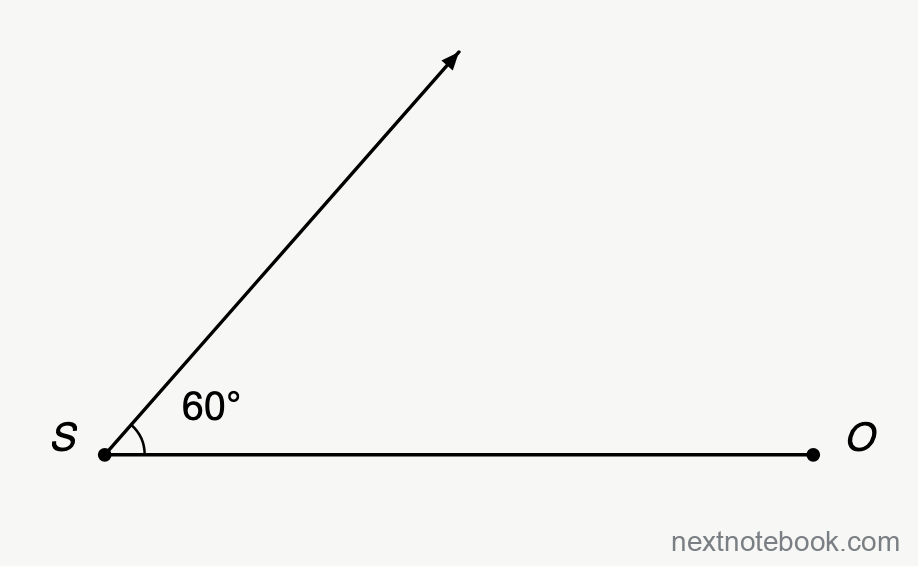 Tap an option to check.
Show answer
Correct answer: option 1, - Q15AIPMT 2015of a gas occupies litres at NTP. The specific heat capacity of the gas at constant volume is . IF the speed of sound in this gas at NTP is , then the heat capacity at constant pressure is (Take gas constant )Tap an option to check.
Show answer
Correct answer: option 4, - Q16AIPMT 2015A string is stretched between fixed points separated by . It is observed to have resonant frequencies of and . There are no other resonant frequencies between these two. The lowest resonant frequency for this string is:Tap an option to check.
Show answer
Correct answer: option 3, - Q17AIPMT 2014If , and are the fundamental frequencies of three segments into which a string is divided, then the original fundamental frequency of the string is given byTap an option to check.
Show answer
Correct answer: option 1, - Q18AIPMT 2014The number of possible natural oscillations of air column in a pipe closed at one end of length whose frequencies lies below are: (velocity of sound )Tap an option to check.
Show answer
Correct answer: option 4, - Q19AIPMT 2014A speeding motorcyclist sees traffic jam ahead of him. He slows down to . He finds that traffic has eased and a car moving ahead of him at is honking at a frequency of . If the speed of sound is , the frequency of the honk as heard by him will beTap an option to check.
Show answer
Correct answer: option 3, - Q20NEET 2013 · Code ASA wave travelling in the +ve -direction having displacement along -direction as , wavelength and frequency of is represented byTap an option to check.
Show answer
Correct answer: option 1, - Stuck on one?Log in free
See the step-by-step solution and video for every question, free with login.
- Q21NEET 2013If we study the vibration of a pipe open at both ends, then the following statement is not trueTap an option to check.
Show answer
Correct answer: option 4,Pressure change will be maximum at both ends - Q22NEET 2013 · Code ASA source of unknown frequency gives beats/s, when sounded with a source of known frequency . The second harmonic of the source of unknown frequency gives five beats per second, when sounded with a source of frequency . The unknown frequency is equal toTap an option to check.
Show answer
Correct answer: option 1, - Q23AIPMT 2012When a string is divided into three segments of length and the fundamental frequencies of these three segments are and respectively. The original fundamental frequency of the string isTap an option to check.
Show answer
Correct answer: option 3, - Q24AIPMT 2012Two sources of sound placed close to each other are emitting progressive waves given by and . An observer located near these two sources of sound will hear:Tap an option to check.
Show answer
Correct answer: option 4,4 beats per second with intensity ratio 81: 1 between waxing and waning
Practise Additional sound-wave applications and mixed problems first. Solutions and video answers are free.