#9 OF 19 IN CHEMISTRY
Amines JEE Main PYQs (2016–2026) with answers
206 questions across 11 JEE Main years, about 1 a paper (≈4 marks). The topics asked most are Diazonium salts and Preparation of amines.
- 79% of papers
- ≈4 marks a paper
- Class 12 · Ch 9
From official NTA papers · Updated 9 Nov 2026
What's asked most
- Diazonium salts28%Synthetic importance and reactions of diazonium salts · Preparation of diazonium salts
- Preparation of amines24%Preparation by ammonolysis of alkyl halides and alcohols · Preparation by Gabriel phthalimide synthesis
- Chemical reactions of amines23%Acylation of amines · Alkylation of amines
- Aniline: preparation and reactions23%Electrophilic substitution and ring substitution in aromatic amines
- Introduction, classification and naming of amines1%Nomenclature of amines
See all 6 topics
- Structure and physical properties of amines1%Physical properties of amines, including aniline
How often it comes
See as a table
| Year | Questions |
|---|---|
| 2026 | 23 |
| 2025 | 15 |
| 2024 | 24 |
| 2023 | 32 |
| 2022 | 24 |
| 2021 | 44 |
| 2020 | 13 |
| 2019 | 26 |
| 2018 | 1 |
| 2017 | 2 |
| 2016 | 2 |
Where it fits
SYLLABUSJEE Main Chemistry syllabusWEIGHTAGE#9 of 19 Chemistry chaptersNCERTClass 12 Chemistry NCERT, Chapter 9
Questions here often join up with
All 206 questions
- Q1JEE Main 2026 · 21 Jan · Shift 1An organic compound () on treatment with aqueous ammonia under hot condition forms compound () which on heating with and forms compound () having molecular formula . Names of , and respectively are.Tap an option to check.
Show answer
Correct answer: option 1,Benzoic acid, benzamide, aniline - Q2JEE Main 2026 · 21 Jan · Shift 2Given below are the sequence of reactions. Consider the above sequence of reactions. The number of bromine atom(s) in the final product will be:
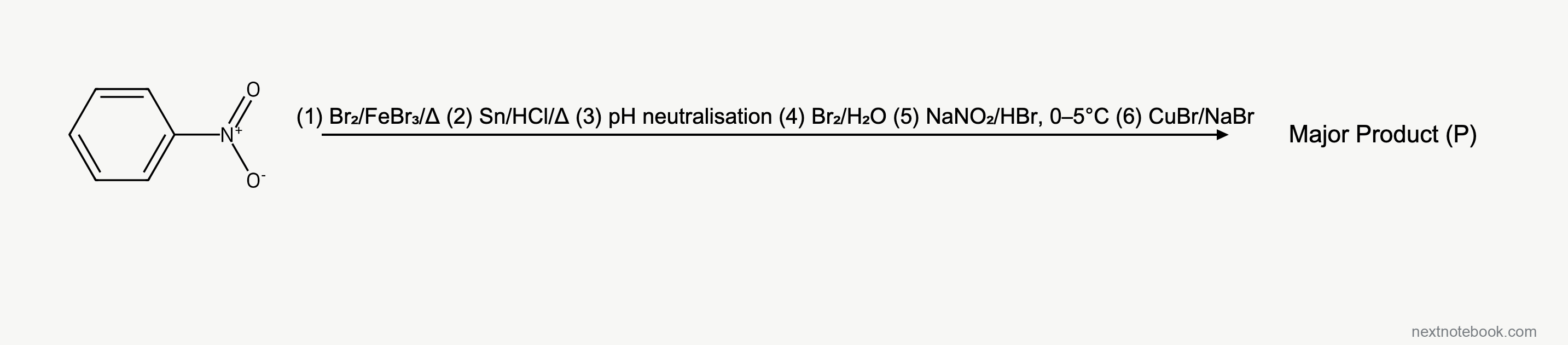 Tap an option to check.
Show answer
Correct answer: option 2, - Q3JEE Main 2026 · 22 Jan · Shift 1A 'p'-block element (E) and hydrogen form a binary cation , while on treatment with in alkaline medium gives a precipitate of basic mercury(II) amido-iodine. Given below are first ionisation enthalpy values for first element each from group 13, 14, 15 and 16. Identify the correct first ionisation enthalpy value for element E.Tap an option to check.
Show answer
Correct answer: option 2, - Q4JEE Main 2026 · 23 Jan · Shift 2Given below are two statements:
Statement I: [chemical structure shown] can be synthesized from [chemical structure shown] using simpler reagents in the order i) Acidic , ii) Ammonia, iii) Bromine and alkali
Statement II: [chemical structure shown] can be converted into [chemical structure shown] using reagents in the order i) Bromine- ii) () (iii) Aq. .
In the light of the above statements, choose the correct answer from the options given below Tap an option to check.
Show answer
Correct answer: option 1,Both Statement I and Statement II are true - Q5JEE Main 2026 · 28 Jan · Shift 2Total number of alkali insoluble solid sulphonamides obtained by reaction of given amines with Hinsberg's reagent is Aniline, N-Methylaniline, Methanamine, N, N - Dimethylmethanamine, N-Methyl methanamine, Phenylmethanamine, N-propylaniline, N-phenylaniline, N, N-Dimethylaniline, Allyl amine, Isopropyl amineTap an option to check.
Show answer
Correct answer: option 2, - Q6JEE Main 2026 · 28 Jan · Shift 1Consider the following reactions giving major product. Identify the correct reaction.Tap an option to check.
Show answer
Correct answer: option 2, - Q7JEE Main 2026 · 23 Jan · Shift 2A student has been given a compound "" of molecular formula . "" is sparingly soluble in water. However, on addition of dilute mineral acid, "" becomes soluble in water. "" when treated with and , "" is produced. "" has a specific unpleasant smell. On treatment with benzenesulphonyl chloride, "" gives a compound "" which is soluble in alkali. The number of different "" atoms present in "" is:Tap an option to check.
Show answer
Correct answer: option 2,7 - Q8JEE Main 2026 · 24 Jan · Shift 2Given below are two statements:
Statement I: The dipole moment of is greater than and can undergo hydrolysis under acidic medium to produce [].
Statement II: hydrolyses under acidic medium to produce a compound which on treatment with followed by the addition of gives another compound (). This compound () on treatment with gives a product, that on treatment with produces
In the light of the above statements, choose the correct answer from the options given below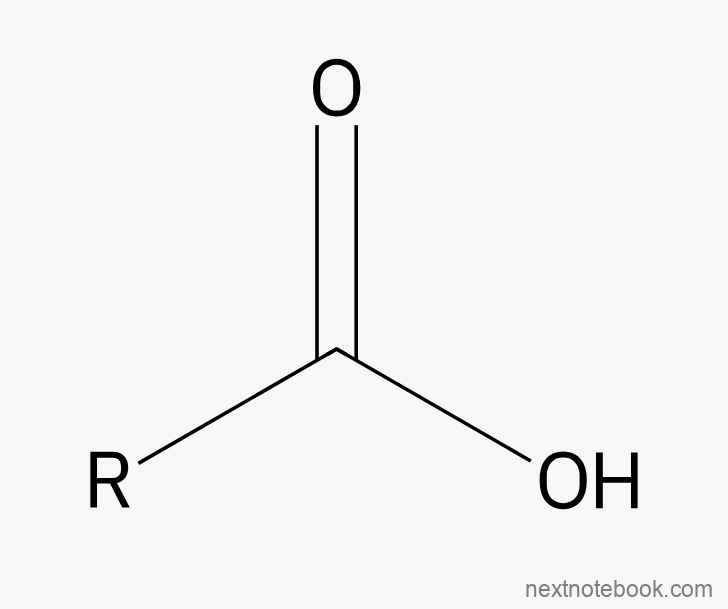 Tap an option to check.
Show answer
Correct answer: option 1,Statement I is false but Statement II is true - Q9JEE Main 2026 · 22 Jan · Shift 2[A] [B]. The final product [B] is:
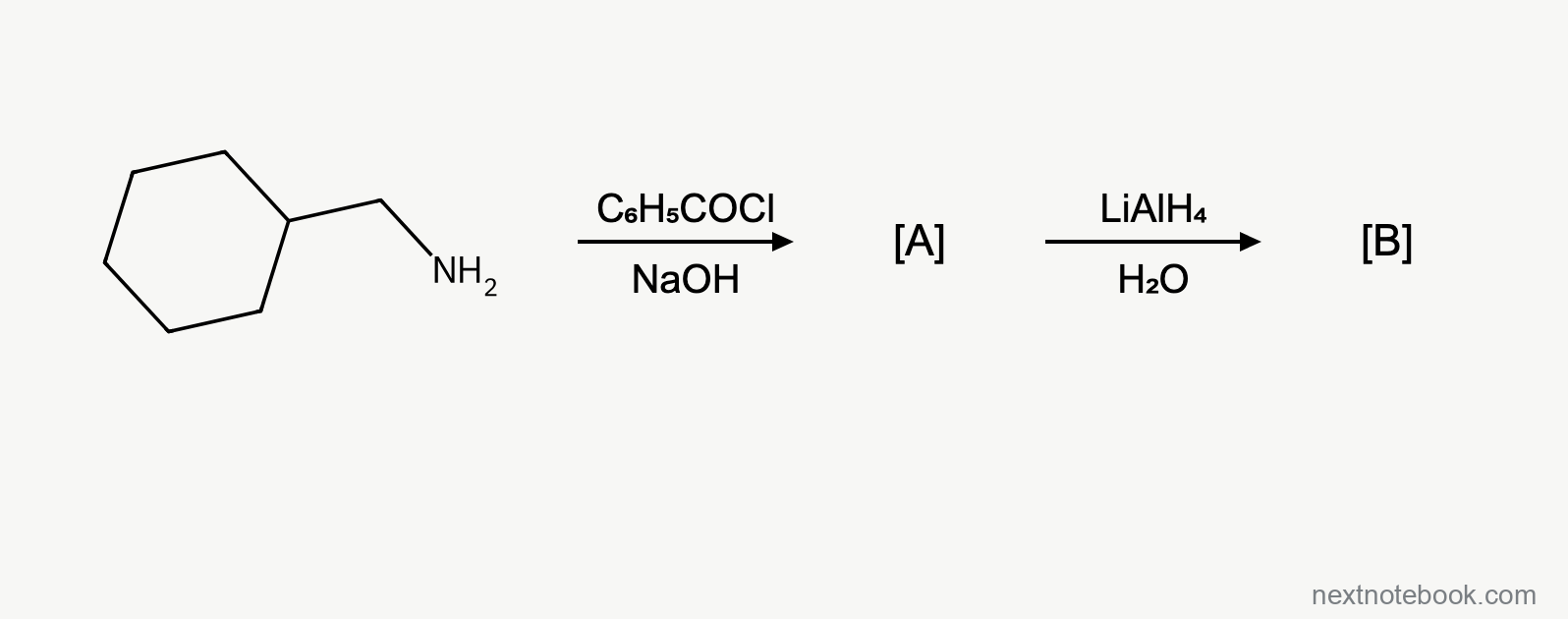 Tap an option to check.
Show answer
Correct answer: option 2,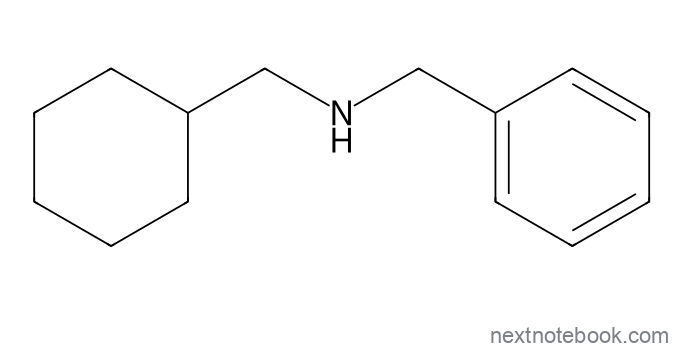
- Q10JEE Main 2026 · 23 Jan · Shift 1Compound 'P' undergoes the following sequence of reactions: 'P' is:
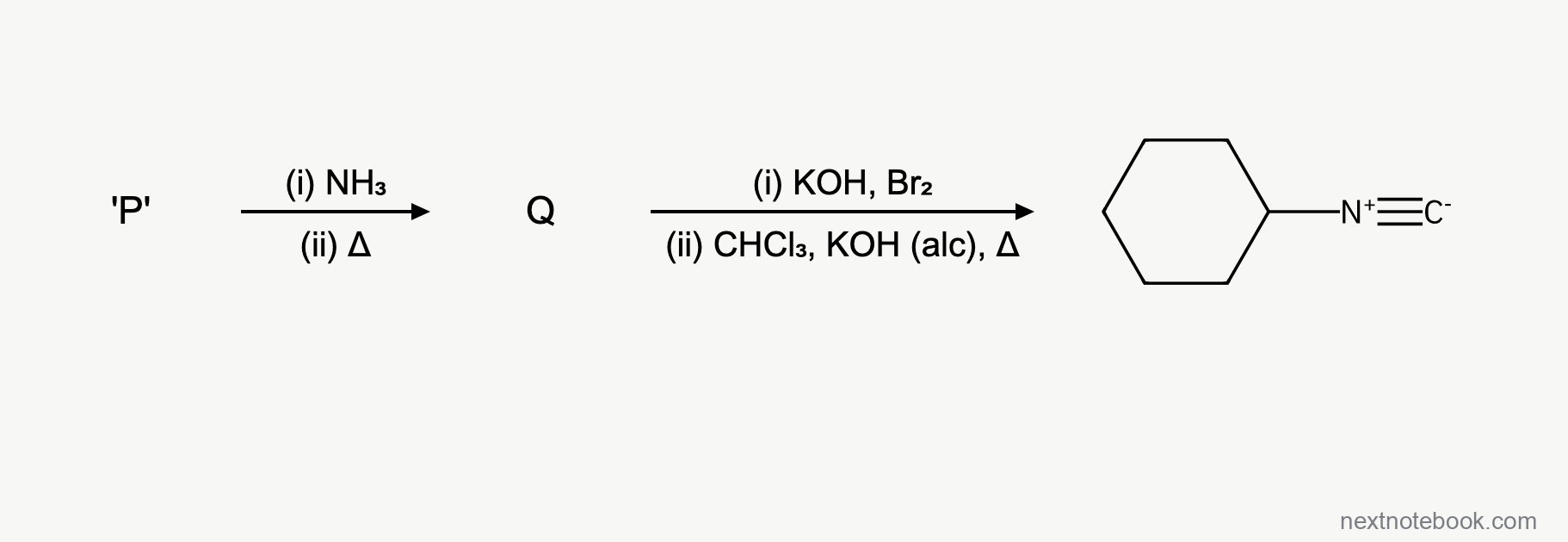 Tap an option to check.
Show answer
Correct answer: option 4,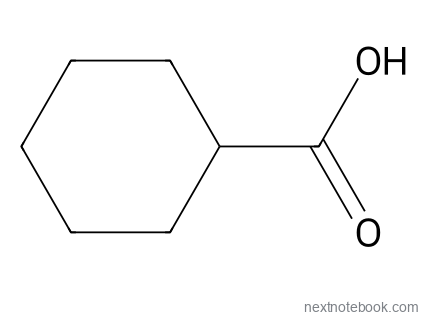
Show the other 50 questions
- Q11JEE Main 2026 · 22 Jan · Shift 1' A ' is a neutral organic compound (M.F: ). On treatment with aqueous , ' A ' forms a compound ' B ' which is soluble in dilute acid. ' B ' on treatment with aqueous produces a compound ' C ' which on treatment with produces ' D '. Hydrolysis of ' D ' produces ' E ' which is also obtainable from the hydrolysis of ' A '. ' E ' on treatment with acidified produces ' F '. ' F ' contains two different types of hydrogen atoms. The structure of ' A ' isTap an option to check.
Show answer
Correct answer: option 4, - Q12JEE Main 2026 · 28 Jan · Shift 1Given below are two statements:
Statement I: Griss-Ilosvay test is used for the detection of nitrite ion, which involves the use of sulphanilic acid and -naphthylamine reagent.
Statement II: In the above test, sulphanilic acid is diazotized by the acidified nitrite ion, which on further coupling with -naphthylamine forms an azo-dye.
In the light of the above statements, choose the correct answer from the options given below.Tap an option to check.Show answer
Correct answer: option 2,Both Statement I and Statement II are true - Q13JEE Main 2026 · 5 Apr · Shift 2Given below are two statements:
Statement I: Heating benzamide with bromine in an ethanolic solution of sodium hydroxide will give benzylamine.
Statement II: Nitration of aniline with at produces -nitroaniline in higher amount than -nitroaniline ( adjusted).
In the light of the above statements, choose the correct answer from the options given below:Tap an option to check.Show answer
Correct answer: option 4,Statement I is false but Statement II is true - Q14JEE Main 2026 · 4 Apr · Shift 1Product C of the following reaction sequence will be
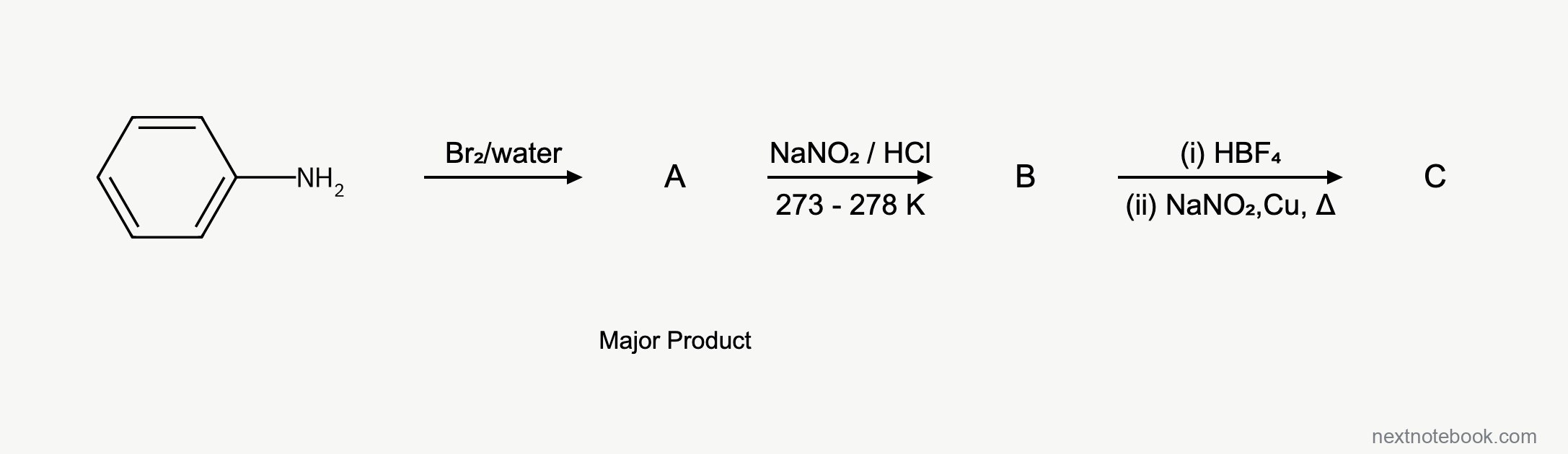 Tap an option to check.
Show answer
Correct answer: option 2,1, 3, 5-Tribromo-2-nitrobenzene - Q15JEE Main 2026 · 6 Apr · Shift 2Consider the following organic reaction sequence. Choose the final product from the following (consider the major product in all intermediate reactions) Major Product
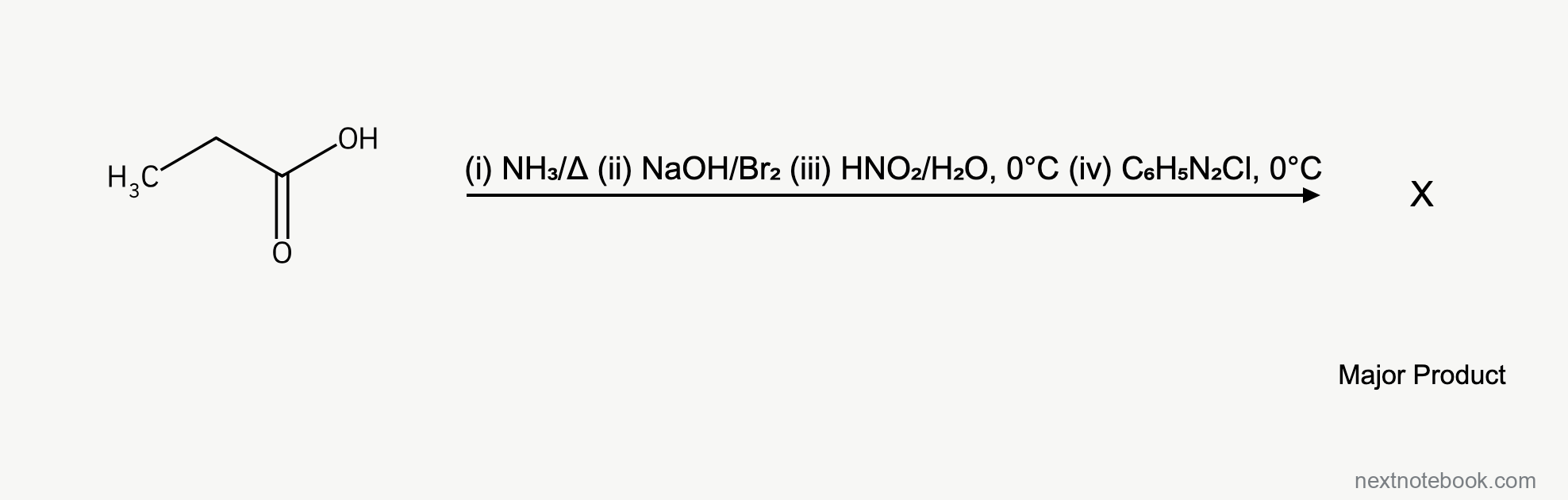 Tap an option to check.
Show answer
Correct answer: option 1,Benzene - Q16JEE Main 2026 · 4 Apr · Shift 2The strongest conjugate acid will result from:Tap an option to check.
Show answer
Correct answer: option 3,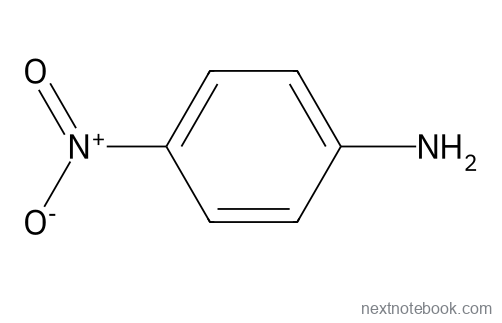
- Q17JEE Main 2026 · 8 Apr · Shift 2Which statements are True? A. In Hoffmann bromamide degradation, 4 moles of and 2 moles of are consumed per mole of an amide B. Hoffmann bromamide reaction is not given by alkyl amides. C. Primary amines can be synthesized by Hoffmann bromamide degradation. D. Secondary amide on reaction with and will give secondary amine. E. The by-products of Hoffmann degradation are , and . Choose the correct answer from the options given below:Tap an option to check.
Show answer
Correct answer: option 3,C and E only - Q18JEE Main 2026 · 2 Apr · Shift 2Identify compounds A and E in the following reaction sequence. 1-Ethyl-4-nitrobenzeneTap an option to check.
Show answer
Correct answer: option 2,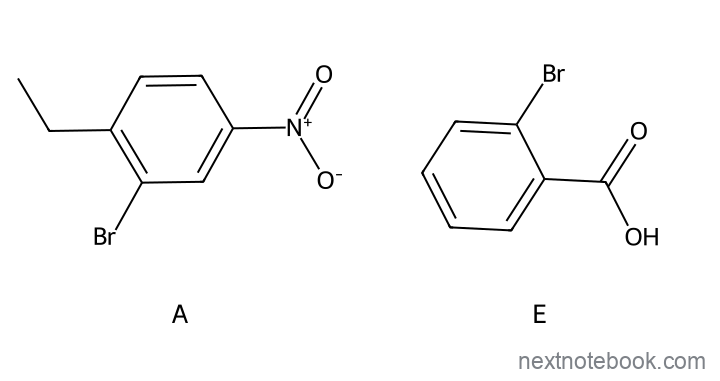
- Q19JEE Main 2026 · 5 Apr · Shift 1Identify the incorrect statements. A. Benzylamine, , is a stronger base than aniline, . B. -Methoxyaniline (-anisidine), -, can be synthesized by Gabriel phthalimide synthesis. C. Phenylacetamide, , primary aromatic amine. D. -Nitroaniline, -, product will dissolve in . (The structures are drawn in the figure.) Choose the correct answer from the options given below:
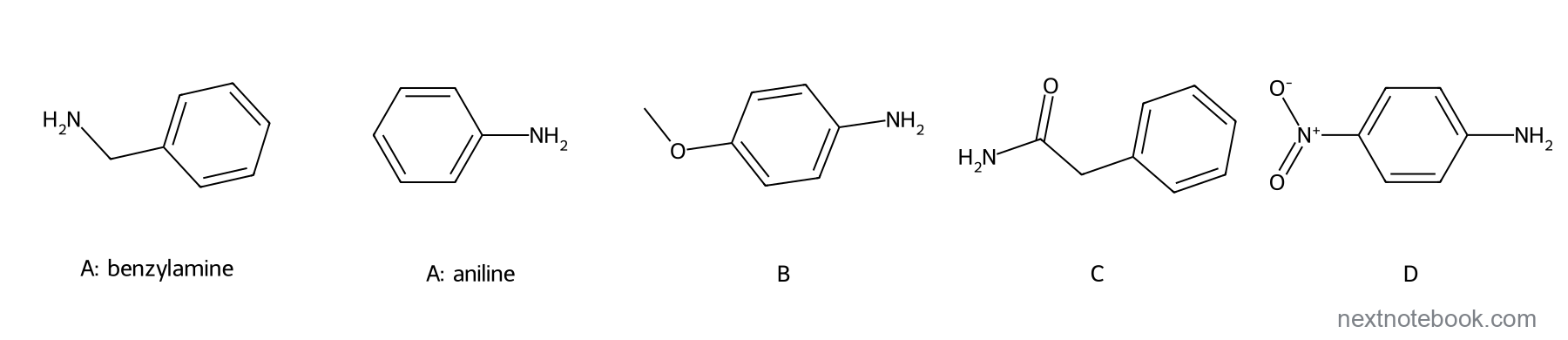 Tap an option to check.
Show answer
Correct answer: option 3,B and C Only - Q20JEE Main 2026 · 6 Apr · Shift 2The number of compounds from the following which can undergo reaction with (alcoholic) to give respective products and these respective products can also be obtained separately by Gabriel phthalimide reaction is: ; ; ; ; ;Tap an option to check.
Show answer
Correct answer: option 3,3 - Stuck on one?Log in free
See the step-by-step solution and video for every question, free with login.
- Q21JEE Main 2026 · 21 Jan · Shift 1A hydrocarbon 'P' () on reaction with HCl gives an optically active compound 'Q' () which on reaction with one mole of ammonia gives compound 'R' (). 'R' on diazotisation followed by hydrolysis gives 'S'. Identify P, Q, R and S.Tap an option to check.
Show answer
Correct answer: option 2,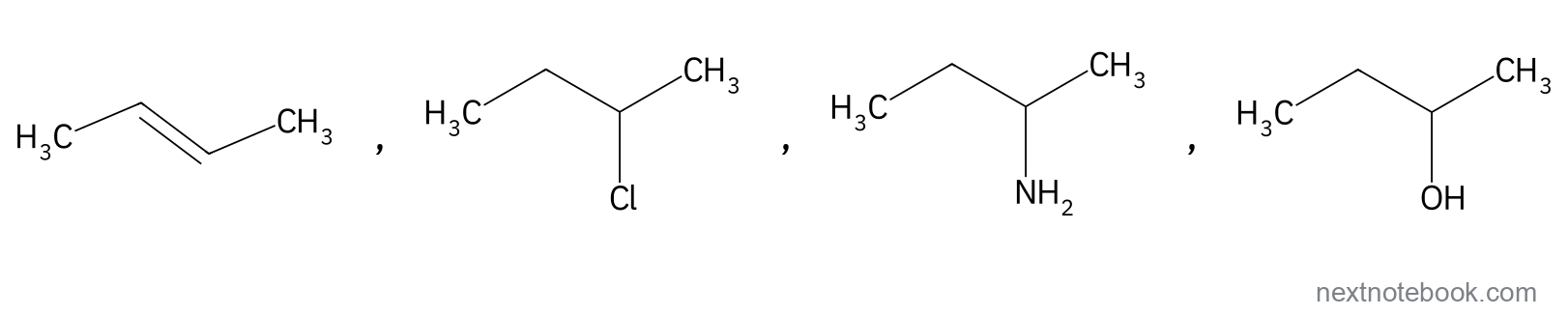
- Q22JEE Main 2026 · 6 Apr · Shift 1Consider the following sequence of reactions. [] (i) ; (ii) Aniline (in excess); (iii) Warm ; (iv) Cool, acetic acid Yellow Product (X) The percentage of nitrogen in the yellow product (X) formed is . (Nearest Integer) (Given Molar mass in H:1, C:12, N:14)
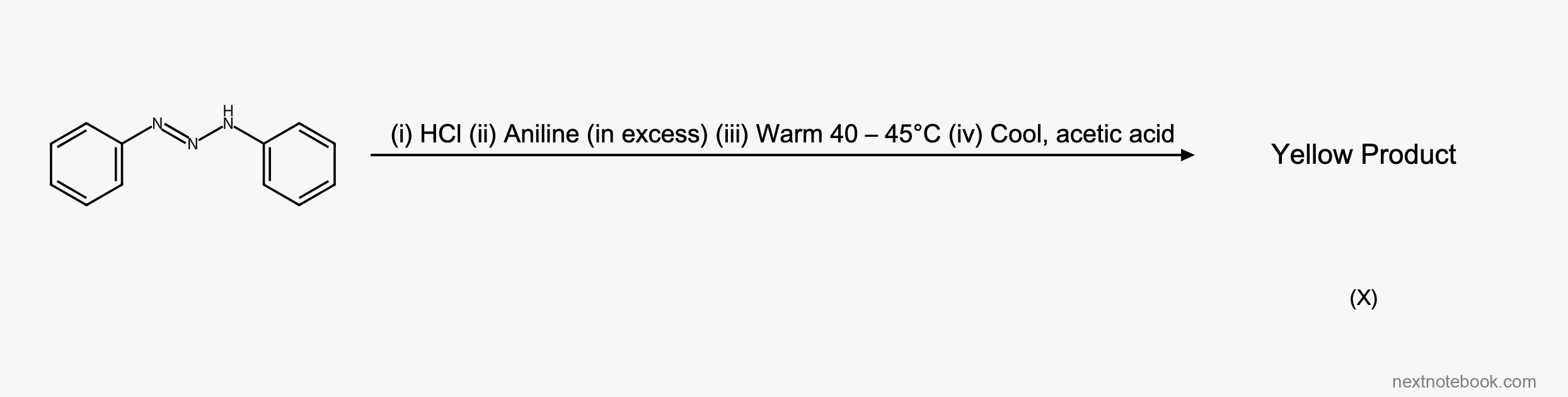 Tap Show answer to check.
Show answer
Answer: 21 - Q23JEE Main 2026 · 21 Jan · Shift 1Consider the following reaction sequence: benzene ring ; (major product) . The percentage of nitrogen in product ' ' formed is ____ . (Nearest integer) (Given molar mass in H: 1, C: 12, N: 14, O: 16)
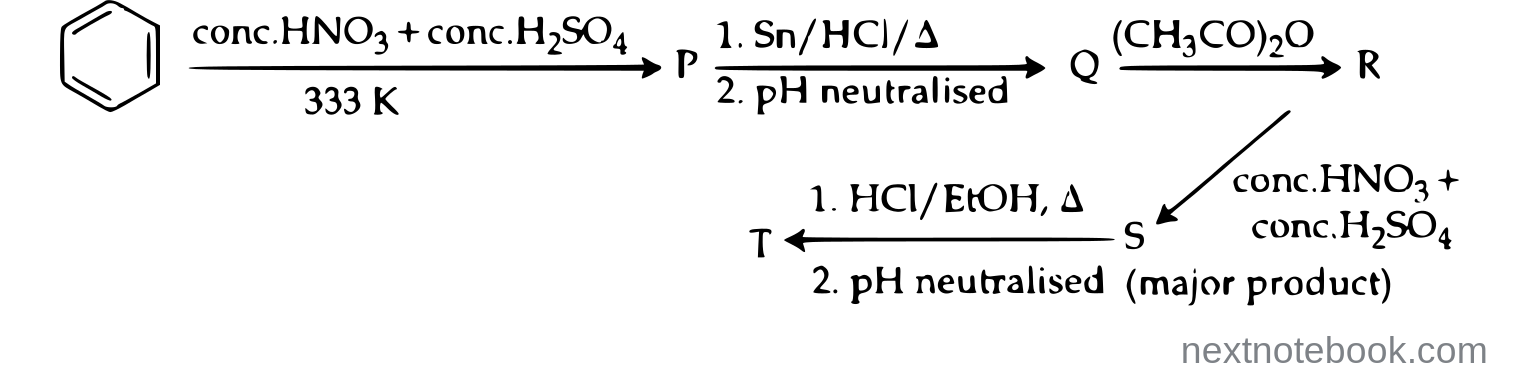 Tap Show answer to check.
Show answer
Answer: 20 - Q24JEE Main 2025 · 7 Apr · Shift 1When a salt is treated with sodium hydroxide solution it gives gas . On passing gas through reagent a brown coloured precipitate is formed. and respectively, areTap an option to check.
Show answer
Correct answer: option 4,and - Q25JEE Main 2025 · 3 Apr · Shift 1Identify [A], [B] and [C], respectively in the following reaction sequence: [A] [B] [C]
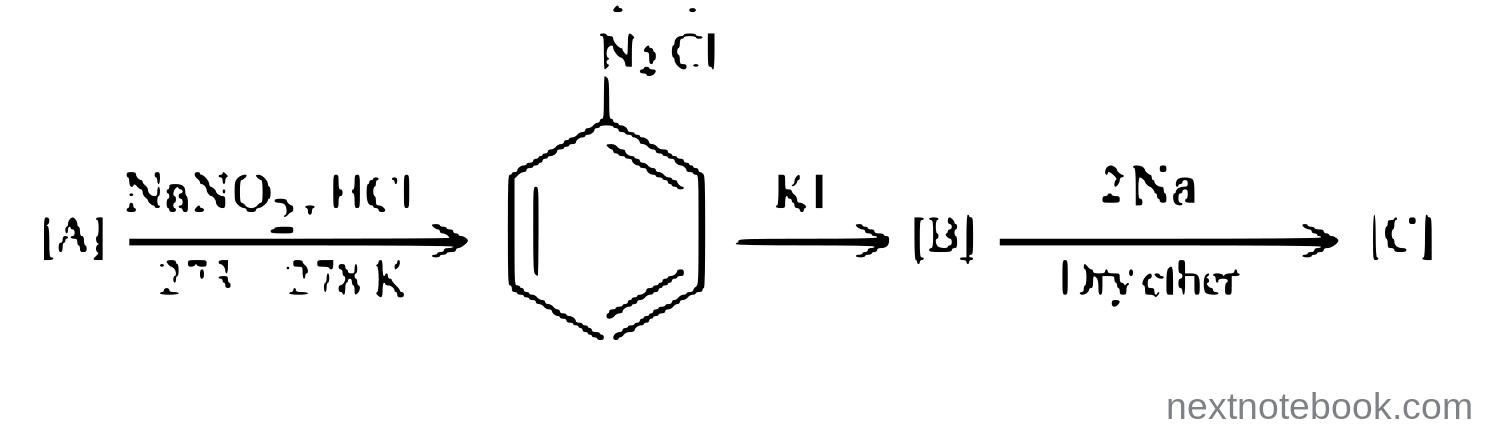 Tap an option to check.
Show answer
Correct answer: option 4,[A] aminobenzene (); [B] iodobenzene (); [C] biphenyl () - Q26JEE Main 2025 · 28 Jan · Shift 2Identify correct statements:
(A) Primary amines do not give diazonium salts when treated with in acidic condition.
(B) Aliphatic and aromatic primary amines on heating with and ethanolic form carbylamines.
(C) Secondary and tertiary amines also give carbylamine test.
(D) Benzenesulfonyl chloride is known as Hinsberg’s reagent.
(E) Tertiary amines reacts with benzenesulfonyl chloride very easily.
Choose the correct answer from the options given below:Tap an option to check.Show answer
Correct answer: option 3,(B) and (D) only - Q27JEE Main 2025 · 23 Jan · Shift 1Which among the following react with Hinsberg's reagent? A. C6H5-NH2 B. C6H5-N(CH3)2 C. CH3-NH2 D. N(CH3)3 E. (C6H5)2NH. Choose the correct answer from the options given below:Tap an option to check.
Show answer
Correct answer: option 1,A, C and E Only - Q28JEE Main 2025 · 4 Apr · Shift 2The correct order of basicity for the following molecules is:
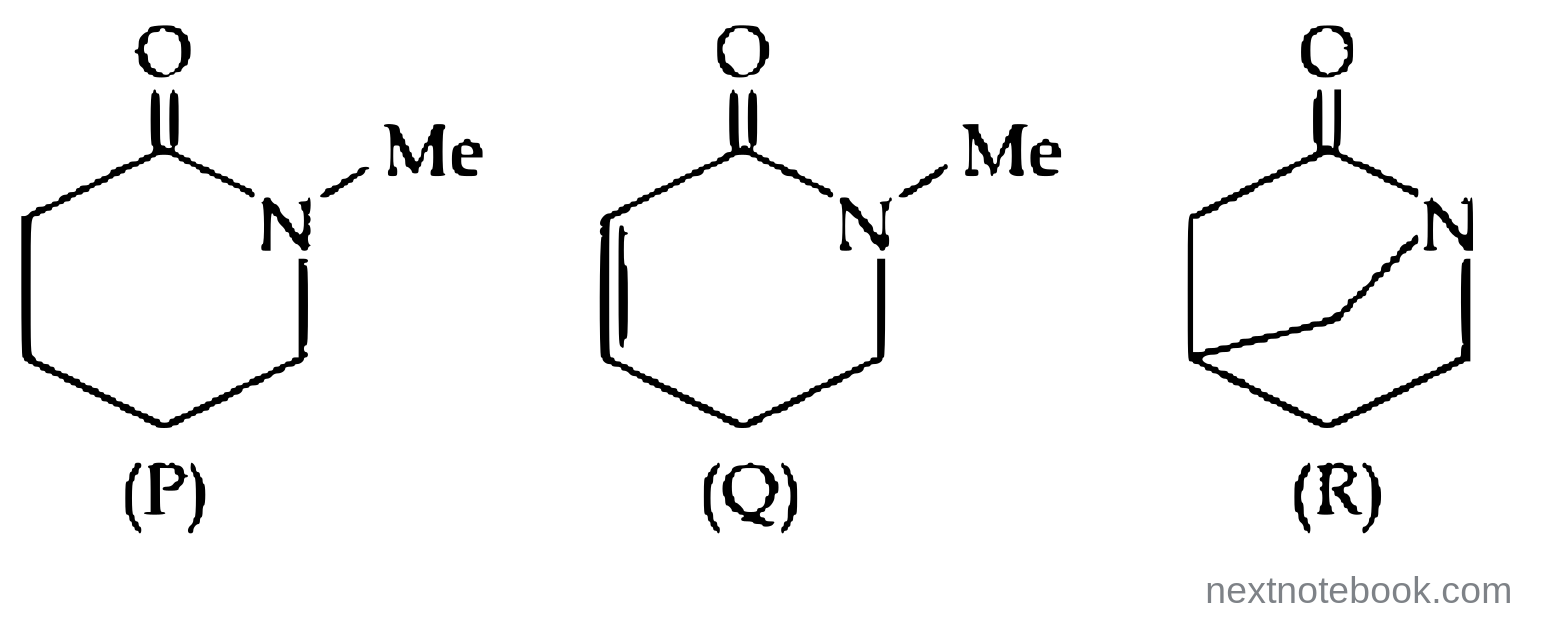 Tap an option to check.
Show answer
Correct answer: option 4, - Q29JEE Main 2025 · 2 Apr · Shift 2When a concentrated solution of sulphanilic acid and 1-naphthylamine is treated with nitrous acid () and acidified with acetic acid, the mass () of mole of product formed is: (Given molar mass in )Tap an option to check.
Show answer
Correct answer: option 2,33 - Q30JEE Main 2025 · 2 Apr · Shift 1The correct order of basic nature in aqueous solution for the bases , , , and is:Tap an option to check.
Show answer
Correct answer: option 3, - Stuck on one?Log in free
See the step-by-step solution and video for every question, free with login.
- Q31JEE Main 2025 · 3 Apr · Shift 1In the following reactions, which one is NOT correct?Tap an option to check.
Show answer
Correct answer: option 1,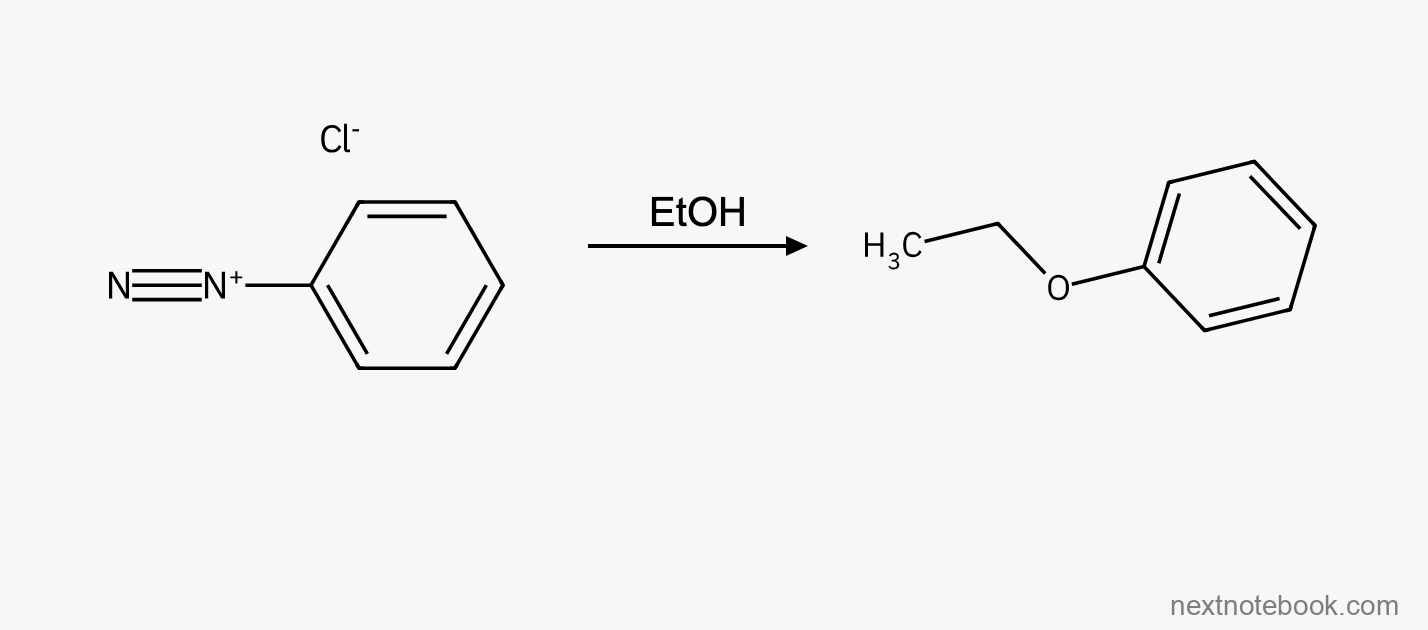
- Q32JEE Main 2025 · 22 Jan · Shift 2Match the compounds (List - I) with the appropriate catalyst/reagents (List - II) suitable for their reduction to the corresponding amines: Choose the correct answer from the options given below:
List-I List-II (A) R-C(=O)-NH2 (I) NaOH (aqueous) (B) nitrobenzene, C6H5-NO2 (II) H2/Ni (C) R-C≡N (III) LiAlH4, H2O (D) N-R substituted phthalimide (IV) Sn, HCl Tap an option to check.Show answer
Correct answer: option 2,(A)-(III), (B)-(IV), (C)-(II), (D)-(I) - Q33JEE Main 2025 · 24 Jan · Shift 1The product (A) formed in the following reaction sequence is: treated successively with (i) , (ii) , (iii) , to give (A).Tap an option to check.
Show answer
Correct answer: option 1, - Q34JEE Main 2025 · 7 Apr · Shift 1Which of the following amine (s) show (s) positive carbylamine test? A. aniline (, benzene ring) B. C. D. E. N-methylaniline (, benzene ring) Choose the correct answer from the options given below:
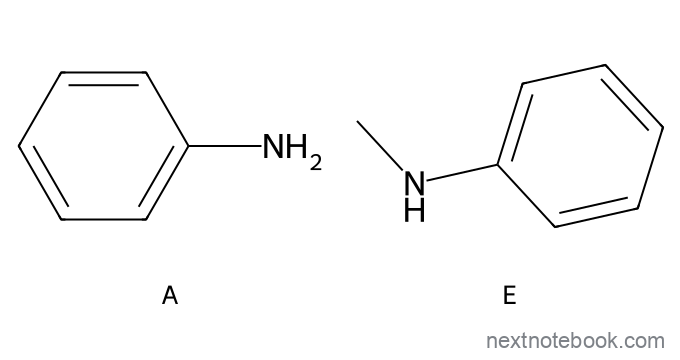 Tap an option to check.
Show answer
Correct answer: option 3,A and C Only - Q35JEE Main 2025 · 7 Apr · Shift 2The descending order of basicity of following amines is: (A) aniline () (B) p-methoxyaniline () (C) p-nitroaniline () (D) (E) Choose the correct answer from the options given below:
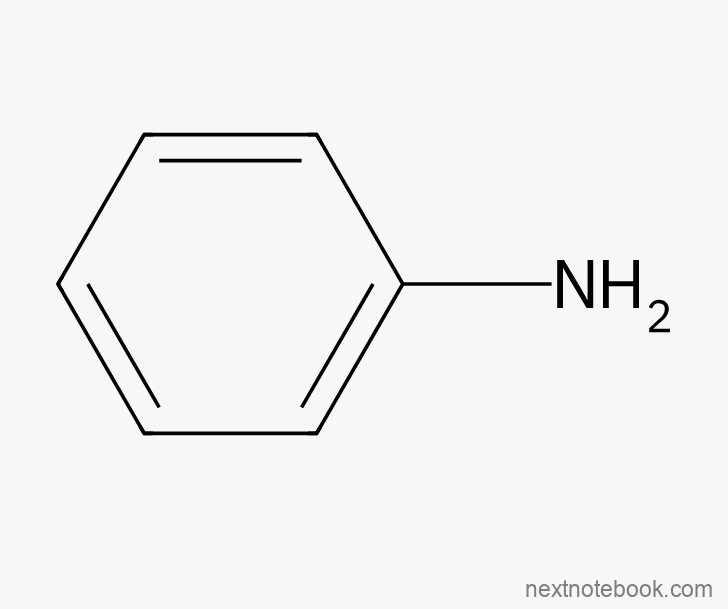
(A) 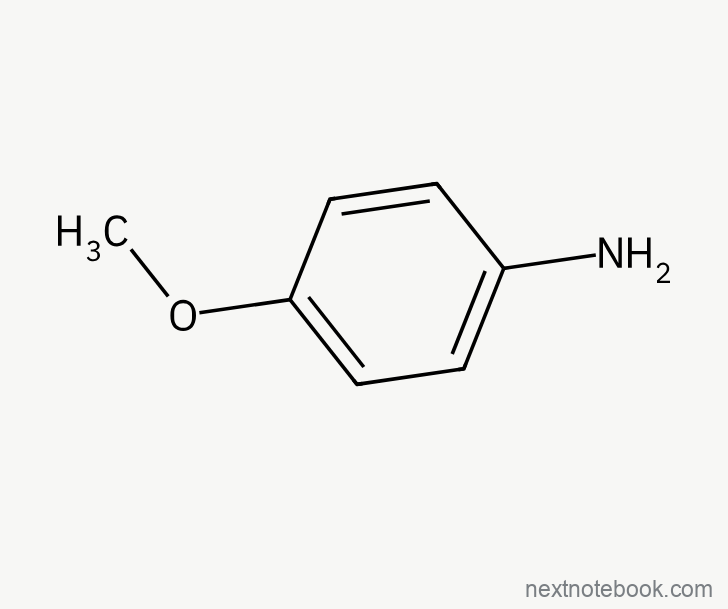
(B) 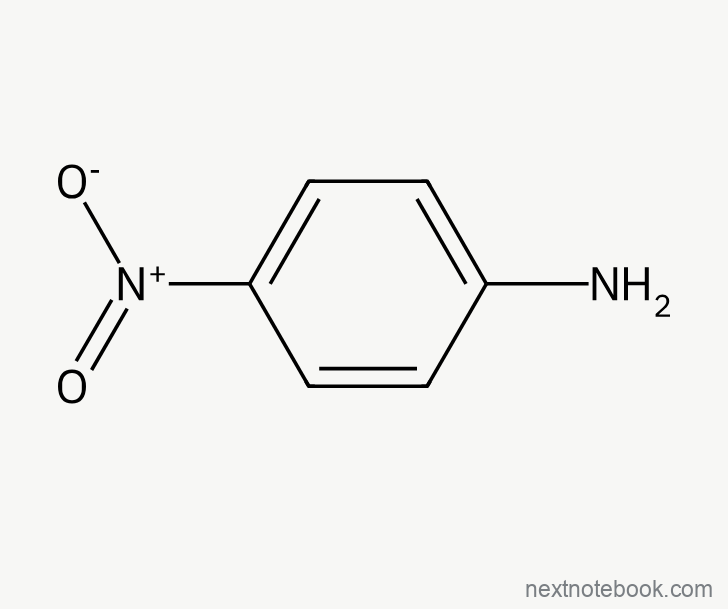
(C) Tap an option to check.Show answer
Correct answer: option 1,E D B A C - Q36JEE Main 2025 · 4 Apr · Shift 1The major product (A) formed in the following reaction sequence is [Nitrobenzene] (i) Sn, HCl (ii) Ac₂O, Pyridine (iii) Br₂, AcOH (iv) NaOH (aq) → ATap an option to check.
Show answer
Correct answer: option 2,4-Bromoaniline - Q37JEE Main 2025 · 23 Jan · Shift 1Consider the following sequence of reactions, starting from 3-nitrotoluene, to produce the major product (A): (i) , Fe; (ii) Sn, HCl; (iii) , HCl, ; (iv) , . The molar mass of product (A) is ______ . (Given molar mass in of C: 12, H: 1, O: 16, Br: 80, N: 14, P: 31)Tap Show answer to check.
Show answer
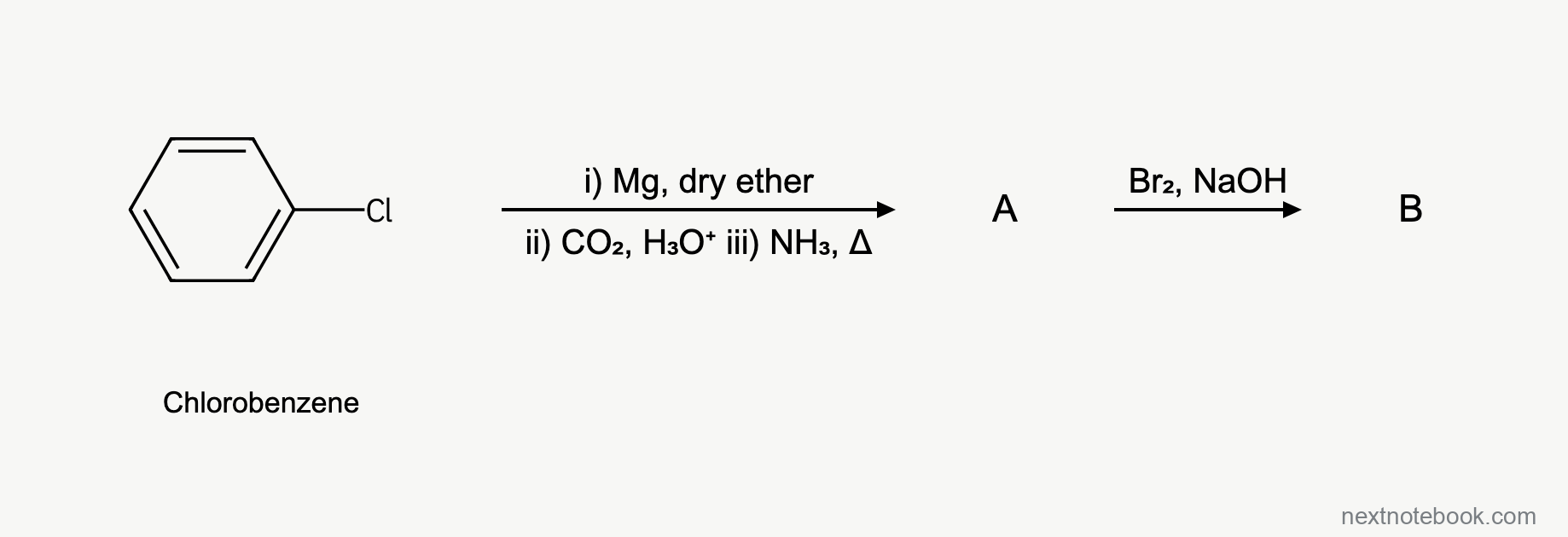
Answer: 171 - Q38JEE Main 2025 · 28 Jan · Shift 1Consider the following sequence of reactions: Chlorobenzene — i) , dry ether; ii) , ; iii) , A — , B 11.25 mg of chlorobenzene will produce ---- mg of product B. (Consider the reactions result in complete conversion.) [Given molar mass of , , , and as 12, 1, 16, 14 and 35.5 respectively]
 Tap Show answer to check.
Show answer
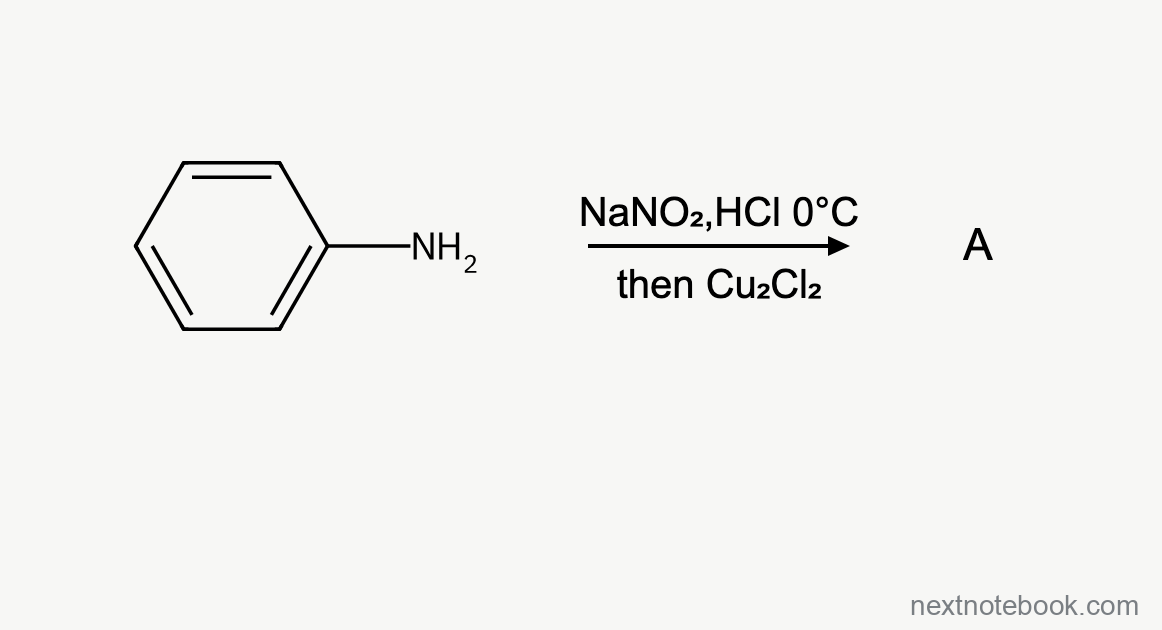
Answer: 93 - Q39JEE Main 2024 · 29 Jan · Shift 2The product formed in the following reaction is
 Tap an option to check.
Show answer
Correct answer: option 4,[benzene ring with substituent] - Q40JEE Main 2024 · 31 Jan · Shift 2Given below are two statements:
Statement I: Aniline reacts with con. followed by heating at to gives p-aminobenzene sulphonic acid, which gives blood red colour in the ‘Lassigne’s test’.
Statement II: In Friedel-Craft’s alkylation and acylation reaction, aniline forms salts with the catalyst. Due to this nitrogen of aniline acquires a positive charge and acts as deactivating group.
In the light of the above statements, choose the correct answer from the options given below: Option:Tap an option to check.Show answer
Correct answer: option 4,Both Statement I and Statement II are true - Stuck on one?Log in free
See the step-by-step solution and video for every question, free with login.
- Q41JEE Main 2024 · 30 Jan · Shift 2The products and formed in the following reaction scheme are respectively: benzene is treated with (i) conc. / conc. , , then (ii) , to give ; is treated with (i) , HCl, , then (ii) phenol, to give .Tap an option to check.
Show answer
Correct answer: option 3,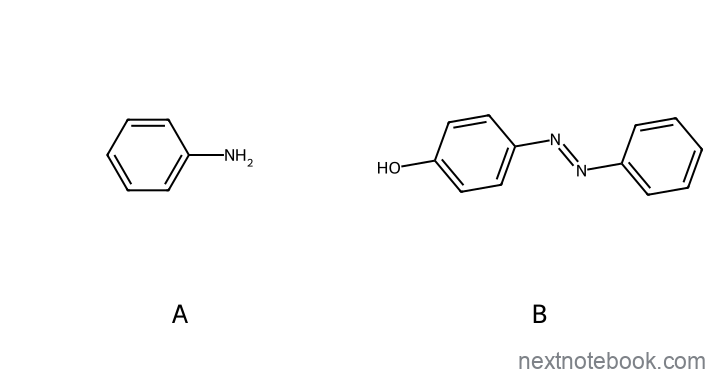
- Q42JEE Main 2024 · 1 Feb · Shift 1Given below are two statements: Statement (I): Aminobenzene and aniline are same organic compounds. Statement (II): Aminobenzene and aniline are different organic compounds. In the light of the above statements, choose the most appropriate answer from the options given below:Tap an option to check.
Show answer
Correct answer: option 2,Statement I is correct but Statement II is incorrect - Q43JEE Main 2024 · 8 Apr · Shift 2Given below are two statements:
Statement I: All the following compounds react with p-toluenesulfonyl chloride.
Statement II: Their products in the above reaction are soluble is aqueous .
In the light of the above statements, choose the correct answer from the options given below:Tap an option to check.Show answer
Correct answer: option 2,Both Statement I and Statement II are false. - Q44JEE Main 2024 · 30 Jan · Shift 1The final product , formed in the following multistep reaction sequence is (i) , ether then , ; (ii) , ; (iii) ,Tap an option to check.
Show answer
Correct answer: option 2, - Q45JEE Main 2024 · 27 Jan · Shift 2Identify B formed in the reaction
 Tap an option to check.
Show answer
Correct answer: option 3, - Q46JEE Main 2024 · 31 Jan · Shift 2The azo dye () formed in the following reaction is: sulphanilic acid + + ; + 1-aminonaphthalene (naphthalene with on a carbon next to the ring fusion) .Tap an option to check.
Show answer
Correct answer: option 3,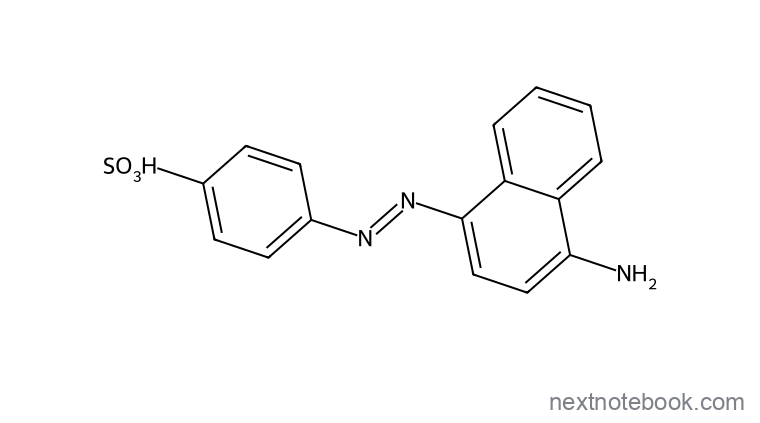
- Q47JEE Main 2024 · 29 Jan · Shift 2On passing a gas, ‘X’, through Nessler’s reagent, a brown precipitate is obtained. The gas ‘X’ isTap an option to check.
Show answer
Correct answer: option 4, - Q48JEE Main 2024 · 9 Apr · Shift 1Correct order of basic strength of pyrrole, pyridine and piperidine (drawn in the figure):
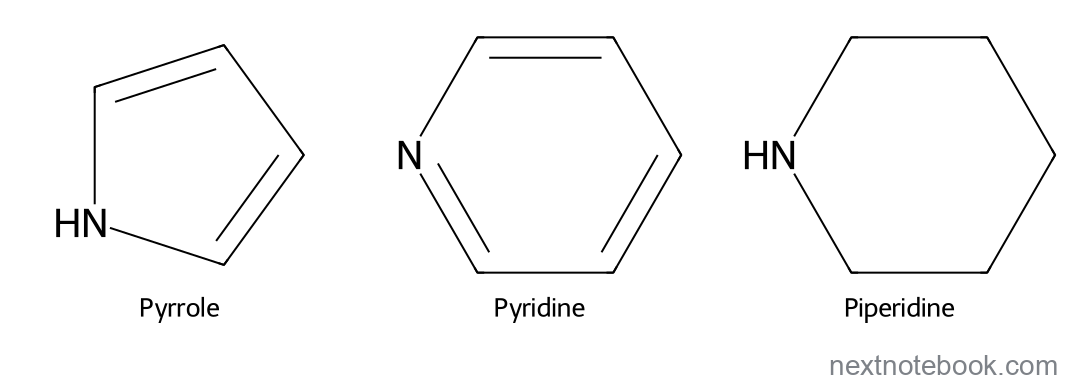 Tap an option to check.
Show answer
Correct answer: option 2,Piperidine Pyridine Pyrrole - Q49JEE Main 2024 · 6 Apr · Shift 2Identify the product (A) in the following reaction. Aniline (A)Tap an option to check.
Show answer
Correct answer: option 4,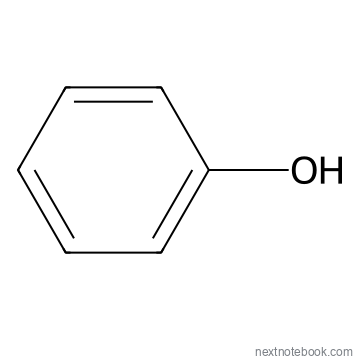
- Q50JEE Main 2024 · 30 Jan · Shift 1Following is a confirmatory test for aromatic primary amines. Identify reagent and : [benzene ring]— — [benzene ring]— — Scarlet red dye
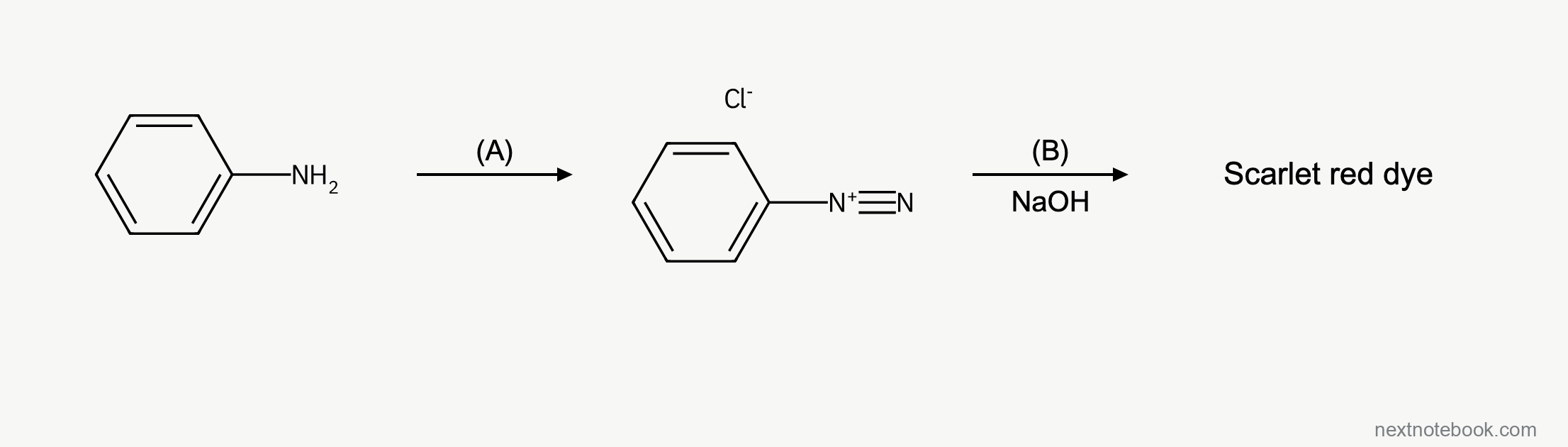 Tap an option to check.
Show answer
Correct answer: option 4,; [naphthalene ring with OH at the upper-right position] - Stuck on one?Log in free
See the step-by-step solution and video for every question, free with login.
- Q51JEE Main 2024 · 27 Jan · Shift 1Which of the following is strongest Bronsted base?Tap an option to check.
Show answer
Correct answer: option 4,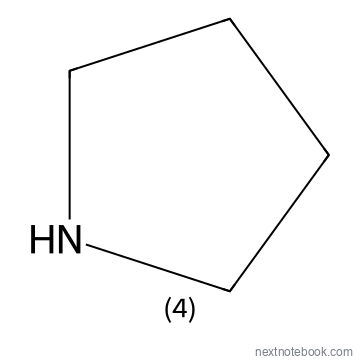
- Q52JEE Main 2024 · 1 Feb · Shift 1Given below are two statements: Statement (I): The group in Aniline is ortho and para directing and a powerful activating group. Statement (II): Aniline does not undergo Friedel-Craft’s reaction (alkylation and acylation). In the light of the above statements, choose the most appropriate answer from the options given below:Tap an option to check.
Show answer
Correct answer: option 1,Both Statement I and Statement II are correct - Q53JEE Main 2024 · 6 Apr · Shift 1of pure aniline upon diazotization followed by coupling with phenol gives an orange dye. The mass of orange dye produced (assume yield / conversion) is ______g. (nearest integer)Tap Show answer to check.
Show answer
Answer: 20 - Q54JEE Main 2024 · 6 Apr · Shift 2An amine is prepared by ammonolysis of benzyl chloride. On adding p-toluenesulphonyl chloride to it the solution remains clear. Molar mass of the amine formed is________. (Given: molar mass in )Tap Show answer to check.
Show answer
Answer: 287 - Q55JEE Main 2024 · 8 Apr · Shift 1If of aniline is reacted with one equivalent of benzenediazonium chloride, the maximum amount of aniline yellow formed will be_____ . (nearest integer) (consider complete conversion)Tap Show answer to check.
Show answer
Answer: 591 - Q56JEE Main 2024 · 4 Apr · Shift 1g of ethylamine is subjected to reaction with / followed by water, evolved dinitrogen gas which occupied volume at STP. is __________ × g.Tap Show answer to check.
Show answer
Answer: 45 - Q57JEE Main 2024 · 4 Apr · Shift 2Phthalimide is made to undergo following sequence of reactions. (i) (ii) Benzylchloride Phthalimide 'P' Total number of bonds present in product ‘P’ is / are____________.
 Tap Show answer to check.
Show answer
Answer: 8 - Q58JEE Main 2024 · 31 Jan · Shift 2A compound (x) with molar mass undergoes acetylation to give product with molar mass . The number of amino groups in the compound (x) is __________.Tap Show answer to check.
Show answer
Answer: 2 - Q59JEE Main 2024 · 1 Feb · Shift 2Number of compounds which give reaction with Hinsberg’s reagent is __________. (The eleven compounds are drawn in the figure, numbered 1 to 11.)
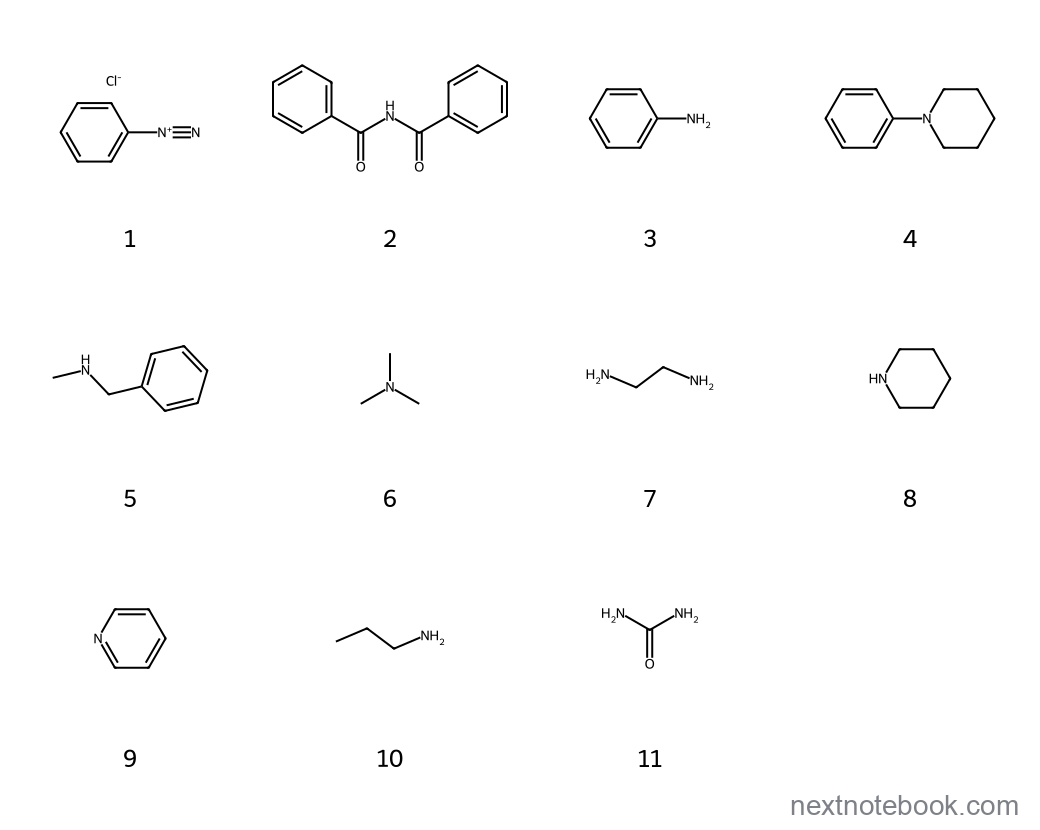 Tap Show answer to check.
Show answer
Answer: 5 - Q60JEE Main 2024 · 5 Apr · Shift 1The number of halobenzenes from the following that can be prepared by Sandmeyer's reaction is: (I) fluorobenzene, (II) chlorobenzene, (III) bromobenzene, (IV) iodobenzene, (V) astatobenzene.Tap Show answer to check.
Show answer
Answer: 2
Showing 60 of 206 questions. The rest are free after login.
Practise Diazonium salts first. Solutions and video answers are free.