#7 OF 19 IN CHEMISTRY
Solutions JEE Main PYQs (2016–2026) with answers
282 questions across 11 JEE Main years, about 1 a paper (≈5 marks). The topics asked most are Colligative properties and Solutions, solution types and concentration.
- 96% of papers
- ≈5 marks a paper
- Class 12 · Ch 1
From official NTA papers · Updated 9 Nov 2026
What's asked most
- Colligative properties43%Depression of freezing point · Elevation of boiling point
- Solutions, solution types and concentration27%Mass percentage and mass-by-volume percentage · Volume percentage
- Vapour pressure and Raoult's law11%Raoult's law for volatile components · Vapour pressure of liquid–liquid solutions
- Abnormal molar masses and the van't Hoff factor9%Association and dissociation of solute particles · Degree of association and degree of dissociation
- Solubility and Henry's law7%Solubility of a gas in a liquid · Henry's law and numerical applications
See all 6 topics
- Ideal and non-ideal solutions3%Ideal and non-ideal solutions · Azeotropes formed by positive deviation: minimum-boiling azeotropes
How often it comes
See as a table
| Year | Questions |
|---|---|
| 2026 | 22 |
| 2025 | 24 |
| 2024 | 30 |
| 2023 | 47 |
| 2022 | 40 |
| 2021 | 52 |
| 2020 | 27 |
| 2019 | 31 |
| 2018 | 1 |
| 2017 | 5 |
| 2016 | 3 |
Where it fits
SYLLABUSJEE Main Chemistry syllabusWEIGHTAGE#7 of 19 Chemistry chaptersNCERTClass 12 Chemistry NCERT, Chapter 1
Questions here often join up with


All 282 questions
- Q1JEE Main 2026 · 23 Jan · Shift 1Which one of the following graphs accurately represents the plot of partial pressure of vs its mole fraction in a mixture of acetone and at constant temperature?Tap an option to check.
Show answer
Correct answer: option 4,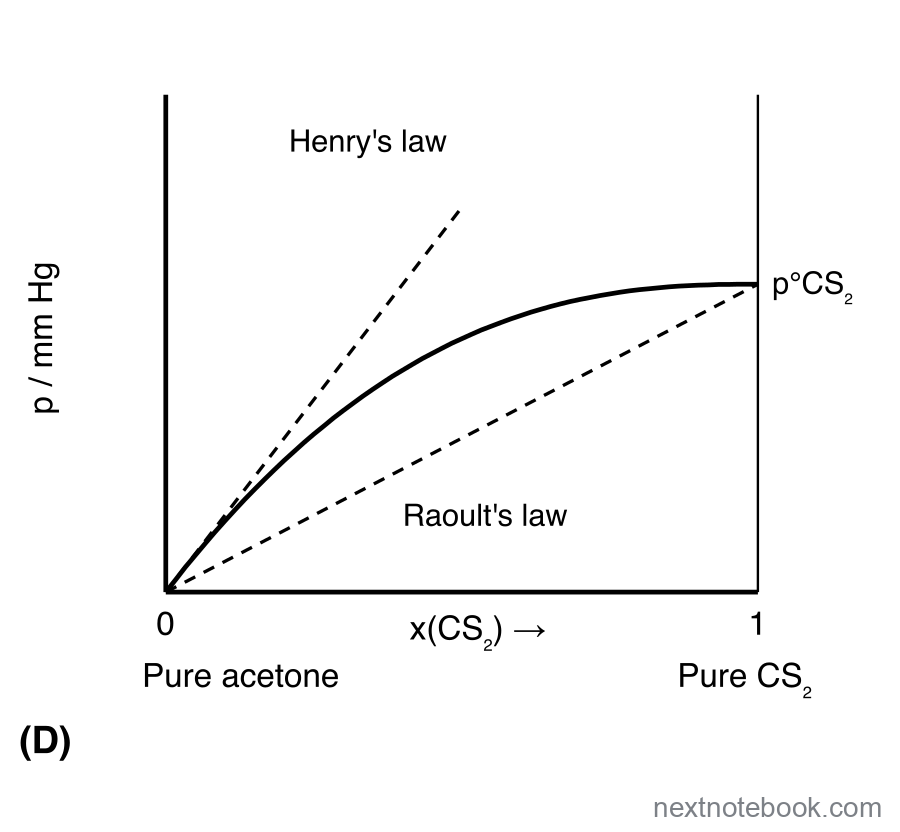
- Q2JEE Main 2026 · 8 Apr · Shift 2Given below are two statements: Given: Molar mass of are and , respectively
Statement I: In solution of methanol in (at ), the mole fraction of is equal to .
Statement II: Mixture of methanol and shows positive deviation from Raoult’s law.
In the light of the above statements, choose the correct answer from the options given below:Tap an option to check.Show answer
Correct answer: option 1,Both Statement I and Statement II are true - Q3JEE Main 2026 · 24 Jan · Shift 1A solution is prepared by dissolving of a non-volatile non-electrolyte solute 'A' of molar mass and of a non-volatile non-electrolyte solute 'B' of molar mass in at . Osmotic pressure of the solution will be [Given: ]Tap an option to check.
Show answer
Correct answer: option 3, - Q4JEE Main 2026 · 24 Jan · Shift 2At , the mole percentage of in air is . Water is in equilibrium with air at a pressure of . What is the mole fraction of in water at ? for is )Tap an option to check.
Show answer
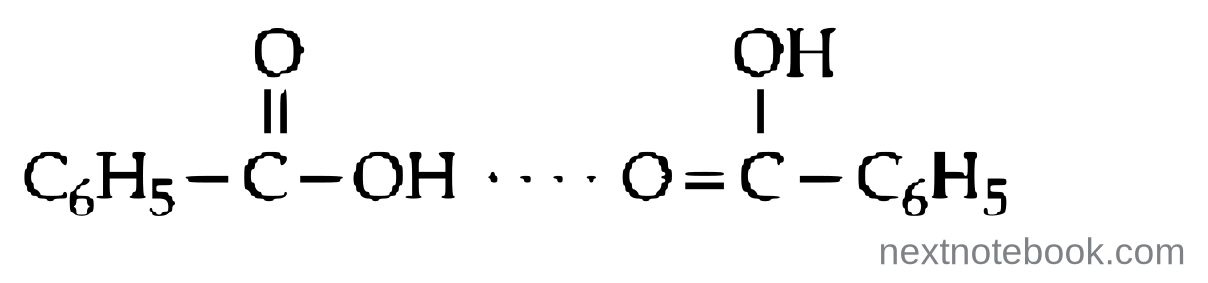
Correct answer: option 2, - Q5JEE Main 2026 · 8 Apr · Shift 2Which of the following statements are not correct? A. For water, magnitude of is more than the magnitude of . B. The elevation in boiling point of water when a non-volatile solute is added to it is larger in magnitude than its depression in freezing point. C. Osmotic pressure measurement is preferred over any other colligative property to determine molar mass of proteins and polymers. D. The dimerised form of benzoic acid in benzene is Choose the correct answer from the options given below:
 Tap an option to check.
Show answer
Correct answer: option 3,A, B and D only - Q6JEE Main 2026 · 5 Apr · Shift 1What is the mole fraction of water in by weight () of aqueous urea solution? [Given: Molar mass of , , and are 1, 16, 12 and 14 respectively.]Tap an option to check.
Show answer
Correct answer: option 4, - Q7JEE Main 2026 · 4 Apr · Shift 2At , , aqueous solution and , aqueous solution are placed in a container separated by a semi permeable membrane . Assume complete dissociation of both the solutes. Which of the following statement is correct?Tap an option to check.
Show answer
Correct answer: option 3,Solution on side '' is hypotonic. - Q8JEE Main 2026 · 28 Jan · Shift 1At temperature (K), 2 moles of liquid A and 3 moles of liquid B are mixed. The vapour pressure of the ideal solution formed is 320 mm Hg. At this stage, one mole of A and one mole of B are added to the solution. The vapour pressure is now measured as 328.6 mm Hg. The vapour pressure (in mm Hg) of A and B are respectively:Tap an option to check.
Show answer
Correct answer: option 1,500, 200 - Q9JEE Main 2026 · 2 Apr · Shift 2Solution A is prepared by dissolving of a protein (molar mass = ) in of water at . Its osmotic pressure is bar. Solution B is made by dissolving of same protein in of water at . Osmotic pressure of solution B is bar. Entire solution of A is mixed with entire solution of B at same temperature. The osmotic pressure of resultant solution is bar. and respectively are: ()Tap an option to check.
Show answer
Correct answer: option 1,(a) 0.7, (b) 2.0 - Q10JEE Main 2026 · 2 Apr · Shift 1of fluoro acetic acid (molar mass = ) is dissolved in of water at . The depression in the freezing point of water was . What is of fluoro acetic acid? (For water, ). Assume molarity and molality to have same values.Tap an option to check.
Show answer
Correct answer: option 4,
Show the other 50 questions
- Q11JEE Main 2026 · 6 Apr · Shift 2Given below are two statements: [Chamber 1: glucose in aqueous solution | Semi-permeable membrane | Chamber 2: glucose in aqueous solution]
Statement I: molecules move from the chamber 1 to chamber 2.
Statement II: The osmotic pressure of a solution prepared by dissolving of potassium sulphate (molar mass ) in of water (at ) is . (Given: and assume complete dissociation of electrolyte)
In the light of the above statements, choose the correct answer from the options given below: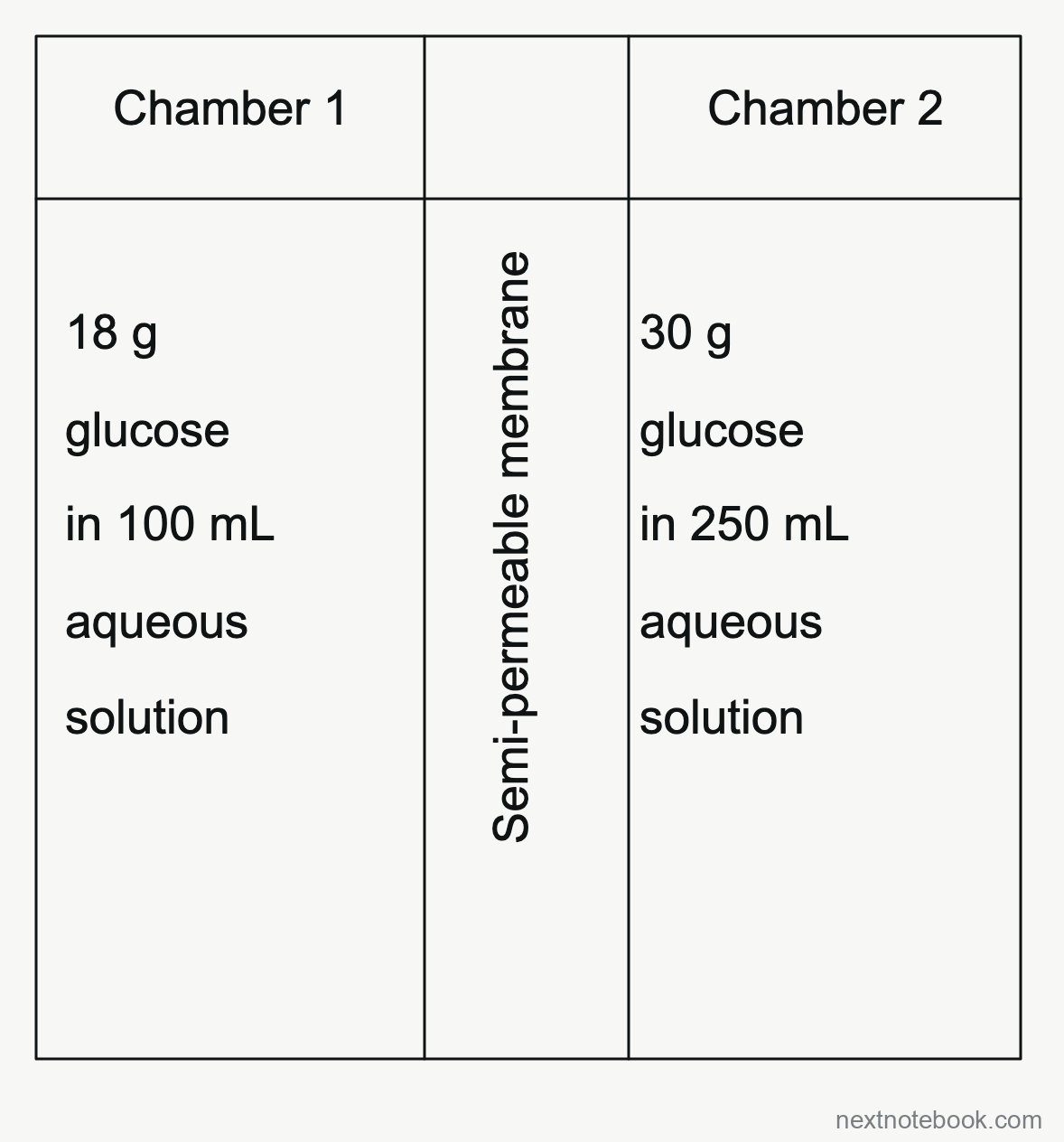 Tap an option to check.
Show answer
Correct answer: option 4,Statement I is false but Statement II is true - Q12JEE Main 2026 · 6 Apr · Shift 1When moles of a non-volatile, non-ionizable solute was dissolved in mole of a solvent the vapor pressure of solution was of vapor pressure of pure solvent. What is ?Tap an option to check.
Show answer
Correct answer: option 4, - Q13JEE Main 2026 · 21 Jan · Shift 1Elements and form two types of non-volatile, non-ionizable compounds and . When of is dissolved in of solvent 'A', was while when of is dissolved in of solvent 'A', was . ( of 'A' = ). The molar masses of elements and (in ) respectively, are:Tap an option to check.
Show answer
Correct answer: option 2, - Q14JEE Main 2026 · 24 Jan · Shift 1'' g of a non-volatile electrolyte solid solute of molar mass '' when dissolved in water, decreases vapour pressure of water from to . If aqueous solution of the electrolyte boils at and for water is , then the mole fraction of the electrolyte solute in the solution can be expressed as (Given: density of water and boiling point of water )Tap an option to check.
Show answer
Correct answer: option 1, - Q15JEE Main 2026 · 22 Jan · Shift 2At , of (w/w) aqueous solution is mixed with of (w/w) aqueous solution. What is the mole fraction of in the resultant solution? (Given: Atomic mass ; ; ). (Assume that temperature after mixing remains constant)Tap an option to check.
Show answer
Correct answer: option 3, - Q16JEE Main 2026 · 22 Jan · Shift 1Given below are two statements:
Statement I: The Henry's law constant is constant with respect to variations in solution's concentration over the range for which the solution is ideally dilute.
Statement II: does not differ for the same solute in different solvents.
In the light of the above statements, choose the correct answer from the options given belowTap an option to check.Show answer
Correct answer: option 3,Statement I is true but Statement II is false - Q17JEE Main 2026 · 22 Jan · Shift 1Consider a solution of (g) dissolved in water in a closed container. Which one of the following plots correctly represents variation of log (partial pressure of in vapour phase above water) [-axis] with log (mole fraction of in water) [-axis] at ?Tap an option to check.
Show answer
Correct answer: option 3,[graph: straight line with positive slope and positive y-intercept, with x- and y-axes] - Q18JEE Main 2026 · 21 Jan · Shift 2A substance ' ' () dissolved in of a solvent ' ' (molar mass ) led to an elevation of the boiling point by . The relative lowering in the vapour pressure of the solvent ' ' is . (nearest integer) [Given: of the solvent ] Assume the solution to be dilute and no association or dissociation of takes place in solution.Tap Show answer to check.
Show answer
Answer: 3 - Q19JEE Main 2026 · 23 Jan · Shift 2Two liquids A and B form an ideal solution. At 320 K, the vapour pressure of the solution, containing 3 mol of A and 1 mol of B, is 500 mm Hg. At the same temperature, if 1 mol of A is further added to this solution, vapour pressure of the solution increases by 20 mm Hg. Vapour pressure (in mm Hg) of B in pure state is _____. (Nearest integer)Tap Show answer to check.
Show answer
Answer: 200 - Q20JEE Main 2026 · 5 Apr · Shift 2hemoglobin in a aqueous solution (A) at is separated from pure water by semi permeable membrane. At equilibrium the height of solution in a tube dipped in a solution (A) is found to be higher than the tube dipped in water. The molar mass of hemoglobin is __________ . (Nearest integer) (Given: , , density of solution )Tap Show answer to check.
Show answer
Answer: 62 - Stuck on one?Log in free
See the step-by-step solution and video for every question, free with login.
- Q21JEE Main 2026 · 21 Jan · Shift 2The osmotic pressure of a living cell is 12 atm at 300 K. The strength of sodium chloride solution that is isotonic with the living cell at this temperature is _____ g . (Nearest integer) Given: Assume complete dissociation of (Given: Molar mass of Na and Cl are 23 and 35.5 respectively.)Tap Show answer to check.
Show answer
Answer: 15 - Q22JEE Main 2026 · 4 Apr · Shift 1A non-volatile, non-electrolyte solid solute when dissolved in of a solvent, the vapour pressure of the solvent decreased from to . If the same solution boils at , then the number of moles of the solvent present in the solution is............. (Nearest integer) [Given: boiling point of the pure solvent , of the solvent ]Tap Show answer to check.
Show answer
Answer: 5 - Q23JEE Main 2025 · 2 Apr · Shift 2‘’ g of is added to water in a beaker with a lid. The temperature of the system is raised from to . Which out of the following plots, is best suited for the change in the molarity () of the solution with respect to temperature? [Consider the solubility of remains unchanged over the temperature range]Tap an option to check.
Show answer
Correct answer: option 1,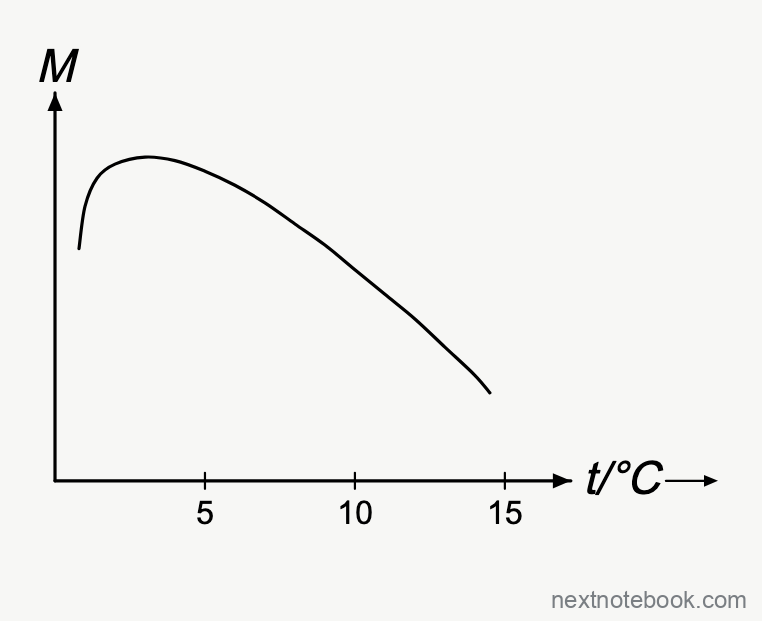
- Q24JEE Main 2025 · 8 Apr · Shift 2Which of the following binary mixture does not show the behaviour of minimum boiling azeotropes?Tap an option to check.
Show answer
Correct answer: option 4, - Q25JEE Main 2025 · 4 Apr · Shift 2Given below are two statements: Statement (I): Molal depression constant is given by , where symbols have their usual meaning. Statement (II): for benzene is less than the for water. In the light of the above statements, choose the most appropriate answer from the options given below:Tap an option to check.
Show answer
Correct answer: option 3,Statement I is correct but Statement II is incorrect - Q26JEE Main 2025 · 28 Jan · Shift 2Assume a living cell with (w/w) of glucose solution (aqueous). This cell is immersed in another solution having equal mole fraction of glucose and water. (Consider the data upto first decimal place only) The cell will:Tap an option to check.
Show answer
Correct answer: option 1,shrink since solution is (w/w) - Q27JEE Main 2025 · 28 Jan · Shift 1What is the freezing point depression constant of a solvent, 50 g of which contain 1 g non volatile solute (molar mass ) and the decrease in freezing point is ?Tap an option to check.
Show answer
Correct answer: option 3, - Q28JEE Main 2025 · 8 Apr · Shift 2The freezing point depression of a aqueous solution of a monobasic weak acid HA is . The dissociation constant for the acid is Given: , molality molarityTap an option to check.
Show answer
Correct answer: option 2, - Q29JEE Main 2025 · 2 Apr · Shift 1Which of the following graph correctly represents the plots of at for gases in water versus temperature?Tap an option to check.
Show answer
Correct answer: option 2,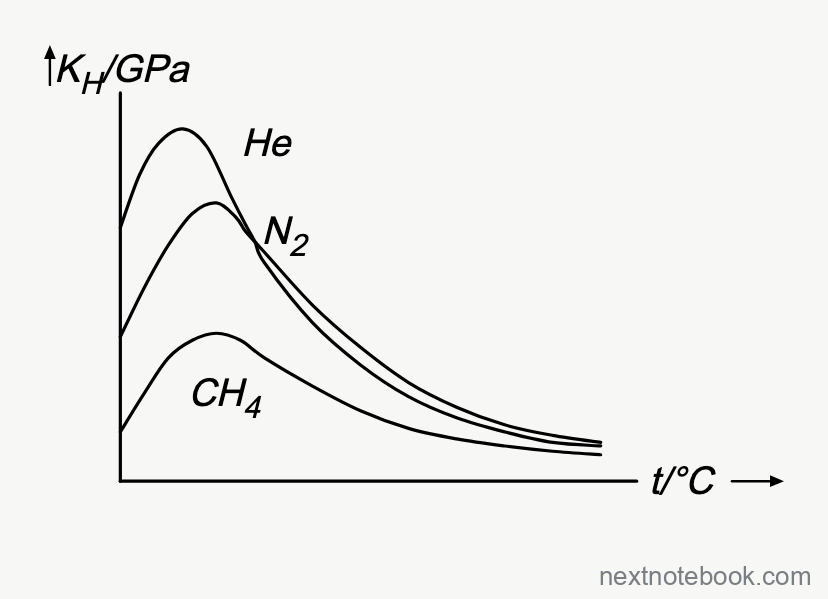
- Q30JEE Main 2025 · 3 Apr · Shift 1moles each of ethylene glycol and glucose are dissolved in of water. The boiling point of the resulting solution is: (Given: Ebullioscopic constant of water = )Tap an option to check.
Show answer
Correct answer: option 3, - Stuck on one?Log in free
See the step-by-step solution and video for every question, free with login.
- Q31JEE Main 2025 · 28 Jan · Shift 2Concentrated nitric acid is labelled as by mass. The volume in of the solution which contains of nitric acid is __________. Given: Density of nitric acid solution is .Tap an option to check.
Show answer
Correct answer: option 3,32 - Q32JEE Main 2025 · 24 Jan · Shift 1Consider the given plots of vapour pressure (VP) vs temperature . Which amongst the following options is correct graphical representation showing , depression in the freezing point of a solvent in a solution?Tap an option to check.
Show answer
Correct answer: option 4,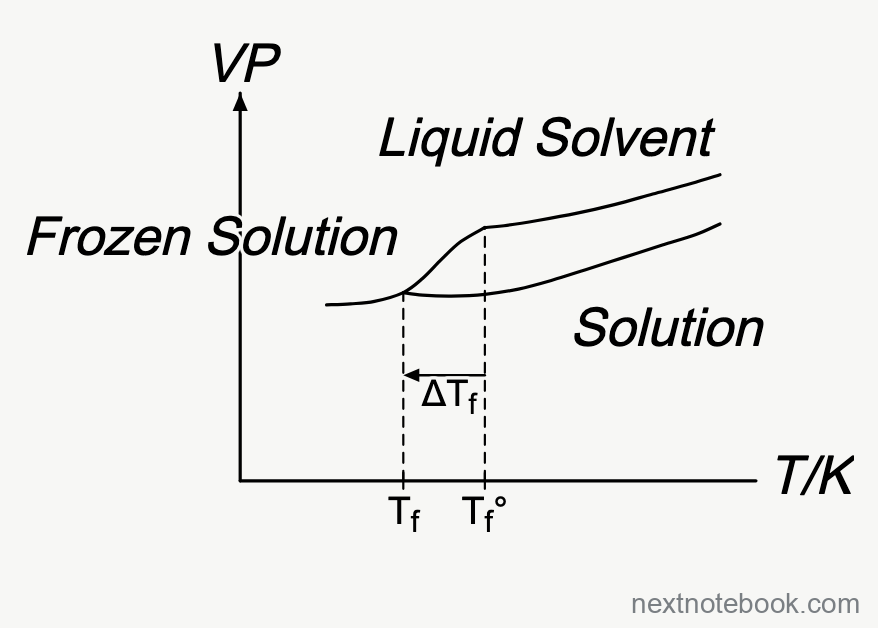
- Q33JEE Main 2025 · 7 Apr · Shift 2Match List - I with List - II. Choose the correct answer from the options given below:
List - I List - II (A) Solution of chloroform and acetone (I) Minimum boiling azeotrope (B) Solution of ethanol and water (II) Dimerizes (C) Solution of benzene and toluene (III) Maximum boiling azeotrope (D) Solution of acetic acid in benzene (IV) Tap an option to check.Show answer
Correct answer: option 3,(A)-(III), (B)-(I), (C)-(IV), (D)-(II) - Q34JEE Main 2025 · 23 Jan · Shift 2When a non-volatile solute is added to the solvent, the vapour pressure of the solvent decreases by 10 mm of Hg. The mole fraction of the solute in the solution is 0.2. What would be the mole fraction of the solvent if decrease in vapour pressure is 20 mm of Hg?Tap an option to check.
Show answer
Correct answer: option 2,0.6 - Q35JEE Main 2025 · 2 Apr · Shift 1A solution is made by mixing one mole of volatile liquid with moles of volatile liquid . The vapour pressure of pure is and that of the solution is . The vapour pressure of pure and the least volatile component of the solution, respectively, are:Tap an option to check.
Show answer
Correct answer: option 3,, - Q36JEE Main 2025 · 7 Apr · Shift 2Liquid A and B form an ideal solution. The vapour pressures of pure liquids A and B are 350 and 750 mm Hg respectively at the same temperature. If and are the mole fraction of A and B in solution while and are the mole fraction of A and B in vapour phase then,Tap an option to check.
Show answer
Correct answer: option 1, - Q37JEE Main 2025 · 23 Jan · Shift 1CrCl3.xNH3 can exist as a complex. 0.1 molal aqueous solution of this complex shows a depression in freezing point of 0.558°C. Assuming 100% ionisation of this complex and coordination number of Cr is 6, the complex will be (Given Kf = 1.86 K kg mol^−1)Tap an option to check.
Show answer
Correct answer: option 2,[Cr(NH3)5Cl]Cl2 - Q38JEE Main 2025 · 23 Jan · Shift 2Consider a binary solution of two volatile liquid components 1 and 2. x1 and y1 are the mole fractions of component 1 in liquid and vapour phase, respectively. The slope and intercept of the linear plot of (1)/(x1) vs (1)/(y1) are given respectively as:Tap an option to check.
Show answer
Correct answer: option 2,(P10)/(P20), (P20 - P10)/(P20) - Q39JEE Main 2025 · 22 Jan · Shift 2Density of 3 M NaCl solution is 1.25 g/mL. The molality of the solution is:Tap an option to check.
Show answer
Correct answer: option 2,2.79 m - Q40JEE Main 2025 · 4 Apr · Shift 1XY is the membrane partition between two chambers 1 and 2 containing sugar solutions of concentration c1 and c2 (c1 > c2) mol L^−1. For the reverse osmosis to take place identify the correct condition. (Here p1 and p2 are pressures applied on chamber 1 and 2). A. Membrane/Partition: Cellophane, p1 > π B. Membrane/Partition: Porous, p2 > π C. Membrane/Partition: Parchment paper, p1 > π D. Membrane/Partition: Cellophane, p2 > π Choose the correct answer from the option given below:Tap an option to check.
Show answer
Correct answer: option 2,A and C only - Stuck on one?Log in free
See the step-by-step solution and video for every question, free with login.
- Q41JEE Main 2025 · 28 Jan · Shift 1The molarity of a (mass/mass) aqueous solution of a monobasic acid is _____ (Nearest integer) [Given: Density of aqueous solution of is Molar mass of the acid is ]Tap Show answer to check.
Show answer
Answer: 125 - Q42JEE Main 2025 · 22 Jan · Shift 220 mL of 2 M NaOH solution is added to 400 mL of 0.5 M NaOH solution. The final concentration of the solution is __________ × 10^-2 M. (Nearest integer)Tap Show answer to check.
Show answer
Answer: 57 - Q43JEE Main 2025 · 7 Apr · Shift 1The percentage dissociation of a salt solution at given temperature (van't Hoff factor ) is __________ (Nearest integer)Tap Show answer to check.
Show answer
Answer: 33 - Q44JEE Main 2025 · 4 Apr · Shift 2Sea water, which can be considered as a molar () solution of , has a density of . The concentration of dissolved oxygen () in sea water is . Then the concentration of dissolved oxygen () in sea water, is . . (Nearest integer) Given: Molar mass of is Molar mass of isTap Show answer to check.
Show answer
Answer: 2 - Q45JEE Main 2025 · 2 Apr · Shift 2When each of compounds and are dissolved in of water separately, they increased the boiling point of water by and respectively. The atomic mass of (in amu) is ________ (Nearest integer) (Given: Molal boiling point elevation constant is )Tap Show answer to check.
Show answer
Answer: 25 - Q46JEE Main 2025 · 4 Apr · Shift 1Fortification of food with iron is done using FeSO₄.7H₂O. The mass in grams of the FeSO₄.7H₂O required to achieve 12 ppm of iron in 150 kg of wheat is ________ (Nearest integer) [Given: Molar mass of Fe, S and O respectively are 56, 32 and 16 g mol⁻¹]Tap Show answer to check.
Show answer
Answer: 9 - Q47JEE Main 2024 · 6 Apr · Shift 1Given below are two statements:
Statement I: Gallium is used in the manufacturing of thermometers
Statement II: A thermometer containing gallium is useful for measuring the freezing point () of brine solution
In the light of the above statements, choose the correct answer from the options given below:Tap an option to check.Show answer
Correct answer: option 3,Statement I is true but Statement II is false. - Q48JEE Main 2024 · 31 Jan · Shift 1Identify the mixture that shows positive deviations from Raoult’s Law:Tap an option to check.
Show answer
Correct answer: option 4, - Q49JEE Main 2024 · 6 Apr · Shift 2Molality of aqueous solution of is: (Given: Density of solution . Molar mass in : Na-23, Cl-35.5)Tap an option to check.
Show answer
Correct answer: option 3,2.79 - Q50JEE Main 2024 · 27 Jan · Shift 1A solution of two miscible liquids showing negative deviation from Raoult’s law will have:Tap an option to check.
Show answer
Correct answer: option 1,decreased vapour pressure, increased boiling point - Stuck on one?Log in free
See the step-by-step solution and video for every question, free with login.
- Q51JEE Main 2024 · 4 Apr · Shift 1The molarity of an aqueous solution containing of in water is: (Given: Molar Mass Na: and Cl: )Tap an option to check.
Show answer
Correct answer: option 1, - Q52JEE Main 2024 · 6 Apr · Shift 1The density of ‘’ solution (‘’ molar) of is , while in molality, the concentration of the solution is ( molal). Then is (Given: Molar mass of is )Tap an option to check.
Show answer
Correct answer: option 2, - Q53JEE Main 2024 · 9 Apr · Shift 1when treated with gives green colour solution of . The two solutions are separated by a semi permeable membrane (SPM) as shown below: side X holds the solution, side Y holds the solution, and the SPM lies between them. Due to osmosis:Tap an option to check.
Show answer
Correct answer: option 4,Molarity of solution is lowered - Q54JEE Main 2024 · 30 Jan · Shift 2*72. If a substance ‘A’ dissolves in solution of a mixture of ‘B’ and ‘C’ with their respective number of moles as , and . Mole fraction of C in the solution isTap an option to check.
Show answer
Correct answer: option 2, - Q55JEE Main 2024 · 30 Jan · Shift 1What happens to freezing point of benzene when small quantity of naphthalene is added to benzene? Option:Tap an option to check.
Show answer
Correct answer: option 4,Decreases - Q56JEE Main 2024 · 1 Feb · Shift 1We have three aqueous solutions of labelled as ‘A’, ‘B’ and ‘C’, with concentration , and , respectively. The value of van’t Hoff factor() for these solutions will be in the order.Tap an option to check.
Show answer
Correct answer: option 1, - Q57JEE Main 2024 · 30 Jan · Shift 2The solution from the following with highest depression in freezing point/lowest freezing point isTap an option to check.
Show answer
Correct answer: option 1,of acetic acid dissolved in water - Q58JEE Main 2024 · 27 Jan · Shift 2The quantity which changes with temperature is:Tap an option to check.
Show answer
Correct answer: option 2,Molarity - Q59JEE Main 2024 · 31 Jan · Shift 2The molarity of orthophoric acid having purity by weight (specific gravity ) is __________ . (Molar mass of )Tap Show answer to check.
Show answer
Answer: 11 - Q60JEE Main 2024 · 6 Apr · Shift 1Consider the dissociation of weak acid [ : dissociation constant] The osmotic pressure of aqueous solution of HX at is_____ bar (nearest integer) [Given: ]Tap Show answer to check.
Show answer
Answer: 76
Showing 60 of 282 questions. The rest are free after login.
Practise Colligative properties first. Solutions and video answers are free.