#10 OF 19 IN CHEMISTRY

Chemical Kinetics JEE Main PYQs (2016–2026) with answers
199 questions across 11 JEE Main years, about 1 a paper (≈4 marks). The topics asked most are Integrated Rate Laws and First-Order Reaction Applications and Rate Law, Order, and Rate Constant.
- 94% of papers
- ≈4 marks a paper
- Class 12 · Ch 3
From official NTA papers · Updated 9 Nov 2026
What's asked most
- Integrated Rate Laws and First-Order Reaction Applications30%Numericals on some important first-order reactions
- Rate Law, Order, and Rate Constant3%Rate constant and its units · Characteristics of the rate constant
How often it comes
See as a table
| Year | Questions |
|---|---|
| 2026 | 26 |
| 2025 | 20 |
| 2024 | 18 |
| 2023 | 34 |
| 2022 | 29 |
| 2021 | 29 |
| 2020 | 16 |
| 2019 | 20 |
| 2018 | 2 |
| 2017 | 2 |
| 2016 | 3 |
Where it fits
SYLLABUSJEE Main Chemistry syllabusWEIGHTAGE#10 of 19 Chemistry chaptersNCERTClass 12 Chemistry NCERT, Chapter 3
Questions here often join up with

All 199 questions
- Q1JEE Main 2026 · 22 Jan · Shift 1product (First order reaction). Three sets of experiment were performed for a reaction under similar experimental conditions: Run 1 of solution of reactant Run 2 of solution of reactant Run 3 of solution of reactant + of added. The correct variation of rate of reaction isTap an option to check.
Show answer
Correct answer: option 1,Run 3 Run 1 Run 2 - Q2JEE Main 2026 · 23 Jan · Shift 2Given above is the concentration vs time plot for a dissociation reaction: . Based on the data of the initial phase of the reaction (initial ), the value of is ____.
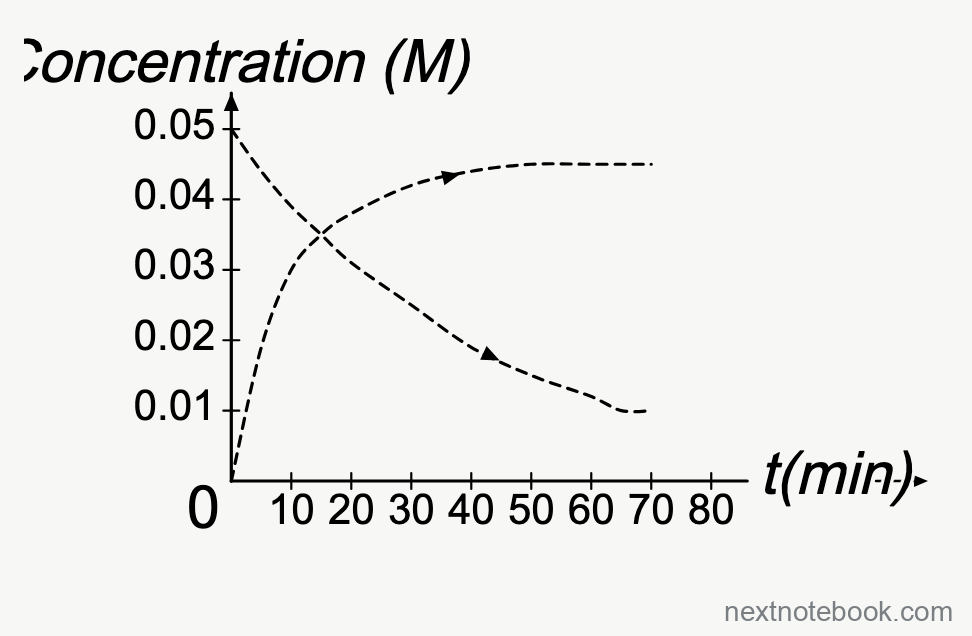 Tap an option to check.
Show answer
Correct answer: option 3,3 - Q3JEE Main 2026 · 8 Apr · Shift 2Given below are two statements: and
Statement I: When , the room temperature rate constant is doubled by a increase in temperature ( to )
Statement II: For a first order reactions , [graph of versus as a straight line through the origin] Here is the initial concentration of A and is half life of reaction.
In the light of the above statements, choose the correct answer from the options given below: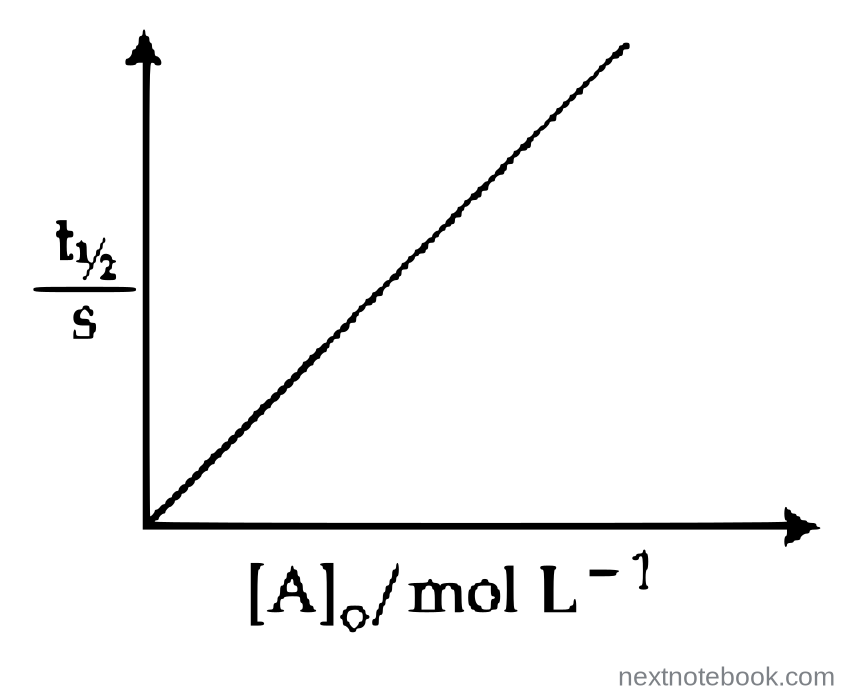 Tap an option to check.
Show answer
Correct answer: option 3,Statement I is true but Statement II is false - Q4JEE Main 2026 · 2 Apr · Shift 2Consider the reaction , for which the rate constant at is . Which of the following statements are true? A. When concentration of ‘’ is increased to four times, the rate of reaction becomes 16 times. B. The reaction is a second order reaction. C. The half-life period is independent of the concentration of . D. Decomposition of is an example of the above reaction. E. plotted against time is valid for the above reaction. Choose the correct answer from the options given below:
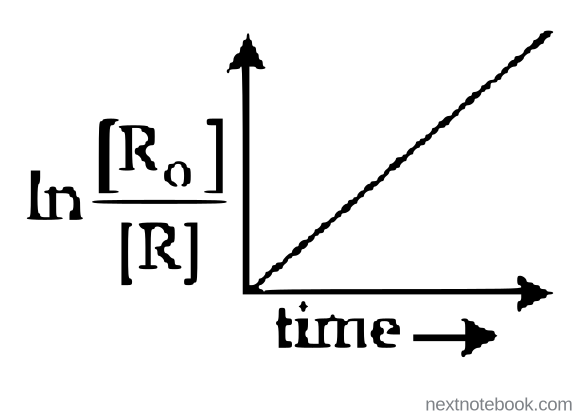 Tap an option to check.
Show answer
Correct answer: option 1,A and B Only - Q5JEE Main 2026 · 4 Apr · Shift 1Consider the first order reaction . The fraction of molecules decomposed in the given first order reaction can be expressed asTap an option to check.
Show answer
Correct answer: option 4, - Q6JEE Main 2026 · 5 Apr · Shift 1First order gas phase reaction = initial pressure of gas A, = total pressure of the reaction mixture at time Expression of rate constant () isTap an option to check.
Show answer
Correct answer: option 1, - Q7JEE Main 2026 · 2 Apr · Shift 1is the time required for the 100% completion of the reaction while is the time required for 50% of the reaction to be completed. Which of the following option correctly represents the relation between and for zero and first order reactions respectively?Tap an option to check.
Show answer
Correct answer: option 2,and - Q8JEE Main 2026 · 28 Jan · Shift 1An organic compound undergoes first order decomposition. The time taken for decomposition to and of its initial concentration are and respectively. What is the value of ? (take )Tap an option to check.
Show answer
Correct answer: option 4, - Q9JEE Main 2026 · 21 Jan · Shift 2Decomposition of is a first order reaction at and is given by . In a closed vessel, is allowed to decompose at . After minutes, the total pressure was . What is the rate constant (in ) of the reaction? ()Tap an option to check.
Show answer
Correct answer: option 4, - Q10JEE Main 2026 · 24 Jan · Shift 1is an endothermic reaction occurring in three steps (elementary). (i) (ii) (iii) Which of the following graphs between potential energy (-axis) vs reaction coordinate (-axis) correctly represents the reaction profile of ?Tap an option to check.
Show answer
Correct answer: option 3,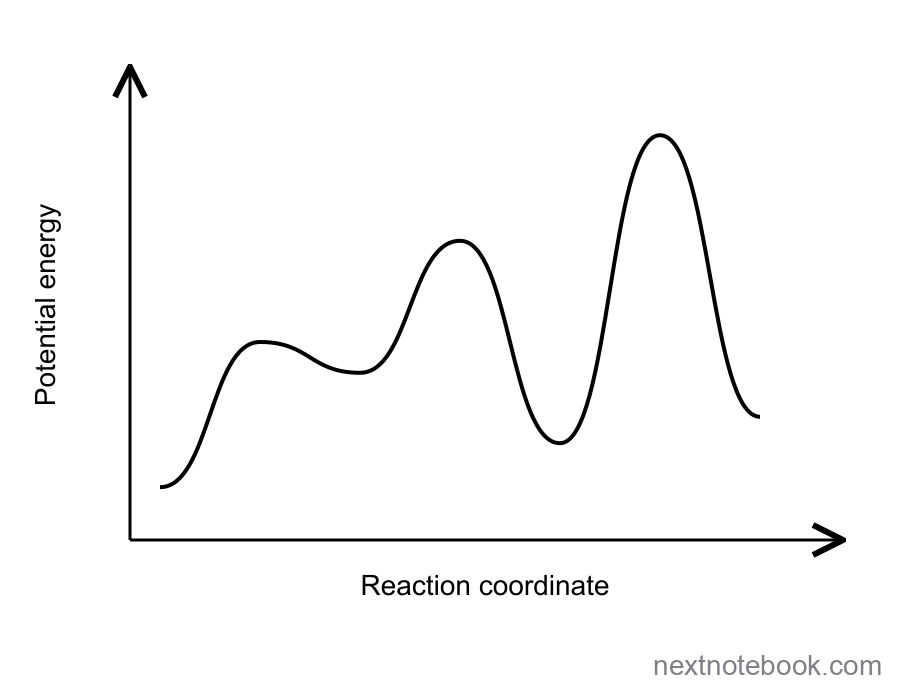
Show the other 50 questions
- Q11JEE Main 2026 · 4 Apr · Shift 2Consider the given graph showing variation of reactant concentration with time. Three different reactions were started with identical initial concentration of reactants. Which of the following statement is correct?
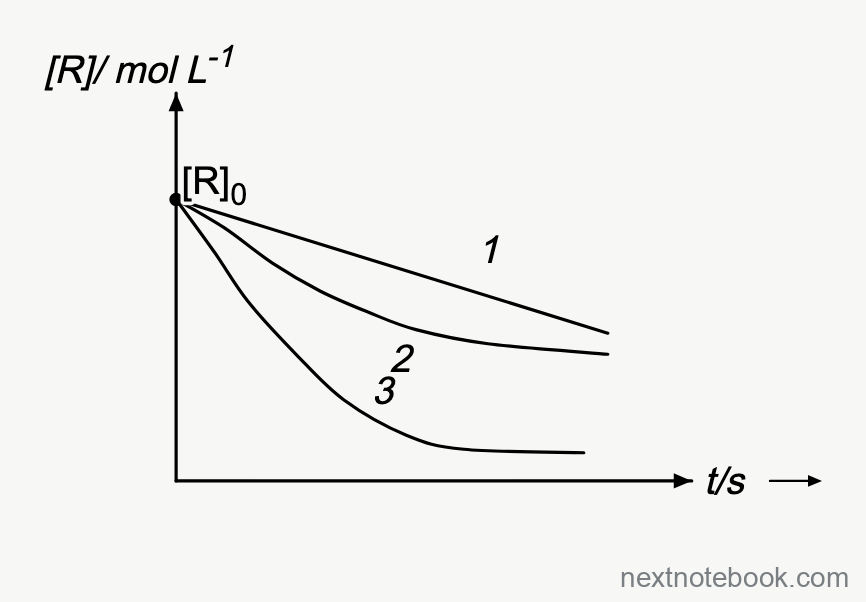 Tap an option to check.
Show answer
Correct answer: option 2,The rate constant of reaction 3 is larger than the rate constant of reaction 2 if the order of reaction is same for both. - Q12JEE Main 2026 · 22 Jan · Shift 2Correct statements regarding Arrhenius equation among the following are: A. Factor corresponds to fraction of molecules having kinetic energy less than . B. At a given temperature, lower the , faster is the reaction. C. Increase in temperature by about doubles the rate of reaction. D. Plot of vs gives a straight line with slope = . Choose the correct answer from the options given belowTap an option to check.
Show answer
Correct answer: option 1,B and C Only - Q13JEE Main 2026 · 24 Jan · Shift 1At in presence of a catalyst, activation energy of reaction is lowered by . The logarithm of the ratio of is.... (Consider that the frequency factor for both the reaction is same)Tap an option to check.
Show answer
Correct answer: option 4, - Q14JEE Main 2026 · 23 Jan · Shift 2Observe the following reactions at (K). I. . II. Both the reactions are started at 10:00 am. The rates of these reactions at 10:10 am are the same. The value of at 10:10 am is . The concentration of at 10:10 am is . What is the first order rate constant (in ) of reaction I?Tap an option to check.
Show answer
Correct answer: option 2, - Q15JEE Main 2026 · 22 Jan · Shift 1The temperature at which the rate constants of the given two gaseous reactions become equal is _____ K. (Nearest integer) Given:Tap Show answer to check.
Show answer
Answer: 1303 - Q16JEE Main 2026 · 2 Apr · Shift 2Consider the following gas phase reaction being carried out in a closed vessel at . time (min) total pressure of the system (mm Hg) The pressure of at 30 minutes time interval would be __________ . (nearest integer)
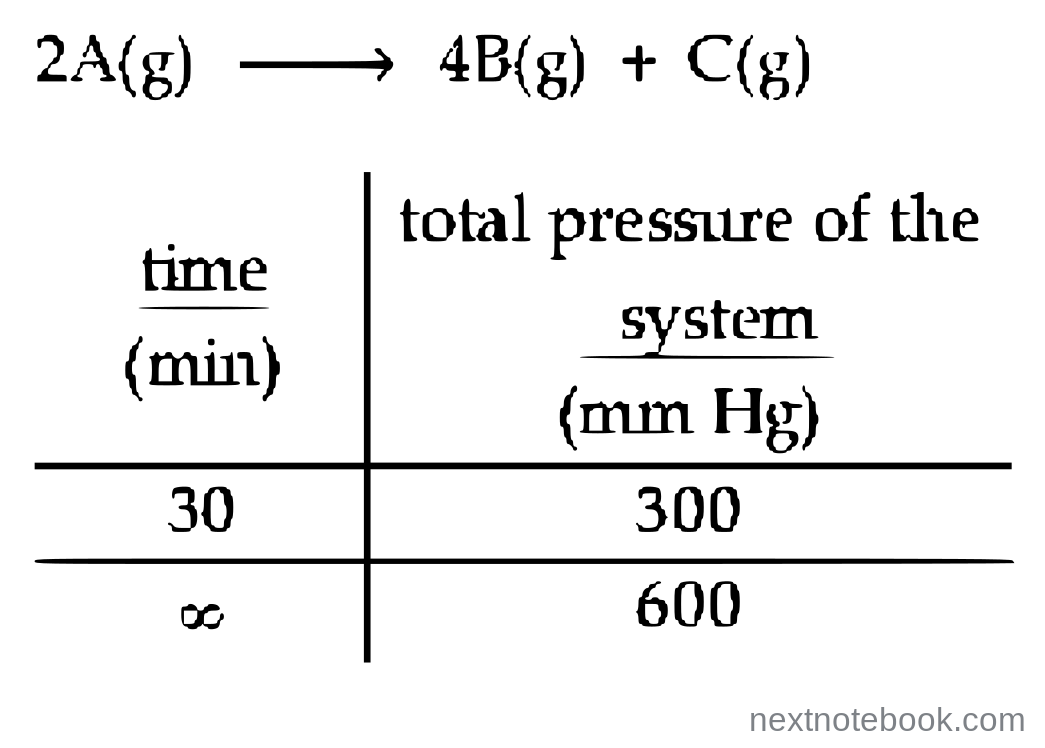 Tap Show answer to check.
Show answer
Answer: 20 - Q17JEE Main 2026 · 23 Jan · Shift 1For the thermal decomposition of reactant , the following plot is constructed. The half life of the reaction is '' min. ____ min (Nearest integer)
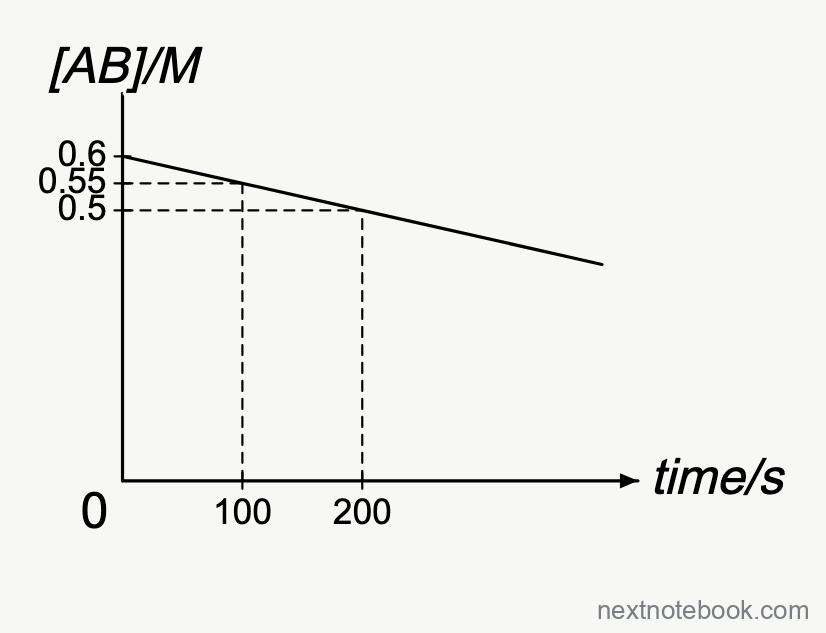 Tap Show answer to check.
Show answer
Answer: 10 - Q18JEE Main 2026 · 22 Jan · Shift 2Consider and are two reactions. If the rate constant of the reaction can be expressed by the following equation and activation energy of reaction is th of the reaction , then the value is ____ . (Nearest Integer)Tap Show answer to check.
Show answer
Answer: 57 - Q19JEE Main 2026 · 6 Apr · Shift 1Sucrose hydrolyses in acidic medium into glucose and fructose by first order rate law with hour. The percentage of sucrose remaining after 6 hours is _____. (Nearest integer) (Given: and )Tap Show answer to check.
Show answer
Answer: 25 - Q20JEE Main 2026 · 2 Apr · Shift 1For reaction , rate constant at If activation energy for the above reaction is , then the temperature (in ) at which rate constant, is __________. (Nearest integer) Given: , , ,Tap Show answer to check.
Show answer
Answer: 41 - Stuck on one?Log in free
See the step-by-step solution and video for every question, free with login.
- Q21JEE Main 2026 · 28 Jan · Shift 2Consider the two first-order reactions: and . The rate constant for the first reaction at is double the rate constant at . At , of the first reaction is completed in hours. The activation energy of the second reaction is half of that of the first reaction. If the rate constant of the second reaction at is double the rate constant of the first reaction at the same temperature, find the rate constant for the second reaction at , expressed as ____ (nearest integer).Tap Show answer to check.
Show answer
Answer: 5 - Q22JEE Main 2026 · 4 Apr · Shift 2For a first order reaction ____________ . (Nearest integer)
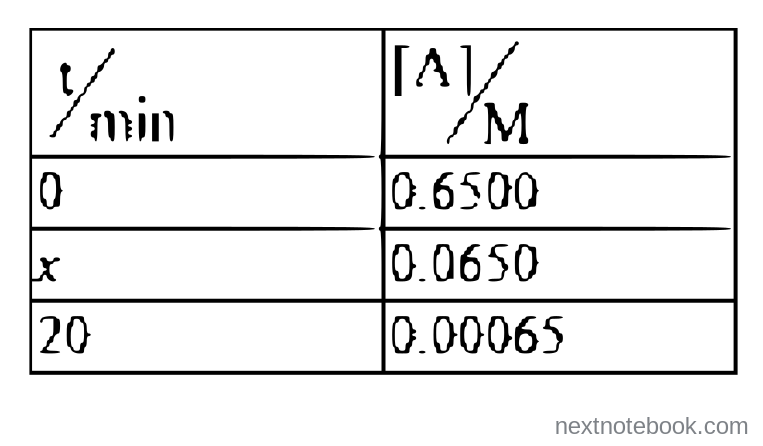 Tap Show answer to check.
Show answer
Answer: 7 - Q23JEE Main 2026 · 5 Apr · Shift 2For a reaction at , the half life is plotted as a function of initial concentration of as given below. Figure: A graph of versus . The graph is a straight line through the origin, with at and at . The value of in the given figure is __________ (Nearest integer)
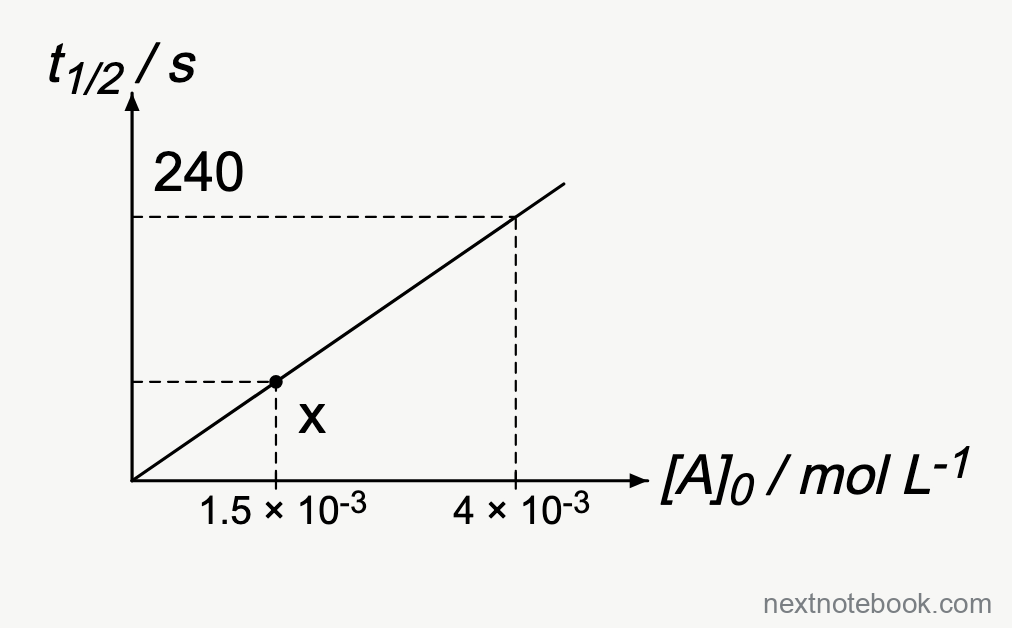 Tap Show answer to check.
Show answer
Answer: 90 - Q24JEE Main 2026 · 21 Jan · Shift 1Pre-exponential factors of two different reactions of same order are identical. Let activation energy of first reaction exceeds the activation energy of second reaction by . If and are the rate constants of first and second reaction respectively at , then will be (nearest integer). Given: .Tap Show answer to check.
Show answer
Answer: 8 - Q25JEE Main 2026 · 5 Apr · Shift 1If the half life of a first order reaction is minutes then the time required for completion of of the reaction will be ________ minutes. (Given: )Tap Show answer to check.
Show answer
Answer: 46 - Q26JEE Main 2026 · 6 Apr · Shift 2Decomposition of a hydrocarbon follows the equation . The activation energy of reaction is __________ . (Nearest Integer) Given:Tap Show answer to check.
Show answer
Answer: 232 - Q27JEE Main 2025 · 4 Apr · Shift 2Half life of zero order reaction A product is 1 hour, when initial concentration of reactant is . The time required to decrease concentration of A from to is:Tap an option to check.
Show answer
Correct answer: option 3,min - Q28JEE Main 2025 · 8 Apr · Shift 2In a first order decomposition reaction, the time taken for the decomposition of reactant to one fourth and one eighth of its initial concentration are and (s), respectively. The ratio will be:Tap an option to check.
Show answer
Correct answer: option 4, - Q29JEE Main 2025 · 4 Apr · Shift 2Consider the following plots of log of rate constant () vs for three different reactions. The correct order of activation energies of these reactions is:
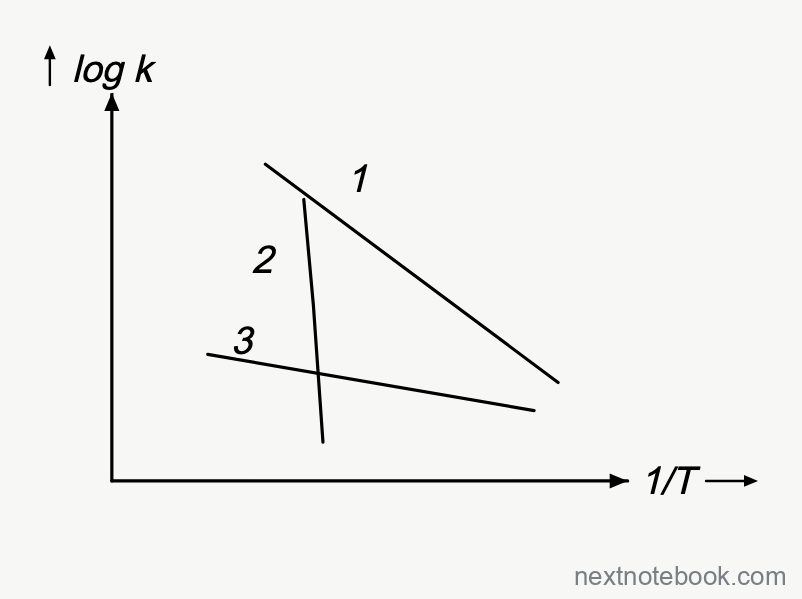 Tap an option to check.
Show answer
Correct answer: option 1, - Q30JEE Main 2025 · 2 Apr · Shift 2Reactant converts to product through the given mechanism (with the net evolution of heat): , slow, ; , fast, ; , fast, . Which of the following represents the above reaction mechanism?Tap an option to check.
Show answer
Correct answer: option 1,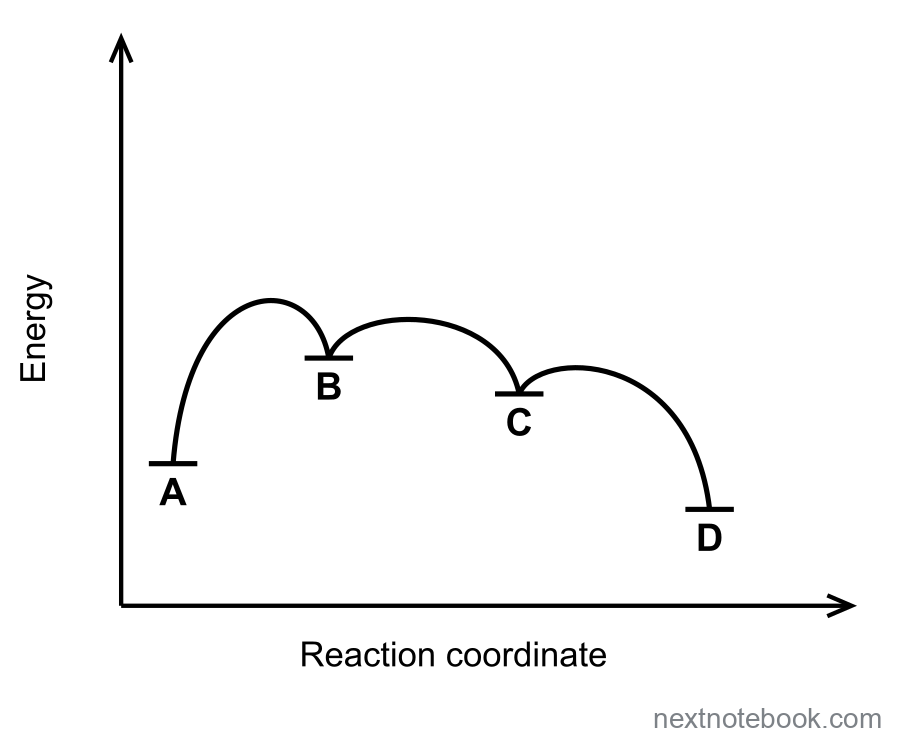
- Stuck on one?Log in free
See the step-by-step solution and video for every question, free with login.
- Q31JEE Main 2025 · 28 Jan · Shift 2For bacterial growth in a cell culture, growth law is very similar to the law of radioactive decay. Which of the following graphs is most suitable to represent bacterial colony growth? Where - Number of Bacteria at any time, - Initial number of Bacteria.Tap an option to check.
Show answer
Correct answer: option 2,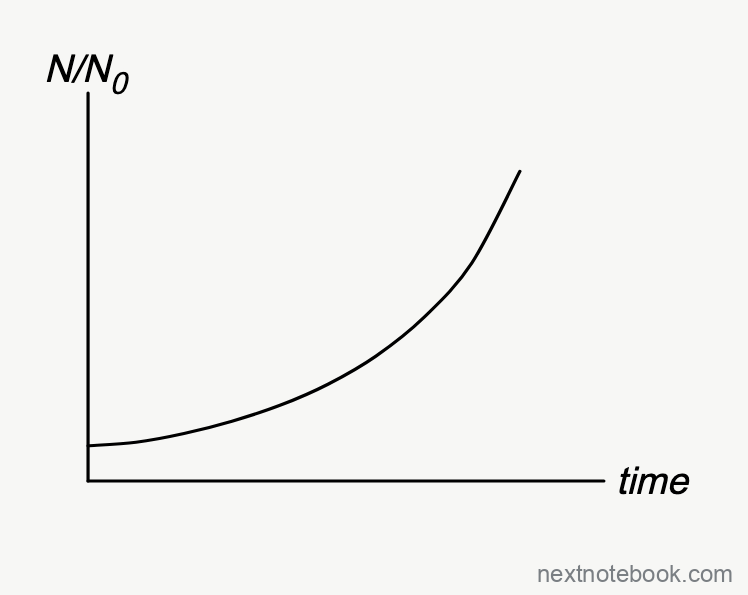
- Q32JEE Main 2025 · 7 Apr · Shift 1Reaction is a first order reaction. It was started with pure A | Pressure of system at time 10 | 160 | 240 Which of the following option is incorrect?Tap an option to check.
Show answer
Correct answer: option 3,Rate constant of the reaction is - Q33JEE Main 2025 · 24 Jan · Shift 2Given below are two statements: Statement (I): [graph of versus , a horizontal line] is valid for a first order reaction. Statement (II): [graph of versus time, a straight line with slope = ] is valid for a first order reaction. In the light of the above statements, choose the correct answer from the options given below:
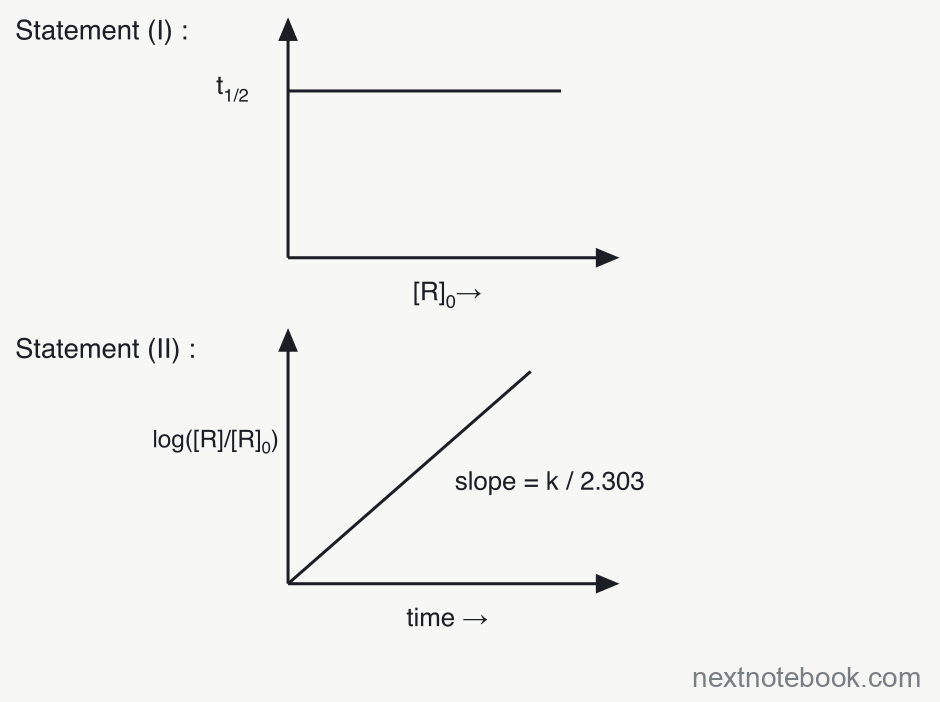 Tap an option to check.
Show answer
Correct answer: option 3,Statement I is true but Statement II is false - Q34JEE Main 2025 · 28 Jan · Shift 2Consider an elementary reaction If the volume of reaction mixture is suddenly reduced to of its initial volume, the reaction rate will become ‘’ times of the original reaction rate. The value of is:Tap an option to check.
Show answer
Correct answer: option 4,9 - Q35JEE Main 2025 · 28 Jan · Shift 1For a given reaction , is related to as given in table. Given: Which of the following is true? A. The order of the reaction is . B. If is , then is C. The order of the reaction changes to if the concentration of reactant changes from to . D. is for Choose the correct answer from the options given below: Options:Tap an option to check.
Show answer
Correct answer: option 3,A, B and D Only - Q36JEE Main 2025 · 7 Apr · Shift 1A person's wound was exposed to some bacteria and then bacterial growth started to happen at the same place. The wound was later treated with some antibacterial medicine and the rate of bacterial decay() was found to be proportional with the square of the existing number of bacteria at any instance. Which of the following set of graphs correctly represents the ‘before’ and ‘after’ situation of the application of the medicine? [Given: = No. of bacteria, = time, bacterial growth follows order kinetics.]Tap an option to check.
Show answer
Correct answer: option 4,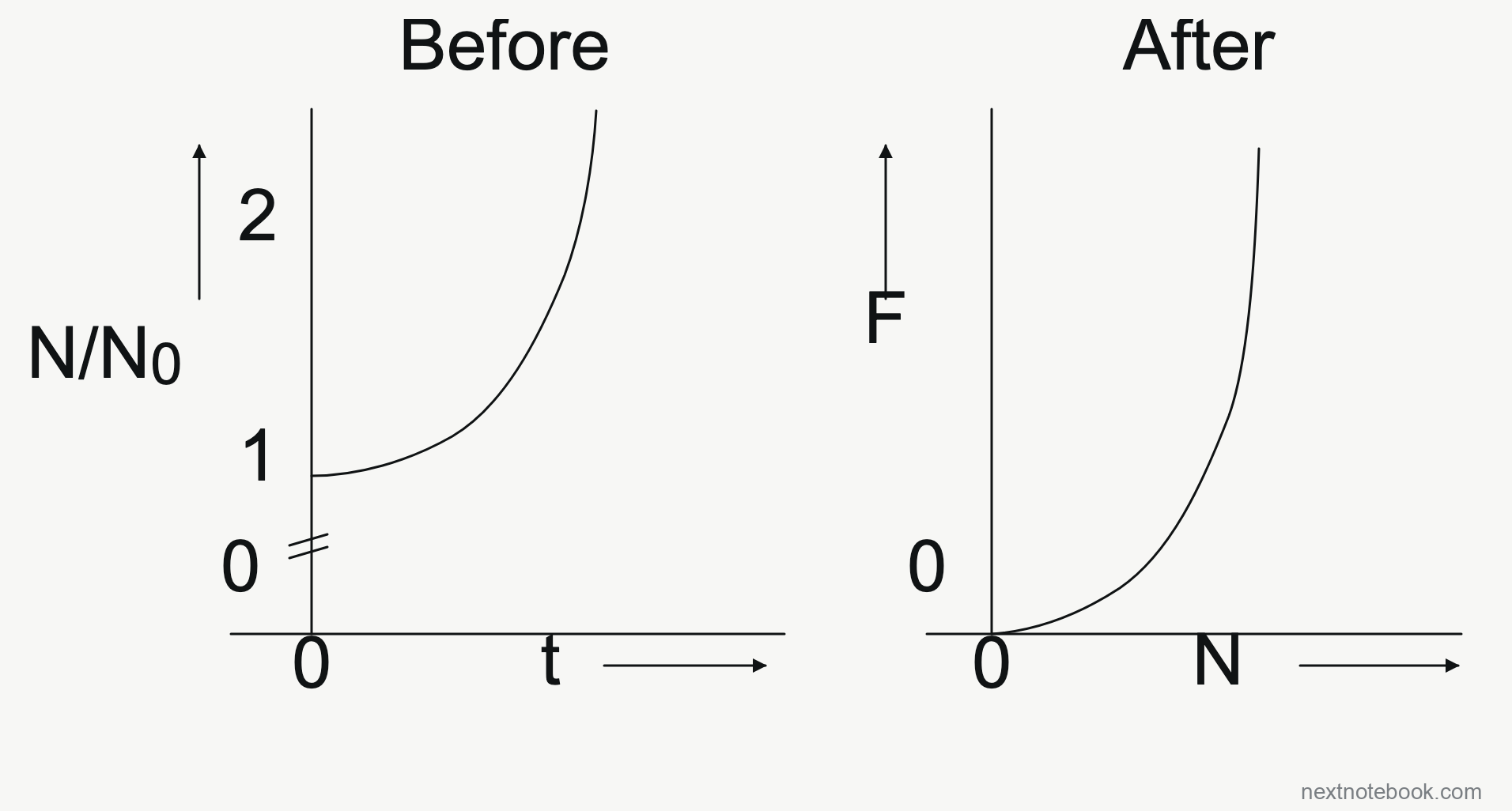
- Q37JEE Main 2025 · 3 Apr · Shift 2Consider the following statements related to temperature dependence of rate constants. Identify the correct statements. A. The Arrhenius equation holds true only for an elementary homogenous reaction. B. The unit of is same as that of in Arrhenius equation. C. At a given temperature, a low activation energy means a fast reaction. D. and as used in Arrhenius equation depend on temperature. E. When , and become interdependent. Choose the correct answer from the options given below:Tap an option to check.
Show answer
Correct answer: option 2,B and C Only - Q38JEE Main 2025 · 7 Apr · Shift 2is a first order reaction. Time The reaction was started with reactant A only. Which of the following expression is correct for rate constant ?Tap an option to check.
Show answer
Correct answer: option 2, - Q39JEE Main 2025 · 23 Jan · Shift 2Which of the following graphs most appropriately represents a zero order reaction?Tap an option to check.
Show answer
Correct answer: option 4,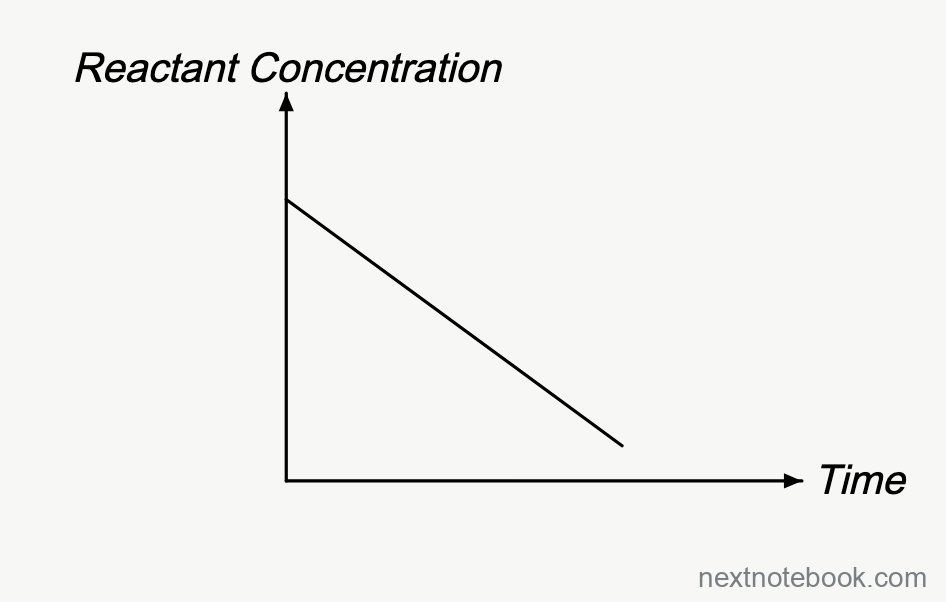
- Q40JEE Main 2025 · 22 Jan · Shift 2Consider the given figure and choose the correct option:
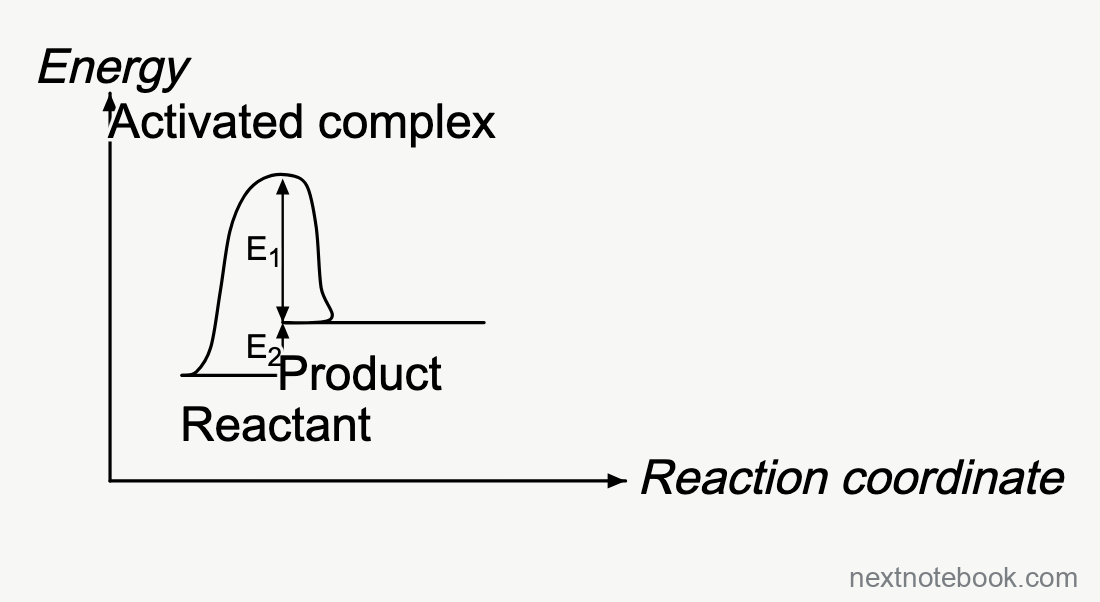 Tap an option to check.
Show answer
Correct answer: option 1,Activation energy of forward reaction is E1 + E2 and product is less stable than reactant. - Stuck on one?Log in free
See the step-by-step solution and video for every question, free with login.
- Q41JEE Main 2025 · 3 Apr · Shift 1In a reaction , initial concentrations of A and B are related as . The half lives of A and B are and , respectively. If they start to disappear at the same time, both following first order kinetics, after how much time will the concentration of both the reactants be same?Tap an option to check.
Show answer
Correct answer: option 2, - Q42JEE Main 2025 · 4 Apr · Shift 1For A2 + B2 ⇌ 2AB Ea for forward and backward reaction are 180 and 200 kJ mol^-1 respectively. If catalyst lowers Ea for both reaction by 100 kJ mol^-1. Which of the following statement is correct?Tap an option to check.
Show answer
Correct answer: option 4,Catalyst does not alter the Gibbs energy change of a reaction. - Q43JEE Main 2025 · 4 Apr · Shift 1Rate law for a reaction between A and B is given by r = k[A]n [B]m. If concentration of A is doubled and concentration of B is halved from their initial value, the ratio of new rate of reaction to the initial rate of reaction (r2)/(r1) isTap an option to check.
Show answer
Correct answer: option 2,2^(n − m) - Q44JEE Main 2025 · 2 Apr · Shift 2For the reaction the following graph was obtained. The time required (in seconds) for the concentration of to reduce to (if the initial concentration of was ) is ________. (Nearest integer) Given:
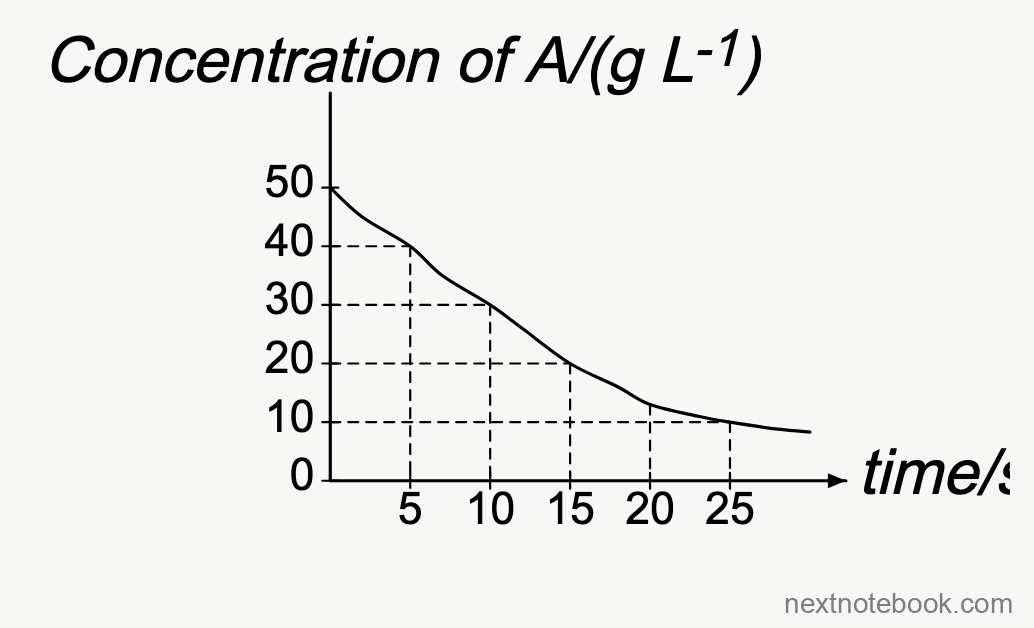 Tap Show answer to check.
Show answer
Answer: 43 - Q45JEE Main 2025 · 2 Apr · Shift 1For the reaction products. The graph of versus is a straight line through the origin with slope = (appropriate units). The concentration of A at 10 minutes is ______ × (nearest integer). The reaction was started with of A.
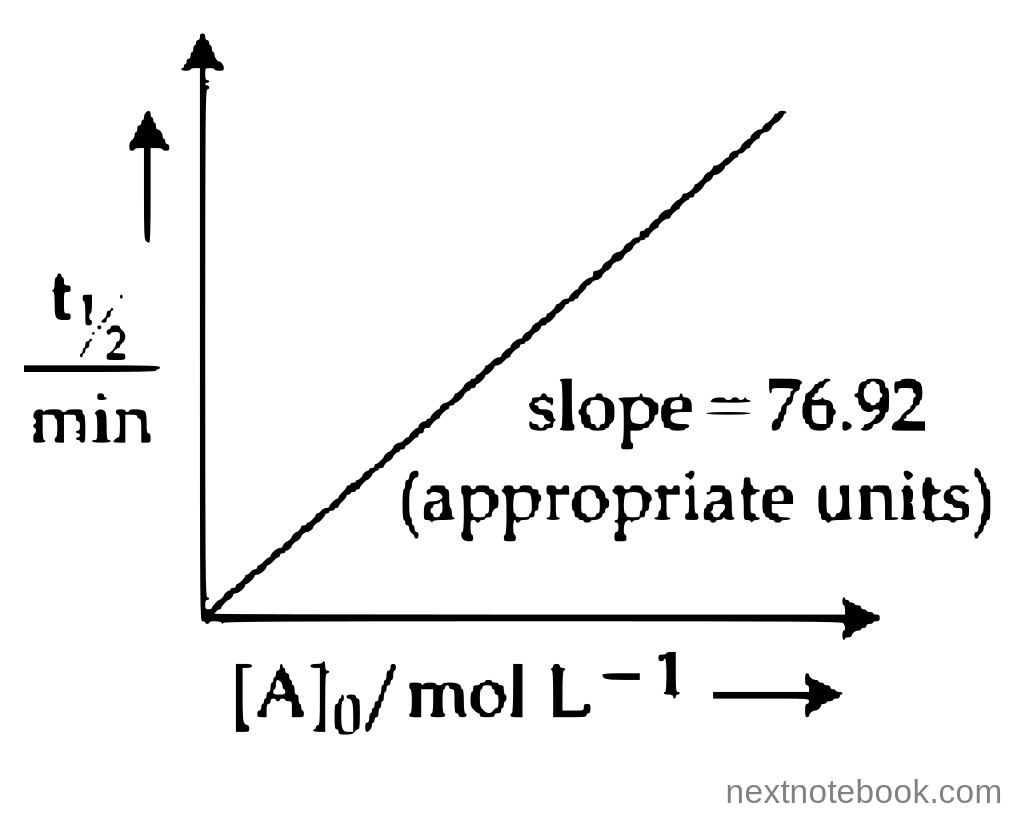 Tap Show answer to check.
Show answer
Answer: 2435 - Q46JEE Main 2025 · 24 Jan · Shift 2Consider a complex reaction taking place in three steps with rate constants , and respectively. The overall rate constant is given by the expression . If the activation energies of the three steps are 60, 30 and 10 respectively, then the overall energy of activation in is __________. (Nearest integer)Tap Show answer to check.
Show answer
Answer: 20 - Q47JEE Main 2024 · 8 Apr · Shift 2For reaction If the rate of formation of B is set to be zero then the concentration of B is given by:Tap an option to check.
Show answer
Correct answer: option 3, - Q48JEE Main 2024 · 31 Jan · Shift 1Integrated rate law equation for a first order gas phase reaction is given by (where is initial pressure and is total pressure at time )Tap an option to check.
Show answer
Correct answer: option 2, - Q49JEE Main 2024 · 30 Jan · Shift 1The rate of First reaction is at minutes and at minutes after initiation. Half life of the reaction is __________ minutes (Given , )Tap Show answer to check.
Show answer
Answer: 24 - Q50JEE Main 2024 · 4 Apr · Shift 1Consider the following transformation involving a first order elementary reaction in each step at constant temperature: . Step 1: ; Step 2: ; Step 3: . Details: Step 1 has rate constant and activation energy ; Step 2 has and ; Step 3 has and . If the overall rate constant is and the overall activation energy is , then the value of is ____ (nearest integer).Tap Show answer to check.
Show answer
Answer: 100 - Stuck on one?Log in free
See the step-by-step solution and video for every question, free with login.
- Q51JEE Main 2024 · 30 Jan · Shift 2required for a reaction is produced by decomposition of in as by equation . The initial concentration of is and it is after 30 minutes. The rate of formation of is , value of is __________. (nearest integer)Tap Show answer to check.
Show answer
Answer: 17 - Q52JEE Main 2024 · 8 Apr · Shift 1Consider the following reaction The time taken for A to become th of its initial concentration is twice the time taken to become of the same. Also, when the change of concentration of B is plotted against time, the resulting graph gives a straight line with a negative slope and positive intercept on the concentration axis. The overall order of the reaction is ______.Tap Show answer to check.
Show answer
Answer: 1 - Q53JEE Main 2024 · 31 Jan · Shift 2for a reaction of A is decomposed in minutes. The time taken for decomposition of A is ____________ minutesTap Show answer to check.
Show answer
Answer: 399 - Q54JEE Main 2024 · 5 Apr · Shift 2Consider the following single step reaction in gas phase at constant temperature The initial rate of the reaction is recorded as when the reaction starts with pressure of A and pressure of B. After some time, the rate is recorded when the pressure of C becomes . The ratio is ________ . (Nearest integer)Tap Show answer to check.
Show answer
Answer: 315 - Q55JEE Main 2024 · 1 Feb · Shift 2The following data were obtained during the first order thermal decomposition of a gas A at constant volume: S. No. Time/ Total pressure/ (1) (2) The rate constant of the reaction is ______ (nearest integer)Tap Show answer to check.
Show answer
Answer: 2 - Q56JEE Main 2024 · 4 Apr · Shift 2Consider the following reaction, the rate expression of which is given below rate The reaction is initiated by taking concentration of A and B each. If the rate constant (k) is , then the time taken for A to become is _________sec. (nearest integer)Tap Show answer to check.
Show answer
Answer: 50 - Q57JEE Main 2024 · 6 Apr · Shift 2Consider the two different first order reactions given below (Reaction 1) (Reaction 2) The ratio of the half life of Reaction 1: Reaction 2 is . If and represent the time take to complete and of Reaction 1 and Reaction 2, respectively, then the value of the ratio is __________ (nearest integer) [Given: and ]Tap Show answer to check.
Show answer
Answer: 17 - Q58JEE Main 2024 · 9 Apr · Shift 2Consider the following first order gas phase reaction at constant temperature If the total pressure of the gases is found to be after , and upon the complete decomposition of A after a very long time, then the rate constant of the given reaction is__________ (nearest integer) [Given: ]Tap Show answer to check.
Show answer
Answer: 3 - Q59JEE Main 2024 · 6 Apr · Shift 1Time required for completion of a first order reaction is times the time required for completion of reaction (nearest integer)Tap Show answer to check.
Show answer
Answer: 3 - Q60JEE Main 2024 · 5 Apr · Shift 1During Kinetic study of reaction , the following results were obtained: initial rate of formation of D I II III IV Based on above data, overall order of the reaction is__________.Tap Show answer to check.
Show answer
Answer: 3
Showing 60 of 199 questions. The rest are free after login.
Practise Integrated Rate Laws and First-Order Reaction Applications first. Solutions and video answers are free.