#8 OF 19 IN CHEMISTRY
Aldehydes, Ketones and Carboxylic Acids JEE Main PYQs (2016–2026) with answers
196 questions across 11 JEE Main years, about 1 a paper (≈5 marks). The topics asked most are Nucleophilic addition reactions of aldehydes and ketones and Other reactions of aldehydes and ketones.
- 78% of papers
- ≈5 marks a paper
- Class 12 · Ch 8
From official NTA papers · Updated 9 Nov 2026
What's asked most
- Nucleophilic addition reactions of aldehydes and ketones23%Addition of alcohols: hemiacetals and acetals · Addition of Grignard reagents
- Other reactions of aldehydes and ketones23%Oxidation of aldehydes and ketones · Oxidation and reduction of aldehydes
- Tests and important examples of aldehydes and ketones23%Oxidation by Fehling's solution · Oxidation by Tollens' reagent
- Preparation of aldehydes and ketones12%Preparation of aldehydes and ketones from alcohols · Preparation from carboxylic acids and their derivatives
- Introduction, classification, nomenclature and structure3%Nomenclature of carbonyl compounds and carboxylic acids · Introduction to aldehydes, ketones and carboxylic acids
See all 6 topics
- Carboxylic acids: physical properties, acidity and reactions<1%Physical properties of carboxylic acids
How often it comes
See as a table
| Year | Questions |
|---|---|
| 2026 | 23 |
| 2025 | 17 |
| 2024 | 22 |
| 2023 | 28 |
| 2022 | 25 |
| 2021 | 39 |
| 2020 | 10 |
| 2019 | 25 |
| 2018 | 3 |
| 2017 | 3 |
| 2016 | 1 |
Where it fits
SYLLABUSJEE Main Chemistry syllabusWEIGHTAGE#8 of 19 Chemistry chaptersNCERTClass 12 Chemistry NCERT, Chapter 8
Questions here often join up with
All 196 questions
- Q1JEE Main 2026 · 22 Jan · Shift 1Match the LIST-I with LIST-II Choose the correct answer from the options given below
List-I List-II List-I Reagents List-II Name of Reaction involving carbonyl compound A. NH2–NH2, KOH I. Tollen's Test B. Ag(NH3)2OH II. Clemmensen Reduction C. Aq. CuSO4, Sodium Potassium tartrate, KOH III. Wolff-Kishner Reduction D. Zn–Hg,HCl IV. Fehling's Test Tap an option to check.Show answer
Correct answer: option 1,A-III, B-I, C-IV, D-II - Q2JEE Main 2026 · 24 Jan · Shift 1A student is given one compound among the following compounds that gives positive test with Tollen's reagent. The compounds (shown in the figure) are:
(A) 2-methoxytetrahydrofuran,
(B) 3-methoxytetrahydrofuran,
(C) tetrahydrofuran-2-ol (2-hydroxytetrahydrofuran),
(D) tetrahydrofuran-3-ol. The compound is: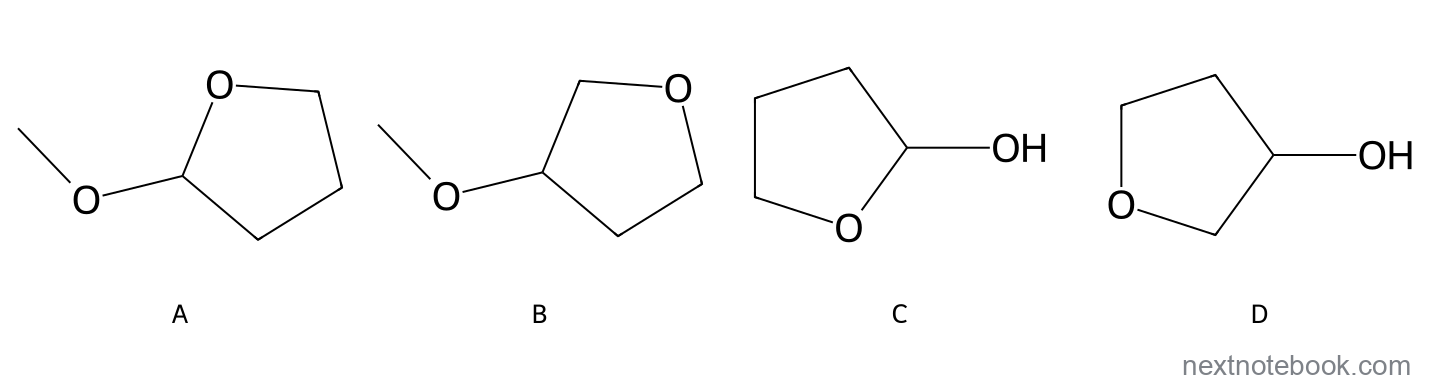 Tap an option to check.
Show answer
Correct answer: option 2,C - Q3JEE Main 2026 · 24 Jan · Shift 2The unsaturated ether on acidic hydrolysis produces carbonyl compounds as shown below: Based on this, predict the solution/reagent that will help to distinguish "P" and "Q" obtained in the following reaction:Tap an option to check.
Show answer
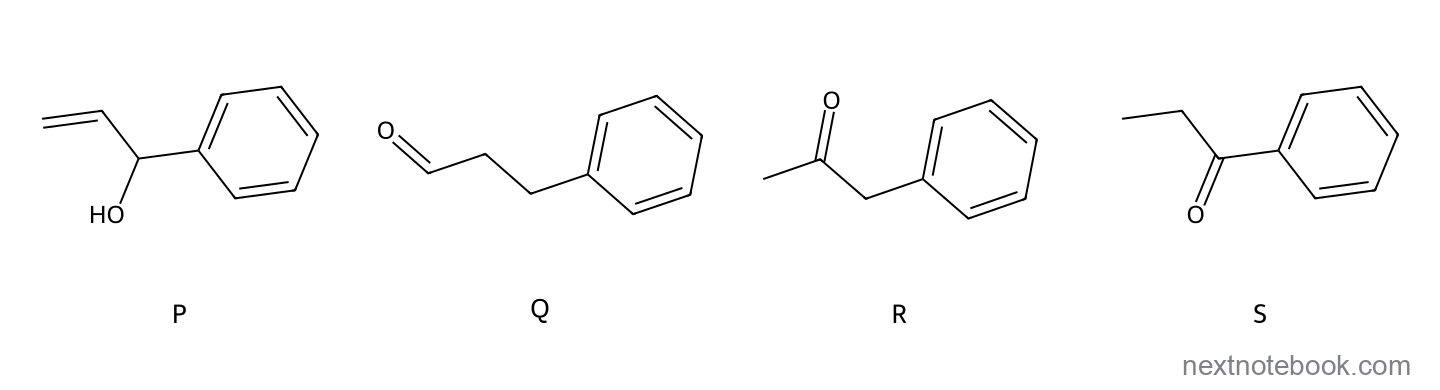
Correct answer: option 1,Fehling solution - Q4JEE Main 2026 · 28 Jan · Shift 1Given below are the four isomeric compounds (P, Q, R, S), shown in the figure: P is 1-phenylprop-2-en-1-ol, Q is 3-phenylpropanal, R is 1-phenylpropan-2-one and S is 1-phenylpropan-1-one. Identify correct statements from below. A. Q, R and S will give precipitate with 2,4-DNP. B. P and Q will give positive Bayer's test. C. Q and R will give sooty flame. D. R and S will give yellow precipitate with . E. Q alone will deposit silver with Tollen's reagent. Choose the correct option.
 Tap an option to check.
Show answer
Correct answer: option 2,A, C and E only - Q5JEE Main 2026 · 22 Jan · Shift 2The compound , reacts with acetophenone to form a single product via cross-Aldol condensation. The compound on reaction with conc. forms a substituted benzyl alcohol as one of the two products. The compound is:Tap an option to check.
Show answer
Correct answer: option 2,4-methoxy benzaldehyde - Q6JEE Main 2026 · 21 Jan · Shift 1An organic compound " P " of molecular formula gives positive Iodoform test but negative Tollen's test. When "P" is treated with dilute acid, it produces "Q". "Q" gives positive Tollen's test and also iodoform test. The structure of " P " is:Tap an option to check.
Show answer
Correct answer: option 1,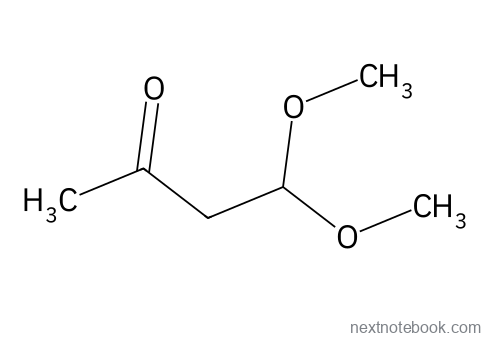
- Q7JEE Main 2026 · 23 Jan · Shift 2Iodoform test can differentiate between A. Methanol and Ethanol B. and C. Cyclohexene and cyclohexanone D. Diethyl ether and Pentan-3-one E. Anisole and acetone Choose the correct answer from the options given below:Tap an option to check.
Show answer
Correct answer: option 3,A & E Only - Q8JEE Main 2026 · 23 Jan · Shift 1'' is the product which is obtained from propanenitrile and stannous chloride in the presence of hydrochloric acid followed by hydrolysis. '' is the product which is obtained from the but-2-ene by the ozonolysis followed by hydrolysis. From the following, which product is not obtained when one mole of '' and one mole of '' react with each other in the presence of alkali followed by heating?Tap an option to check.
Show answer
Correct answer: option 1,3-Methylbut-2-enal - Q9JEE Main 2026 · 5 Apr · Shift 1"P" is a hydrocarbon of molecular formula:- . On ozonolysis, "P" forms "Q". "Q" on treatment with alkali under reflux condition produces "R", which on treatment with gives a yellow precipitate. Acidification of the solution gives "S". The structure of "S" is given below:- 2-methylcyclopent-1-ene-1-carboxylic acid. The correct structure of "P" is
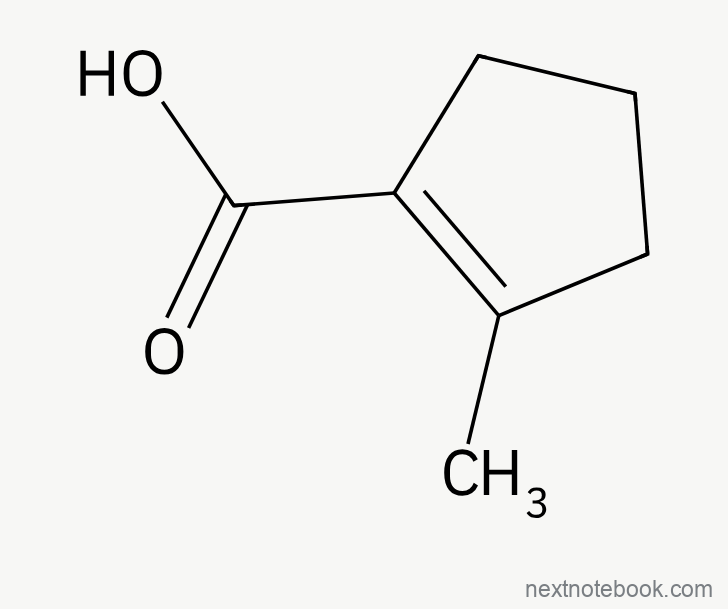 Tap an option to check.
Show answer
Correct answer: option 4,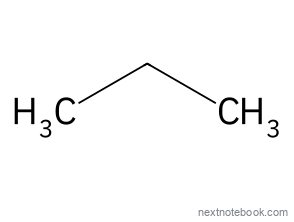
- Q10JEE Main 2026 · 6 Apr · Shift 2‘’ is the product which is obtained by the hydrolysis of prop-1-yne in the presence of mercuric sulphate under dilute acidic medium at . ‘’ is the product which is obtained by the reaction of ethane nitrile with methyl magnesium bromide in dry ether followed by hydrolysis. IUPAC name of product obtained from ‘’ and ‘’ in the presence of barium hydroxide followed by heating is:Tap an option to check.
Show answer
Correct answer: option 2,4 - Methylpent-3-en-2-one
Show the other 50 questions
- Q11JEE Main 2026 · 24 Jan · Shift 1Consider the following two reactions A and B. (A) phenol (shown in the figure) Main Product + gas . (B) benzoic acid (shown in the figure) Main Product + gas . Numerical value of [molar mass of + molar mass of ] is ____.
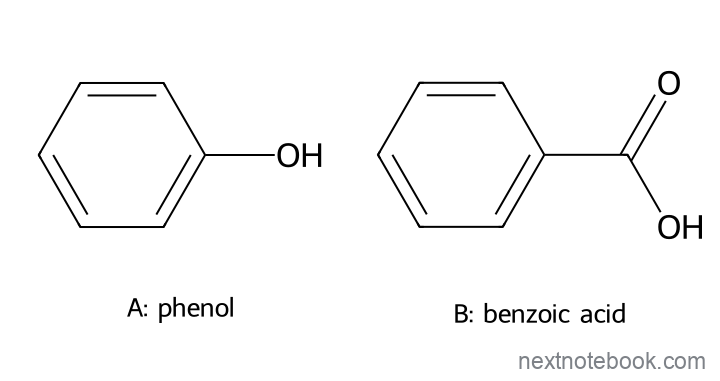 Tap an option to check.
Show answer
Correct answer: option 4,46 - Q12JEE Main 2026 · 5 Apr · Shift 2Complete the following reaction sequence and give the name of major product ‘P’. (Major product); (i) (ii) (iii) /Red (iv)
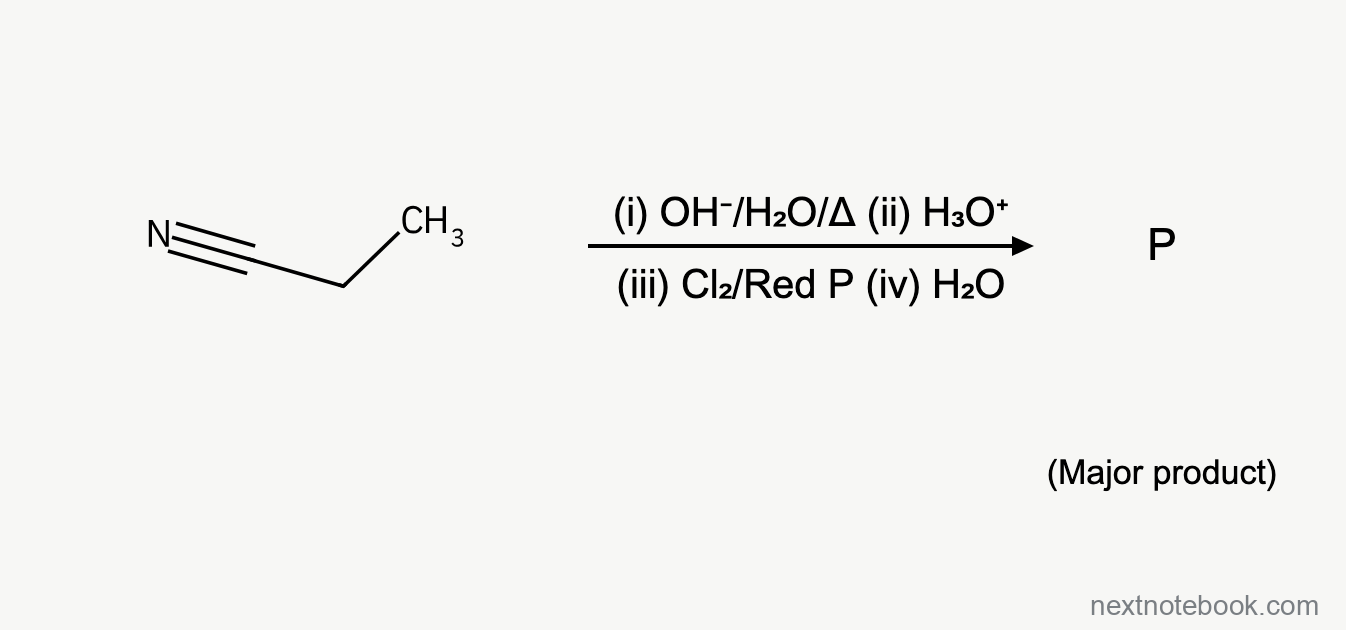 Tap an option to check.
Show answer
Correct answer: option 1,2-Chloropropanoic acid - Q13JEE Main 2026 · 6 Apr · Shift 2An optically active alkyl bromide , reacts with ethanolic KOH to form major compound [A] which reacts with bromine to give compound [B]. Compound [B] reacts with ethanolic KOH and sodamide to give compound [C]. One molecule of water adds to compound [C] on warming with mercuric sulphate and dilute sulphuric acid at to form compound [D]. The functional group in compound D will be confirmed by:Tap an option to check.
Show answer
Correct answer: option 1,Haloform test - Q14JEE Main 2026 · 2 Apr · Shift 2An organic compound “” where molar ratio of , and are equal, on treatment with KOH under reflux followed by acidification produced “”. The most likely structure of “” is: [Molar mass of ‘’ is ]Tap an option to check.
Show answer
Correct answer: option 3,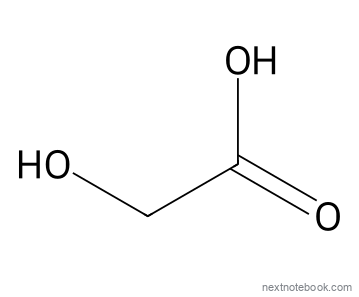
- Q15JEE Main 2026 · 5 Apr · Shift 2Given below are two statements:
Statement I: The condensation reaction between and under optimum pH will produce
Statement II: The molecule, will generate in the presence of dilute acid.
In the light of the above statements, choose the correct answer from the options given below:Tap an option to check.Show answer
Correct answer: option 4,Statement I is false but Statement II is true - Q16JEE Main 2026 · 23 Jan · Shift 2Which of the following statements are TRUE about Haloform reaction?: A. Sodium hypochlorite reacts with to give . B. is a reducing agent. C. -unsaturated methylketone will give iodoform reaction. D. Isopropyl alcohol will not give iodoform test. E. Methanoic acid will give positive iodoform test.Tap an option to check.
Show answer
Correct answer: option 2,A & C Only - Q17JEE Main 2026 · 8 Apr · Shift 2Consider the following reaction. (i) (ii) (iii) (P) The major product (P) formed is:
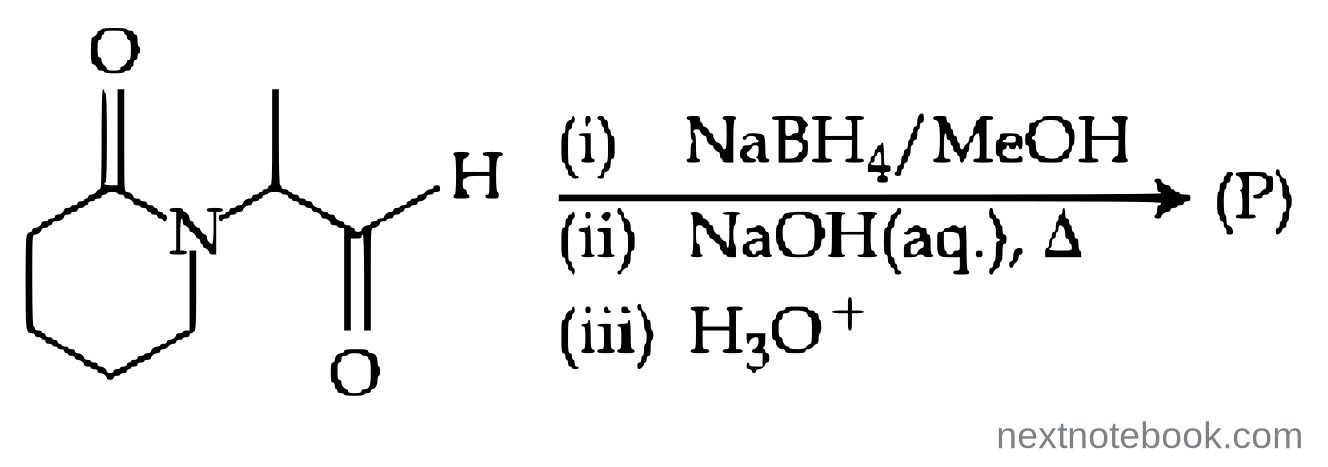 Tap an option to check.
Show answer
Correct answer: option 3,[figure] 6911212022. - Q18JEE Main 2026 · 2 Apr · Shift 2A molecule with following structure under mild acidic condition is hydrolysed to produce and . Identify the correct statements about and . A. Both and have same molar mass. B. and can be distinguished from each other by . C. and react with with same rates. D. and undergo addition reaction with . Choose the correct answer from the options given below:Tap an option to check.
Show answer
Correct answer: option 4,A and D Only - Q19JEE Main 2026 · 2 Apr · Shift 1Match List - I with List - II. Choose the correct answer from the options given below:
List-I (Mixture of Compounds) List-II (Reagent used to distinguish) A. Diethyl amine Ethyl amine I. Bromine water B. Acetaldehyde Acetone II. C. Ethanol Phenol III. Neutral D. Benzoic acid Cinnamic acid IV. Ammoniacal silver nitrate Tap an option to check.Show answer
Correct answer: option 4,A-II, B-IV, C-III, D-I - Q20JEE Main 2026 · 24 Jan · Shift 2Given below are two statements:
Statement I: Cross aldol condensation between two different aldehydes will always produce four different products.
Statement II: When semicarbazide reacts with a mixture of benzaldehyde and acetophenone under optimum pH, forms a condensation product with acetophenone only.
In the light of the above statements, choose the correct answer from the options given below.Tap an option to check.Show answer
Correct answer: option 1,Both Statement I and Statement II are false - Stuck on one?Log in free
See the step-by-step solution and video for every question, free with login.
- Q21JEE Main 2026 · 23 Jan · Shift 2Consider the following reaction of benzene. ⌬ + --anhydrous --> (P) --aq NaOH, --> (Q) In compound ( ), the percentage of oxygen is ____ . (Nearest integer)
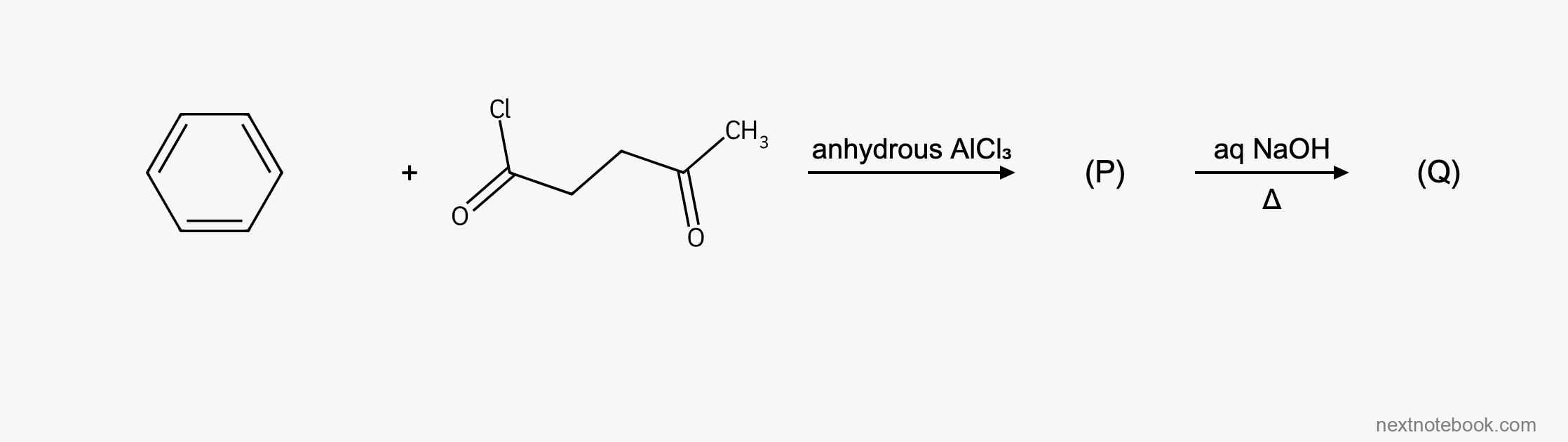 Tap Show answer to check.
Show answer
Answer: 10 - Q22JEE Main 2026 · 24 Jan · Shift 2Grignard reagent reacts with water and forms a gas . One gram of occupies at STP. on reaction with dry ice in dry ether followed by forms a compound . mole of will weigh _____ g. (Nearest integer)Tap Show answer to check.
Show answer
Answer: 6 - Q23JEE Main 2026 · 8 Apr · Shift 2‘’ is the product which is obtained from benzene by reacting it with carbon monoxide and hydrogen chloride in the presence of cuprous chloride. ‘’ is the major product obtained from the benzene by reacting it with ethanoyl chloride in the presence of anhydrous . Product (major) obtained by heating and in the presence of alkali is . Total number of (pi) electrons in is __________.Tap Show answer to check.
Show answer
Answer: 16 - Q24JEE Main 2025 · 28 Jan · Shift 1A molecule on treatment with acid undergoes rearrangement and gives . on ozonolysis followed by reflux under alkaline condition gives . The structure of is given in the figure (1-acetyl-2-methylcyclopent-1-ene). The structure of is
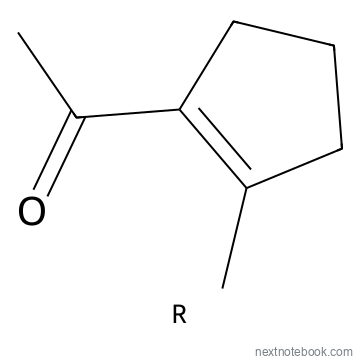 Tap an option to check.
Show answer
Correct answer: option 1,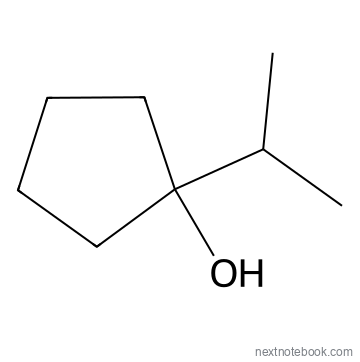
- Q25JEE Main 2025 · 8 Apr · Shift 21,2-dibromocyclooctane (i) (alc.) (ii) (iii) (iv) → major product is
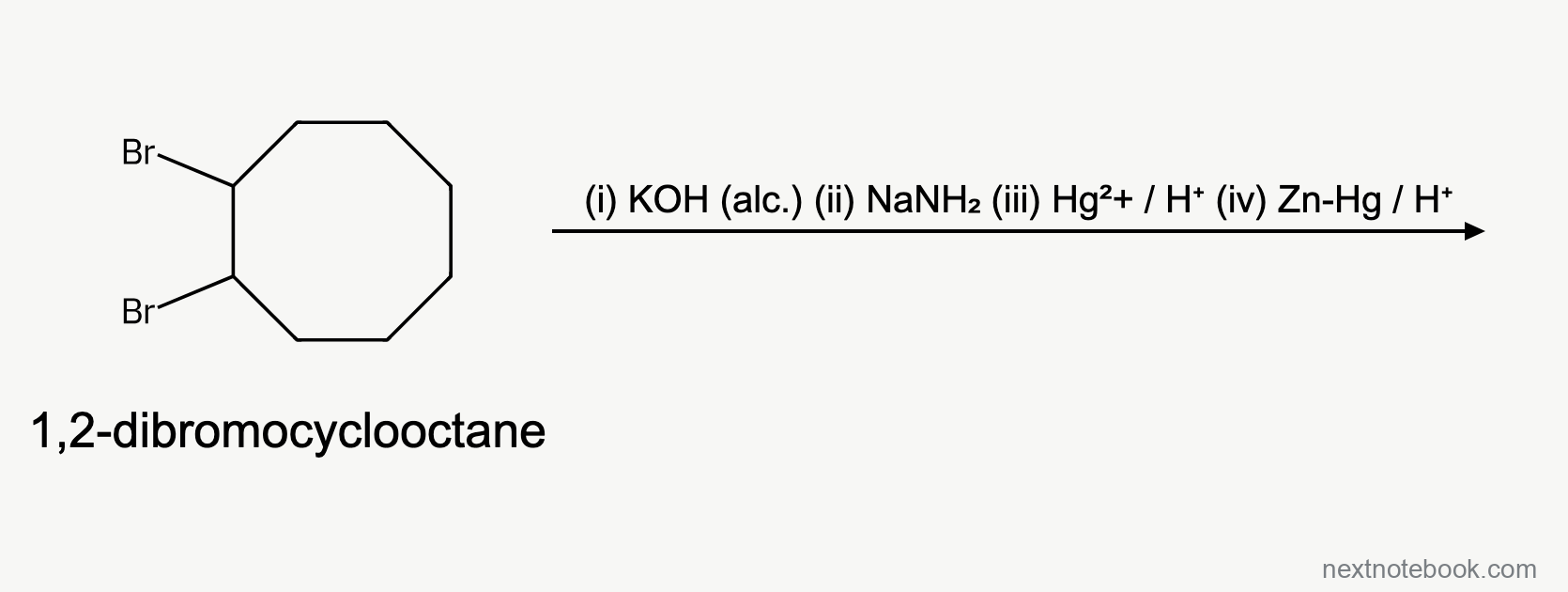 Tap an option to check.
Show answer
Correct answer: option 3,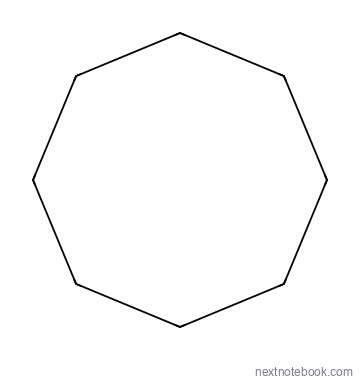
- Q26JEE Main 2025 · 23 Jan · Shift 2Given below are two statements: Consider the following reaction: . Statement (I): In the case of formaldehyde (), K is about 2280, due to small substituents, hydration is faster. Statement (II): In the case of trichloroacetaldehyde (), K is about 2000 due to effect of . In the light of the above statements, choose the correct answer from the options given below:Tap an option to check.
Show answer
Correct answer: option 1,Both Statement I and Statement II are true - Q27JEE Main 2025 · 2 Apr · Shift 1Consider the following molecules: ; ; ; . The correct order of rate of hydrolysis is:
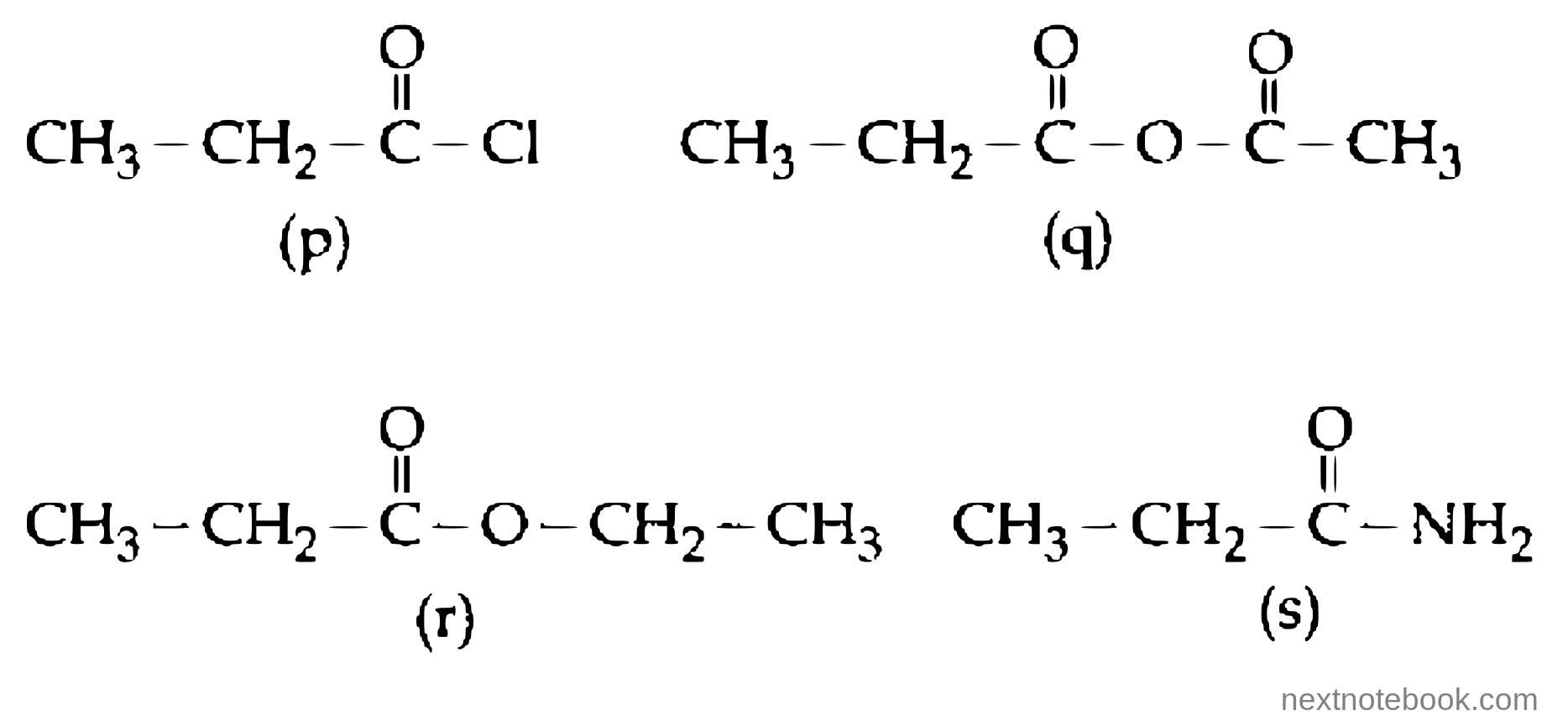 Tap an option to check.
Show answer
Correct answer: option 4, - Q28JEE Main 2025 · 28 Jan · Shift 1Both acetaldehyde and acetone (individually) undergo which of the following reactions? A. Iodoform Reaction B. Cannizaro Reaction C. Aldol Condensation D. Tollen's Test E. Clemmensen Reduction Choose the correct answer from the options given below:Tap an option to check.
Show answer
Correct answer: option 1,A, C and E Only - Q29JEE Main 2025 · 4 Apr · Shift 1An organic compound (X) with molecular formula C3H6O is not readily oxidised. On reduction it gives C3H8O (Y) which reacts with HBr to give a bromide (Z) which is converted to Grignard reagent. This Grignard reagent on reaction with (X) followed by hydrolysis give 2. 3-dimethylbutan-2-ol. Compounds (X), (Y) and (Z) respectively are:Tap an option to check.
Show answer
Correct answer: option 4,CH3COCH3, CH3CH(OH)CH3, CH3CH(Br)CH3 - Q30JEE Main 2025 · 23 Jan · Shift 1The major product of the following reaction is: CH3CH2CH=O --(excess HCHO, alkali, reflux)-->?
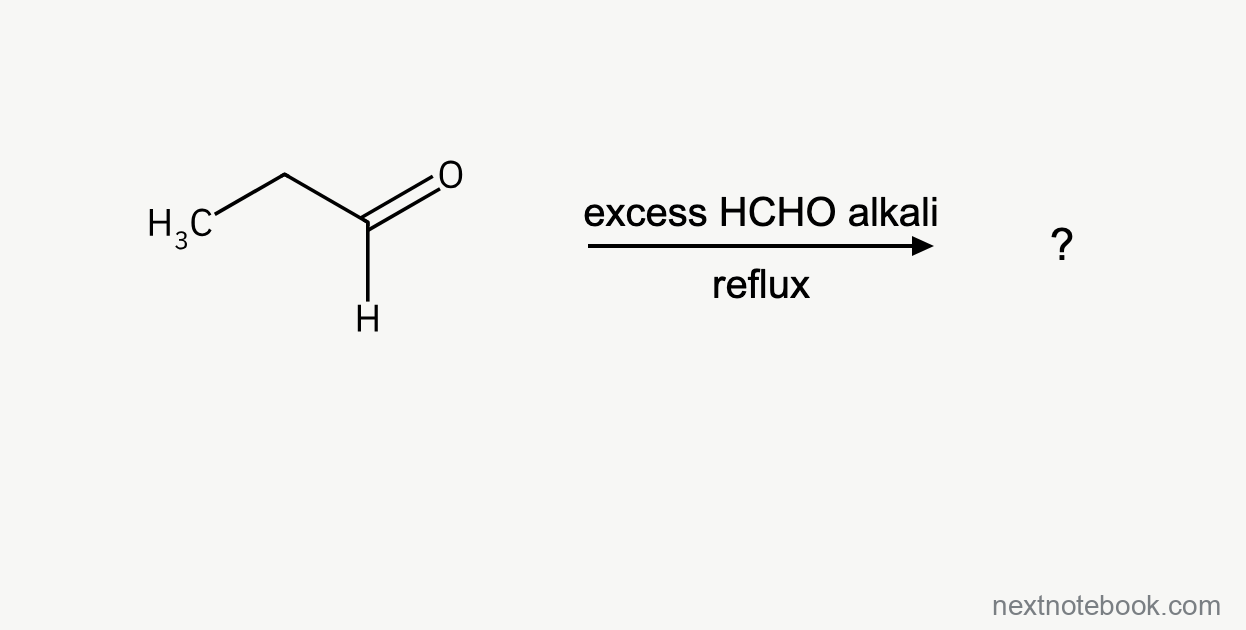 Tap an option to check.
Show answer
Correct answer: option 1,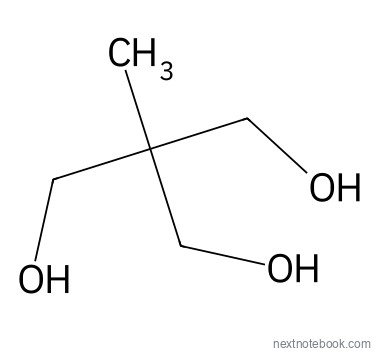
- Stuck on one?Log in free
See the step-by-step solution and video for every question, free with login.
- Q31JEE Main 2025 · 2 Apr · Shift 2Consider the following reactions. From these reactions which reaction will give carboxylic acid as a major product?
(A) —(i) , mild condition→
(B) —(i) ; (ii) →
(C) —(i) ; (ii) →
(D) —PCC→
(E) benzoyl chloride, (a benzene ring bearing COCl, shown in the figure) —(i) ; (ii) water→
Choose the correct answer from the options given below: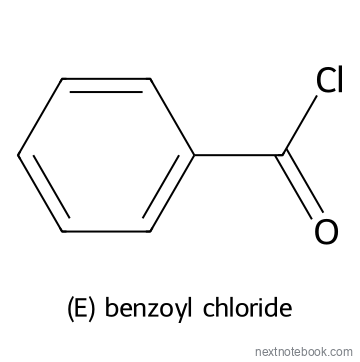 Tap an option to check.
Show answer
Correct answer: option 3,B and E only - Q32JEE Main 2025 · 2 Apr · Shift 1Given below are two statements: Statement (I): Vanillin [structural formula shown] will react with and also with Tollen’s reagent. Statement (II): Vanillin [structural formula shown] will undergo self aldol condensation very easily. In the light of the above statements, choose the most appropriate answer from the options given below:
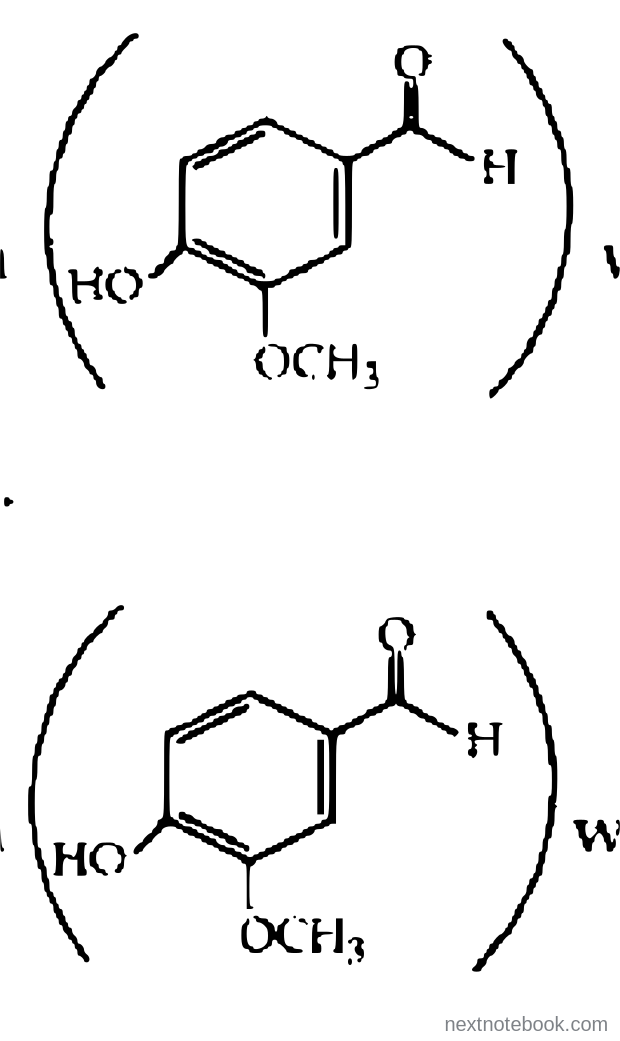 Tap an option to check.
Show answer
Correct answer: option 3,Statement I is correct but Statement II is incorrect - Q33JEE Main 2025 · 3 Apr · Shift 1Number of molecules from below which cannot give iodoform reaction is: Ethanol, Isopropyl alcohol, Bromoacetone, 2–Butanol, 2–Butanone, Butanal, 2–Pentanone, 3–Pentanone, Pentanal and 3–Pentanol.Tap an option to check.
Show answer
Correct answer: option 4, - Q34JEE Main 2025 · 24 Jan · Shift 1Which of the following arrangements with respect to their reactivity in nucleophilic addition reaction is correct?Tap an option to check.
Show answer
Correct answer: option 2, - Q35JEE Main 2025 · 24 Jan · Shift 2Match List - I with List - II. Choose the correct answer from the options given below:
List - I List - II (A) RCN — (i) SnCl2, HCl; (ii) H3O^+ → RCHO (I) Etard reaction (B) C6H5COCl — H2/Pd-BaSO4 → C6H5CHO (II) Gatterman-Koch reaction (C) C6H5CH3 — (i) CrO2Cl2, CS2; (ii) H3O^+ → C6H5CHO (III) Rosenmund reduction (D) C6H6 — (i) CO, HCl; (ii) anhydrous AlCl3/CuCl → C6H5CHO (IV) Stephen reaction Tap an option to check.Show answer
Correct answer: option 1,(A)-(IV), (B)-(III), (C)-(I), (D)-(II) - Q36JEE Main 2025 · 8 Apr · Shift 2When undergoes intramolecular aldol condensation, the major product formed is:
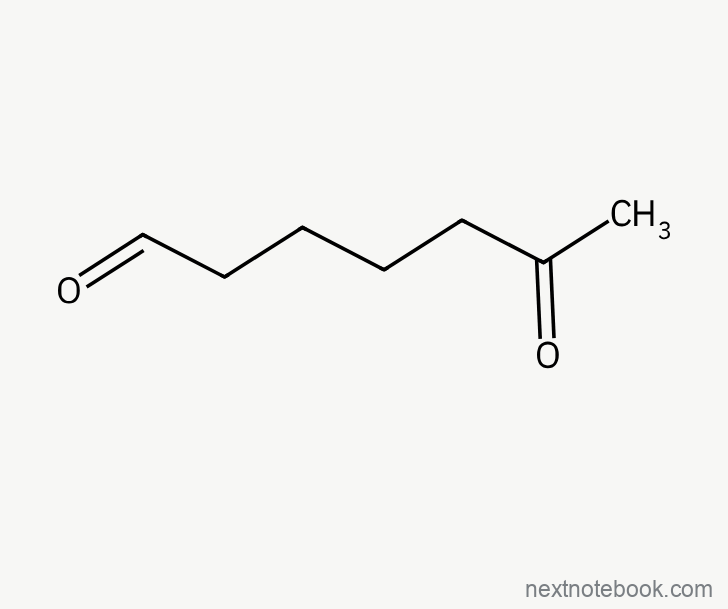 Tap an option to check.
Show answer
Correct answer: option 3,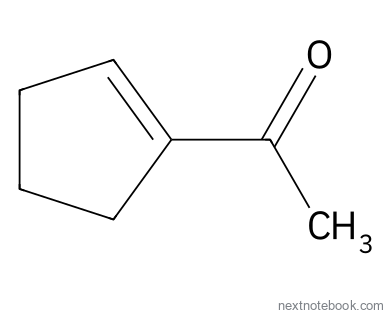
- Q37JEE Main 2025 · 3 Apr · Shift 2The major product (P) in the following reaction is: Major Product
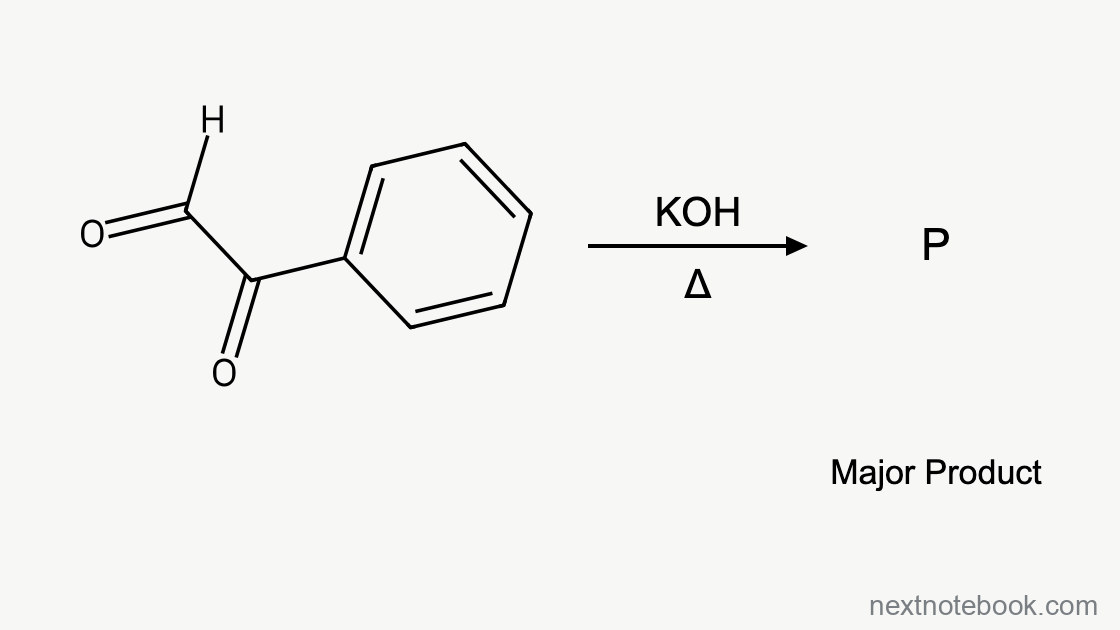 Tap an option to check.
Show answer
Correct answer: option 2,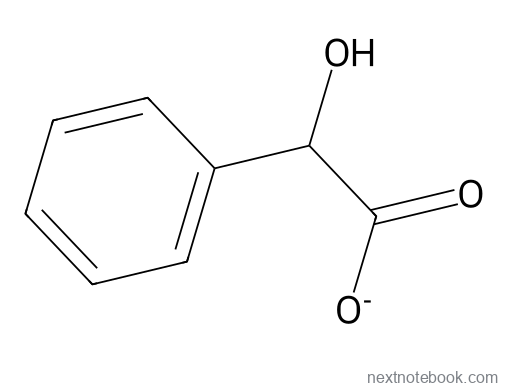
- Q38JEE Main 2025 · 7 Apr · Shift 2“” is an optically active compound with molecular formula . When ‘’ is treated with 2, 4-dinitrophenylhydrazine, it gives a positive test. However, in presence of Tollens reagent, “” gives a negative test. Predict the structure of “”.Tap an option to check.
Show answer
Correct answer: option 2,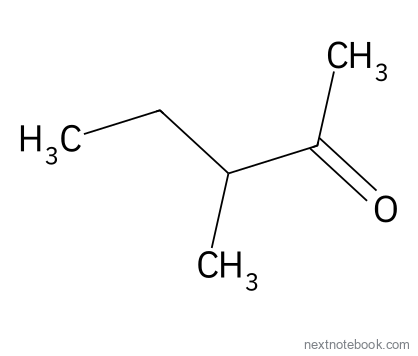
- Q39JEE Main 2025 · 22 Jan · Shift 2Toluene (excess) —(i) CrO2Cl2, CS2; (ii) H3O^+; (iii) NaHSO3→ Filter → Residue (A). Residue (A) + HCl(dil) → Compound (B). Structure of residue (A) and compound (B) formed respectively is: [A] [B]
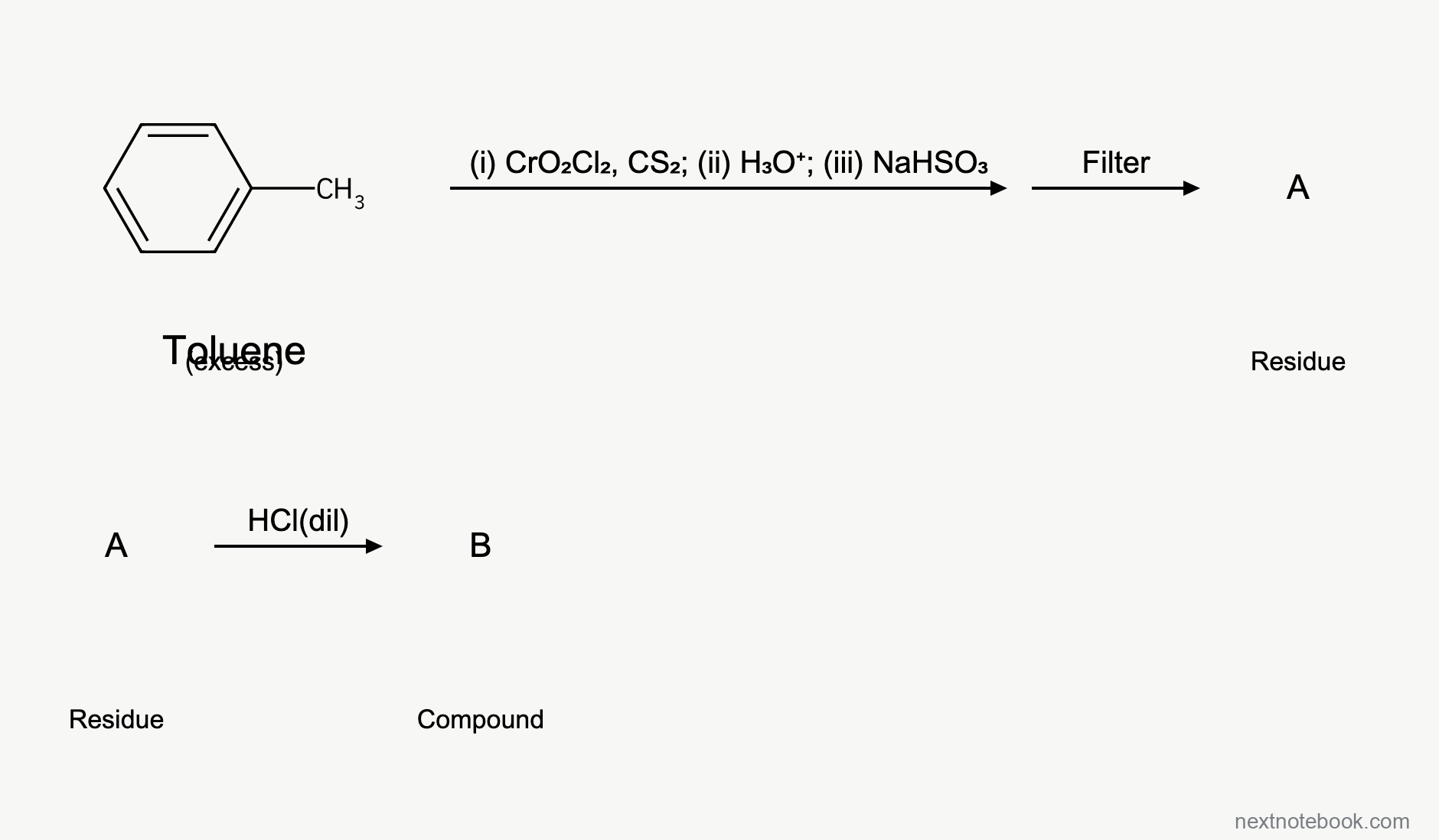 Tap an option to check.
Show answer
Correct answer: option 4,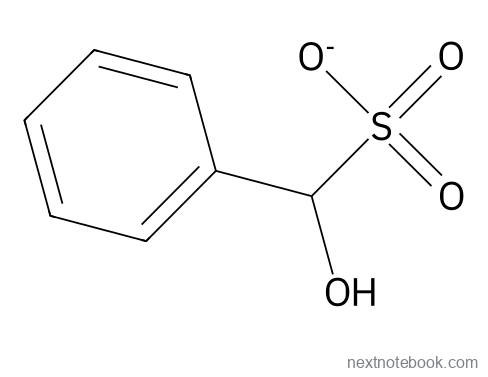
- Q40JEE Main 2025 · 8 Apr · Shift 2‘A’ shows positive Lassaign's test for N and its molar mass is 121. ‘B’ gives effervescence with aq . ‘C’ gives fruity smell. Identify A, B and C from the following.
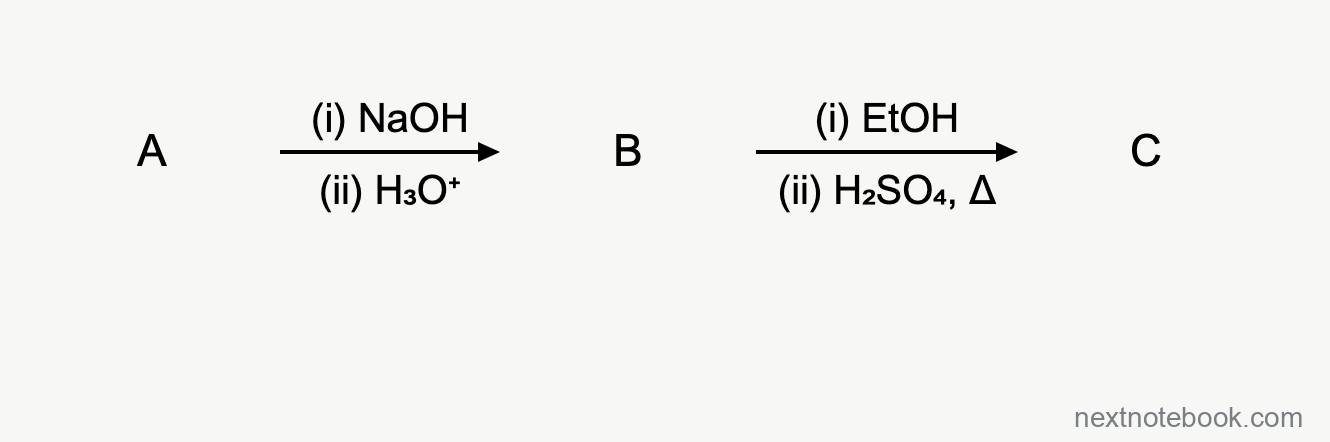 Tap an option to check.
Show answer
Correct answer: option 1,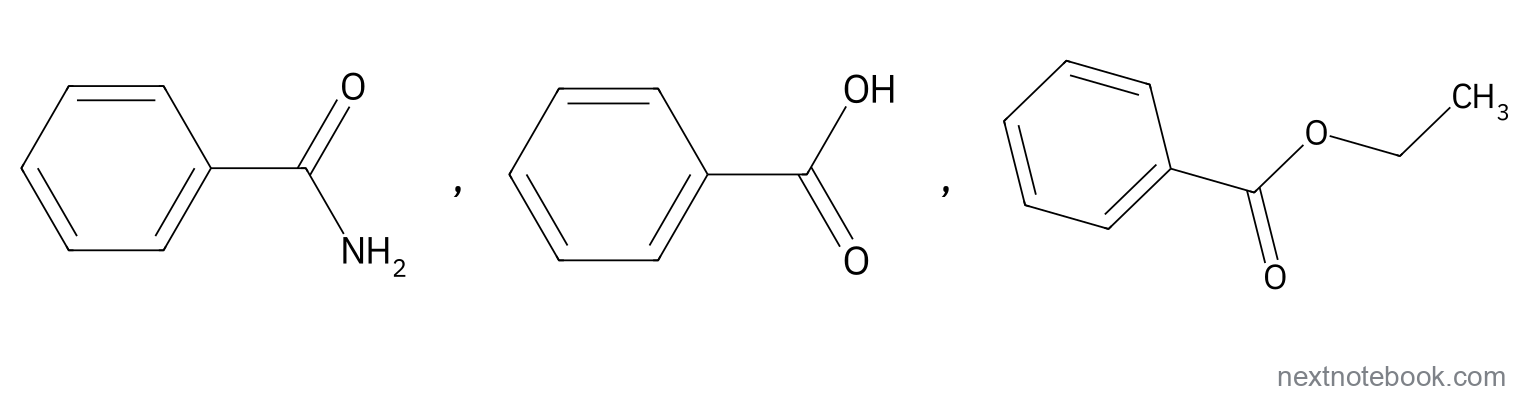
- Stuck on one?Log in free
See the step-by-step solution and video for every question, free with login.
- Q41JEE Main 2024 · 8 Apr · Shift 1Identify the product () in the following reaction
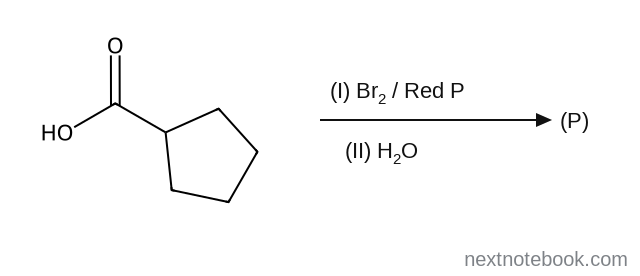 Tap an option to check.
Show answer
Correct answer: option 3,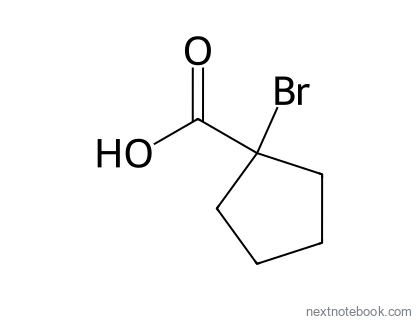
- Q42JEE Main 2024 · 30 Jan · Shift 1This reduction reaction is known as:
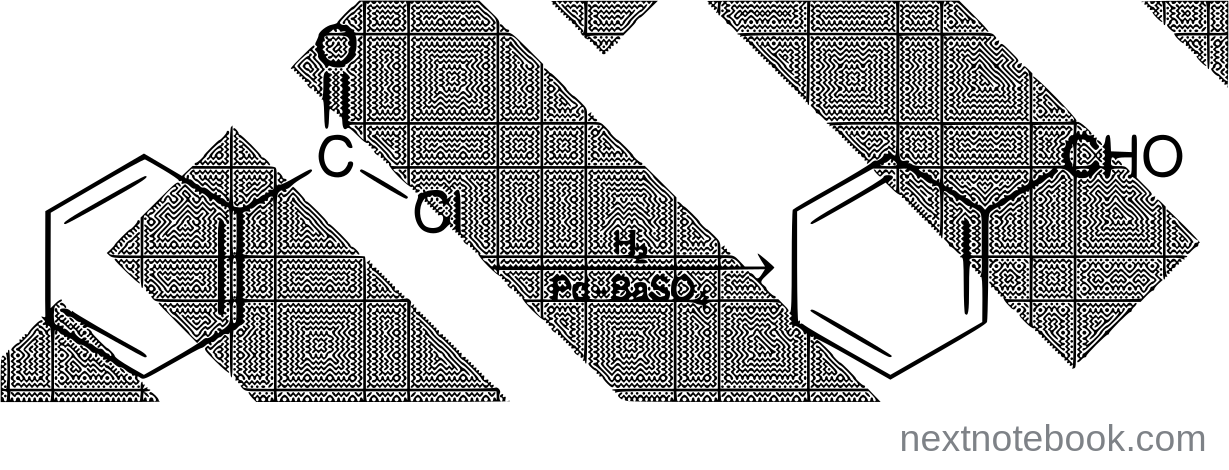 Tap an option to check.
Show answer
Correct answer: option 1,Rosenmund reduction - Q43JEE Main 2024 · 30 Jan · Shift 2m-chlorobenzaldehyde on treatment with 50% KOH solution yieldsTap an option to check.
Show answer
Correct answer: option 2,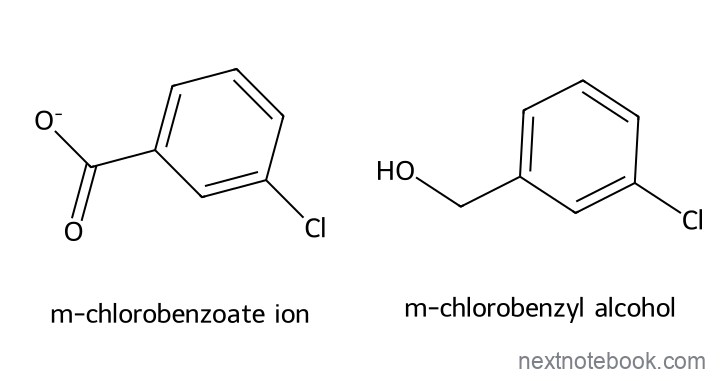
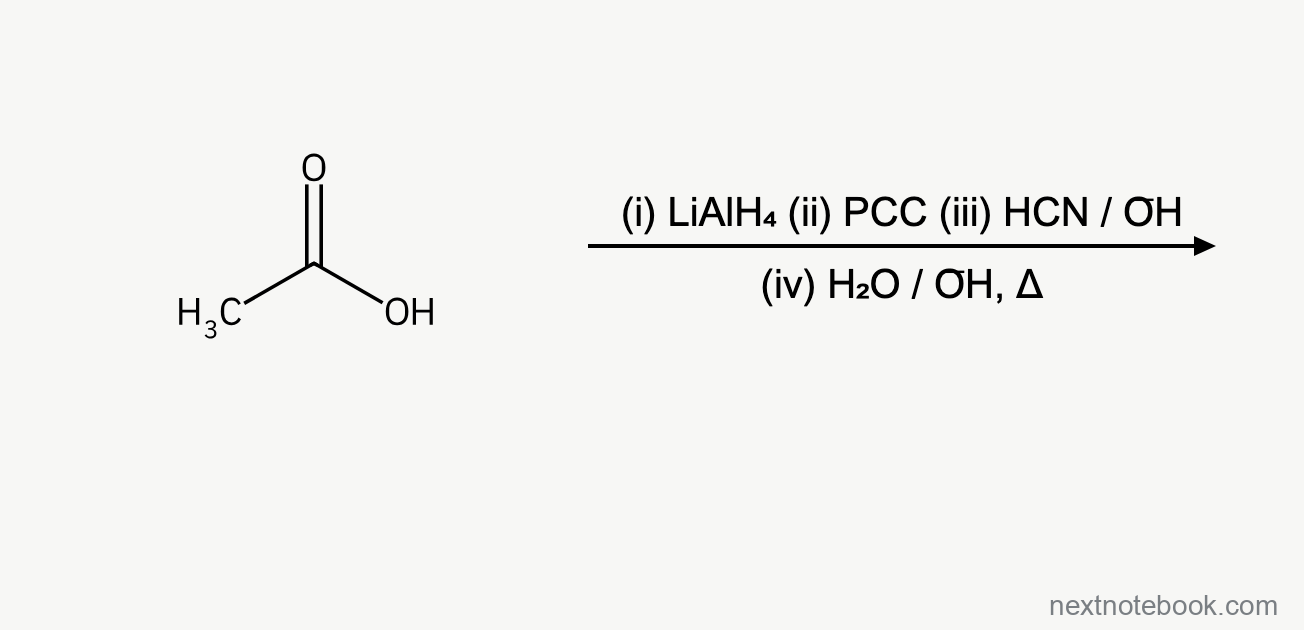
- Q44JEE Main 2024 · 6 Apr · Shift 2Consider the given reaction, identify the major product : (i) (ii) (iii) (iv) ,
 Tap an option to check.
Show answer
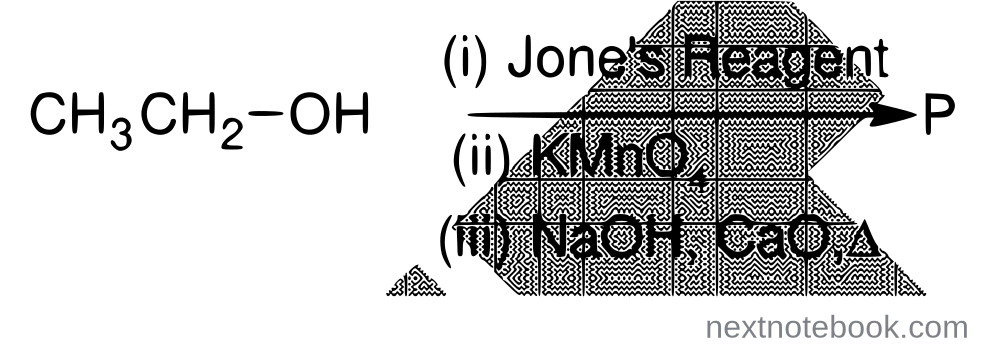
Correct answer: option 4, - Q45JEE Main 2024 · 5 Apr · Shift 2—(i) Jone's Reagent; (ii) ; (iii) , Consider the above reaction sequence and identify the major product ,
 Tap an option to check.
Show answer
Correct answer: option 1,Methane - Q46JEE Main 2024 · 4 Apr · Shift 1Identify the product in the following reaction: 3-acetylbenzaldehyde (a benzene ring carrying and on carbons 1 and 3, shown in the figure) is treated with .
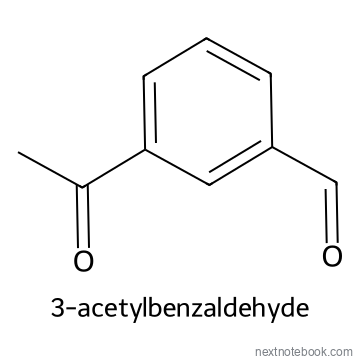 Tap an option to check.
Show answer
Correct answer: option 1,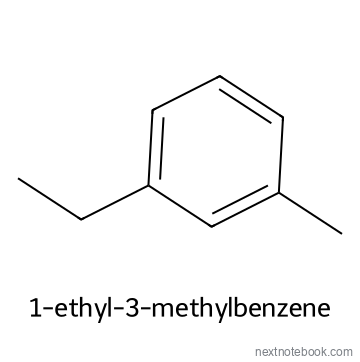
- Q47JEE Main 2024 · 9 Apr · Shift 2Which of the following compounds will give silver mirror with ammoniacal silver nitrate? a. Formic acid b. Formaldehyde c. Benzaldehyde d. Acetone Choose the correct answer from the option given below:Tap an option to check.
Show answer
Correct answer: option 2,a, b and c only - Q48JEE Main 2024 · 1 Feb · Shift 2Acid formed in above reaction is:Tap an option to check.
Show answer
Correct answer: option 3,Succinic acid - Q49JEE Main 2024 · 30 Jan · Shift 1Structure of 4 – Methylpent-2-enal is Option:Tap an option to check.
Show answer
Correct answer: option 4, - Q50JEE Main 2024 · 6 Apr · Shift 1Which among the following aldehydes is most reactive towards nucleophile addition reactions?Tap an option to check.
Show answer
Correct answer: option 3, - Stuck on one?Log in free
See the step-by-step solution and video for every question, free with login.
- Q51JEE Main 2024 · 4 Apr · Shift 1Given below are two statements:
Statement I: Acidity of - hydrogens of aldehydes and ketones is responsible for aldol reaction.
Statement II: Reaction between benzaldehyde and ethanal will NOT give Cross – Aldol product.
In the light of the above statements, choose the most appropriate answer from the options given below:Tap an option to check.Show answer
Correct answer: option 4,Statement I is correct but Statement II is incorrect - Q52JEE Main 2024 · 5 Apr · Shift 1Identify in the following reaction: butan-2-one (i) ; (ii) ethylene glycol / givesTap an option to check.
Show answer
Correct answer: option 4, - Q53JEE Main 2024 · 30 Jan · Shift 1In the reactions, identify the reagent and reagent . Toluene reacts with "" and at to to give an intermediate, which on treatment with and heat gives benzaldehyde (). Toluene also reacts with "" and to give an intermediate, which on treatment with gives benzaldehyde.
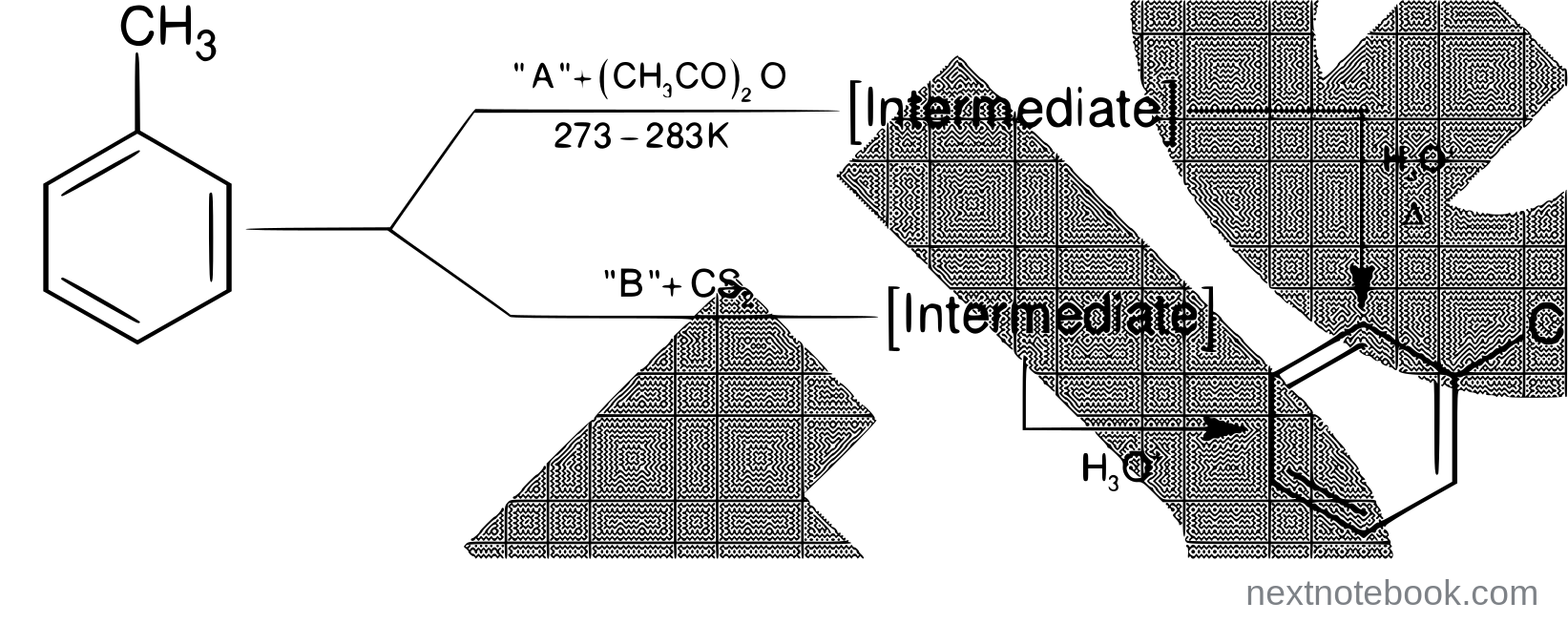 Tap an option to check.
Show answer
Correct answer: option 2,A – B – - Q54JEE Main 2024 · 29 Jan · Shift 1The final product A formed in the following multistep reaction sequence is
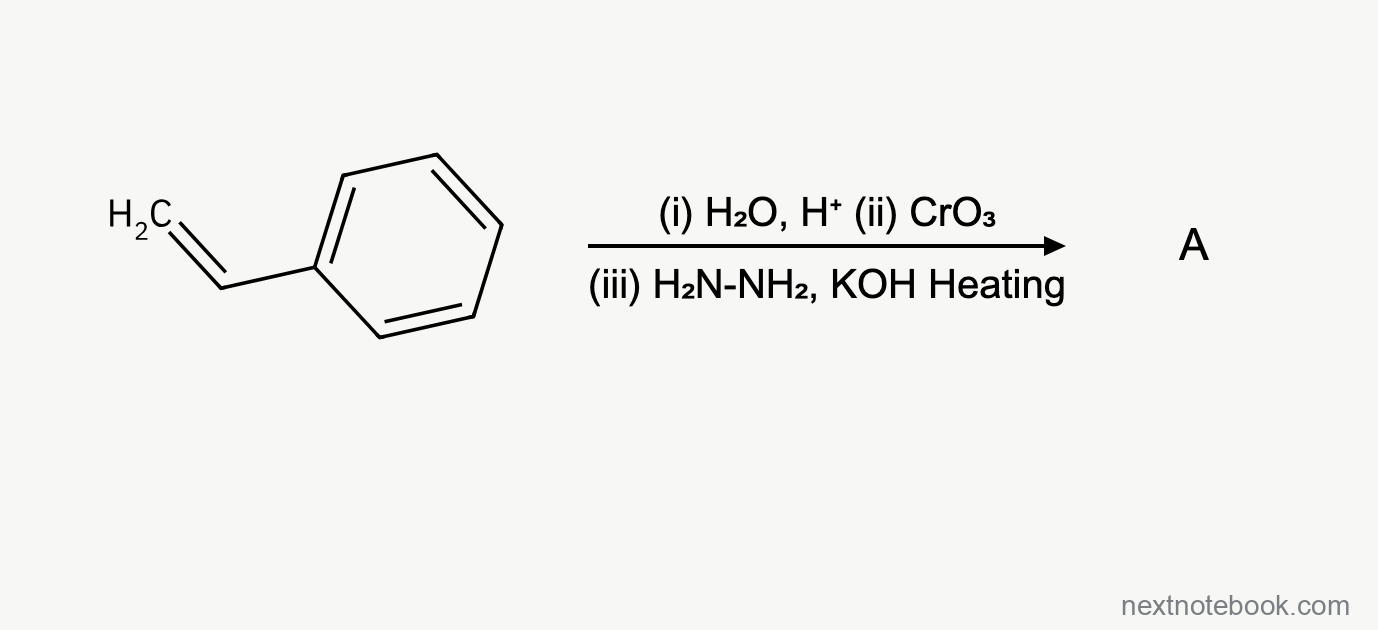 Tap an option to check.
Show answer
Correct answer: option 4, - Q55JEE Main 2024 · 1 Feb · Shift 1Match List-I with List-II Choose the correct answer from the options given below:
List-I (Reactions) List-II (Reagents) (A) CH₃(CH₂)₅C(=O)OC₂H₅ ⟶ CH₃(CH₂)₅CHO (I) CH₃MgBr, H₂O (B) C₆H₅COC₆H₅ ⟶ C₆H₅CH₂C₆H₅ (II) Zn(Hg) and conc. HCl (C) C₆H₅CHO ⟶ C₆H₅CH(OH)CH₃ (III) NaBH₄, H⁺ (D) CH₃COCH₂COOC₂H₅ ⟶ CH₃C(OH)(H)CH₂COOC₂H₅ (IV) DIBAL-H, H₂O Tap an option to check.Show answer
Correct answer: option 2,(A)-(IV), (B)-(II), (C)-(I), (D)-(III) - Q56JEE Main 2024 · 31 Jan · Shift 2Identify the name reaction: [benzene] [benzene-CHO]
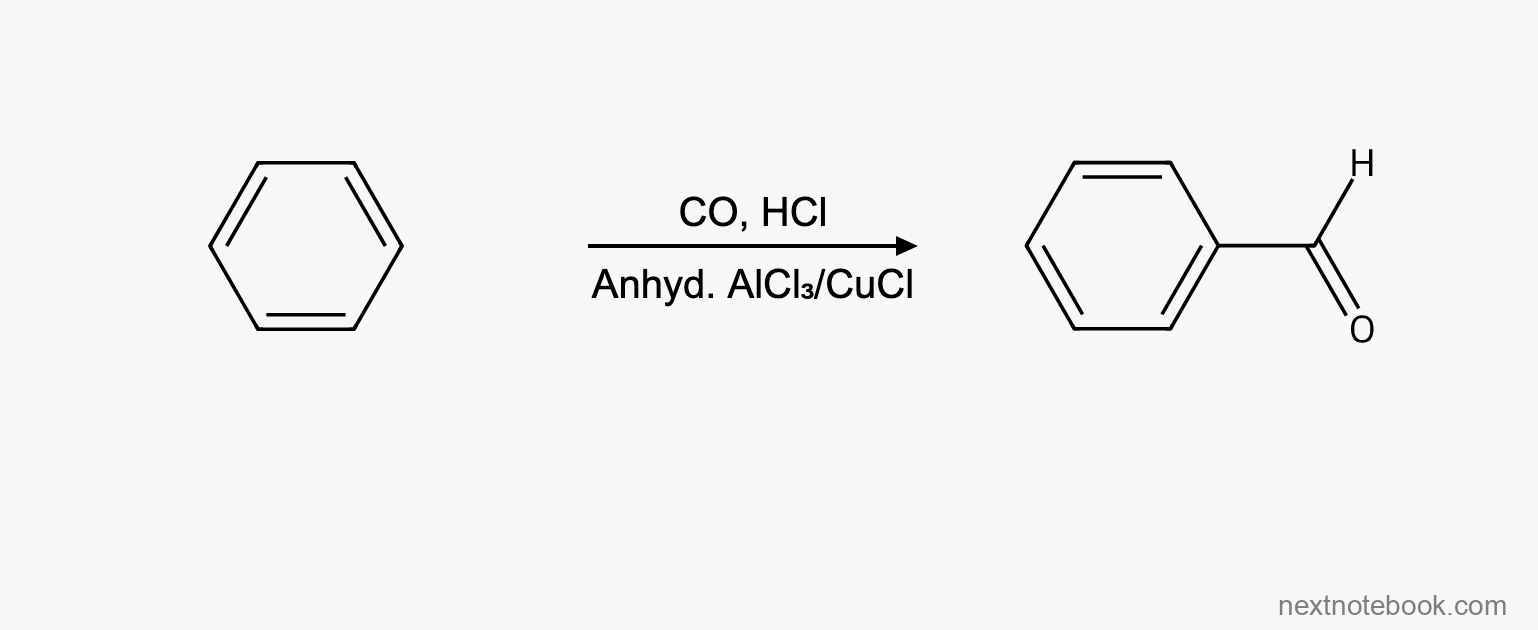 Tap an option to check.
Show answer
Correct answer: option 2,Gatterman – Koch Reaction - Q57JEE Main 2024 · 29 Jan · Shift 2Identify the reagents used for the following conversion. A cyclohexane ring carrying an group, a methyl ester side chain and an aldehyde side chain on neighbouring ring carbons is converted in step A into the compound with two side chains, in step B into the bicyclic compound with a cyclopentene ring bearing , and in step C into the bicyclic compound in which that has become (shown in the figure).
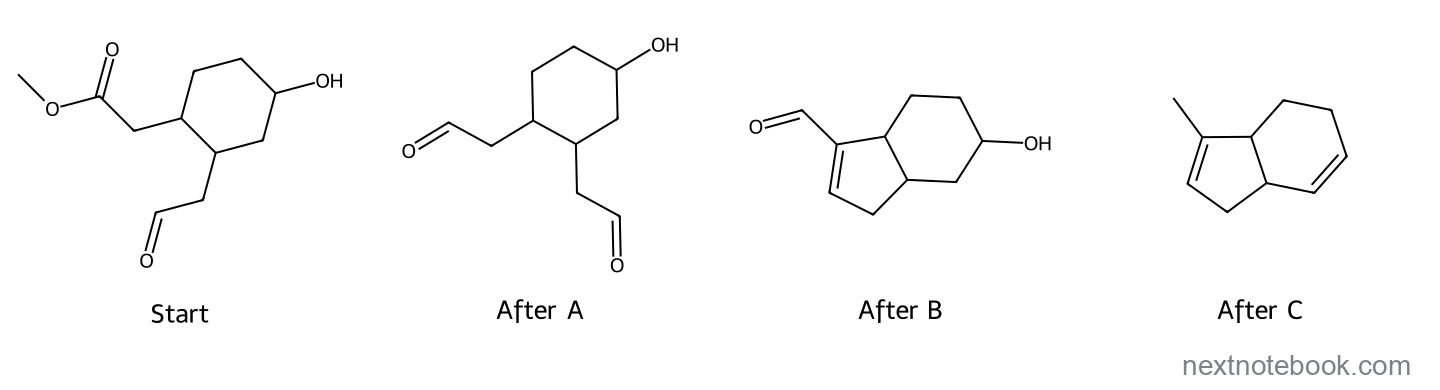 Tap an option to check.
Show answer
Correct answer: option 2,, , , ethylene glycol - Q58JEE Main 2024 · 5 Apr · Shift 2In the Claisen–Schmidt reaction to prepare of dibenzalacetone using of acetone, the amount of benzaldehyde required is ________ . (Nearest integer)Tap Show answer to check.
Show answer
Answer: 318 - Q59JEE Main 2024 · 29 Jan · Shift 1From the compounds given below, number of compounds which give positive Fehling’s test is _____. Benzaldehyde, Acetaldehyde, Acetone, Acetophenone, Methanal, 4-nitrobenzaldehyde, cyclohexane carbaldehyde.Tap Show answer to check.
Show answer
Answer: 3 - Q60JEE Main 2024 · 4 Apr · Shift 1The number of the correct reaction(s) among the following is __________.
(A) Benzene and benzoyl chloride, with anhydrous , give diphenylmethane, .
(B) Benzoyl chloride, with , gives benzoic acid.
(C) Benzene, with and anhydrous , gives benzaldehyde.
(D) Benzamide, with and heat, gives aniline. The reactions are drawn in the figure.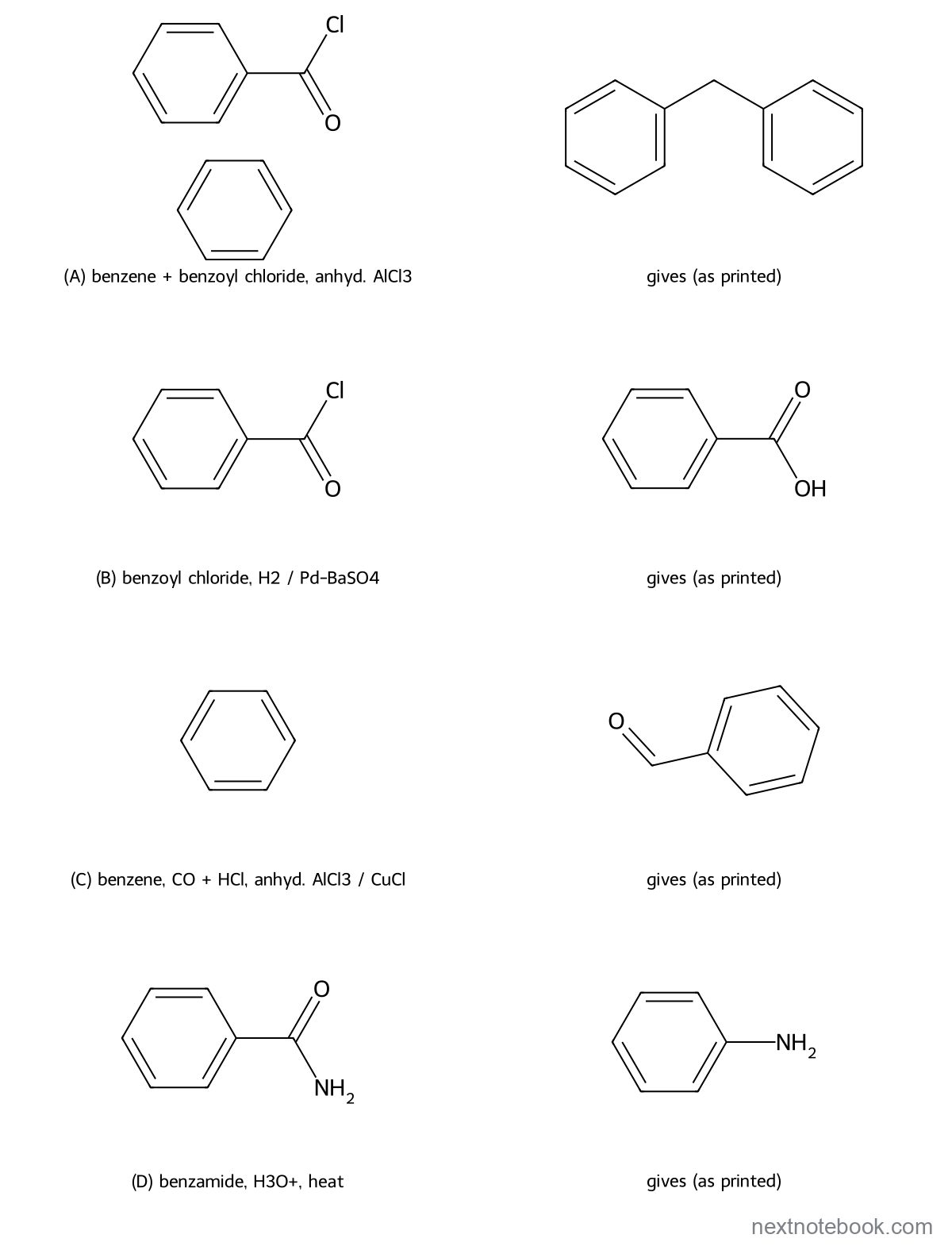 Tap Show answer to check.
Show answer
Answer: 1
Showing 60 of 196 questions. The rest are free after login.
Practise Nucleophilic addition reactions of aldehydes and ketones first. Solutions and video answers are free.